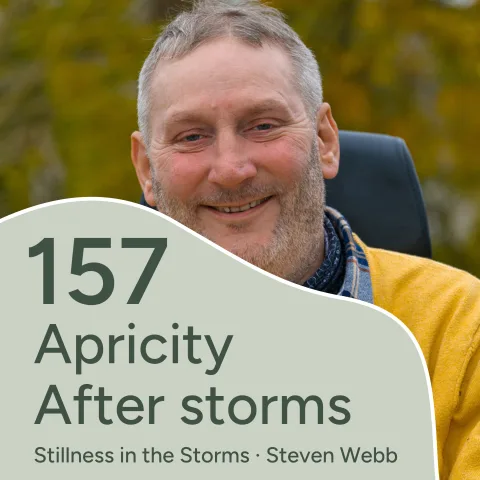
0:02 Hey, and welcome.
0:03 So this week I'm recording the podcast a little bit different.
0:06 I'm going to do it for a YouTube video as well.
0:09 So if you want to watch it on YouTube, you can check out Stephen
0:13 Webb on YouTube and there'll be a link underneath the podcast.
0:17 And also, yeah, that's it, really.
0:21 Just doing a little bit different.
0:23 Just trying to put it out.
0:25 So it just.
0:26 It doesn't just go out on the podcast, it also goes out on YouTube.
0:29 So you can see me.
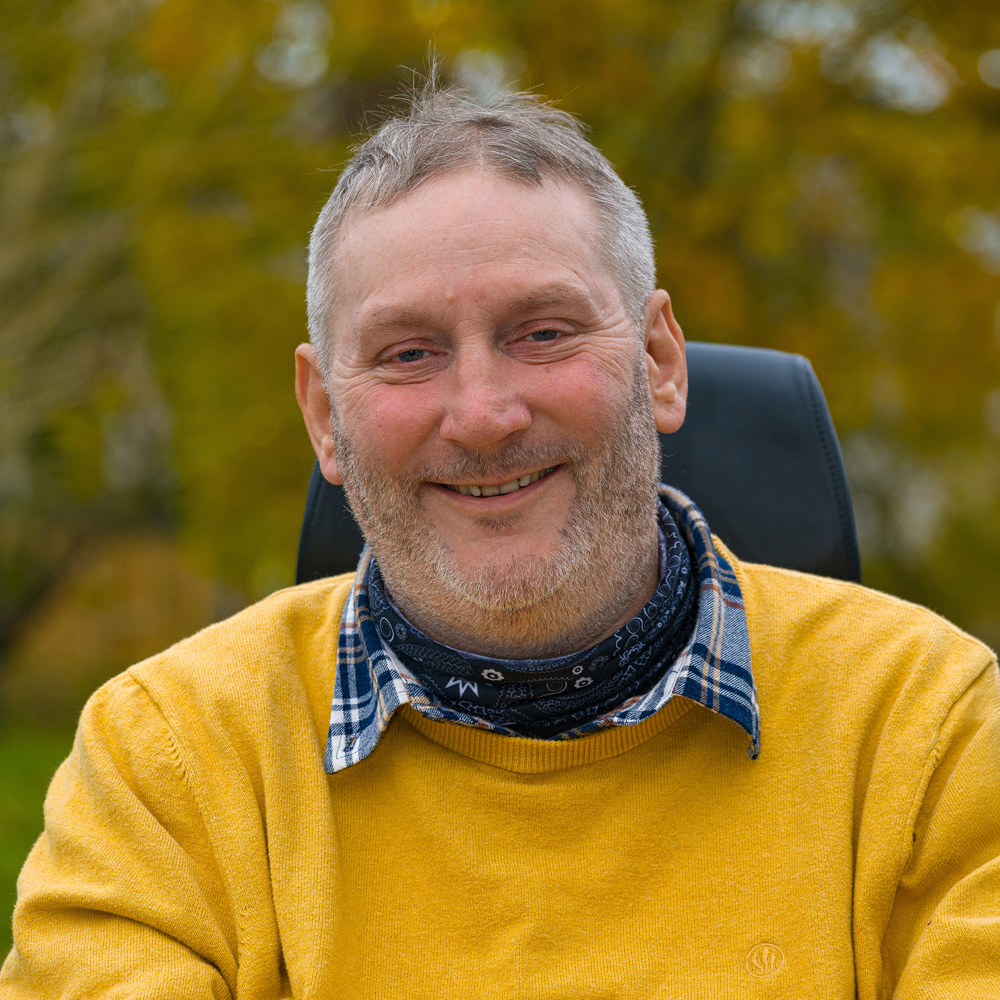
0:32 You can see me in all my glory, sitting there with my headphones
0:36 on and the microphone.
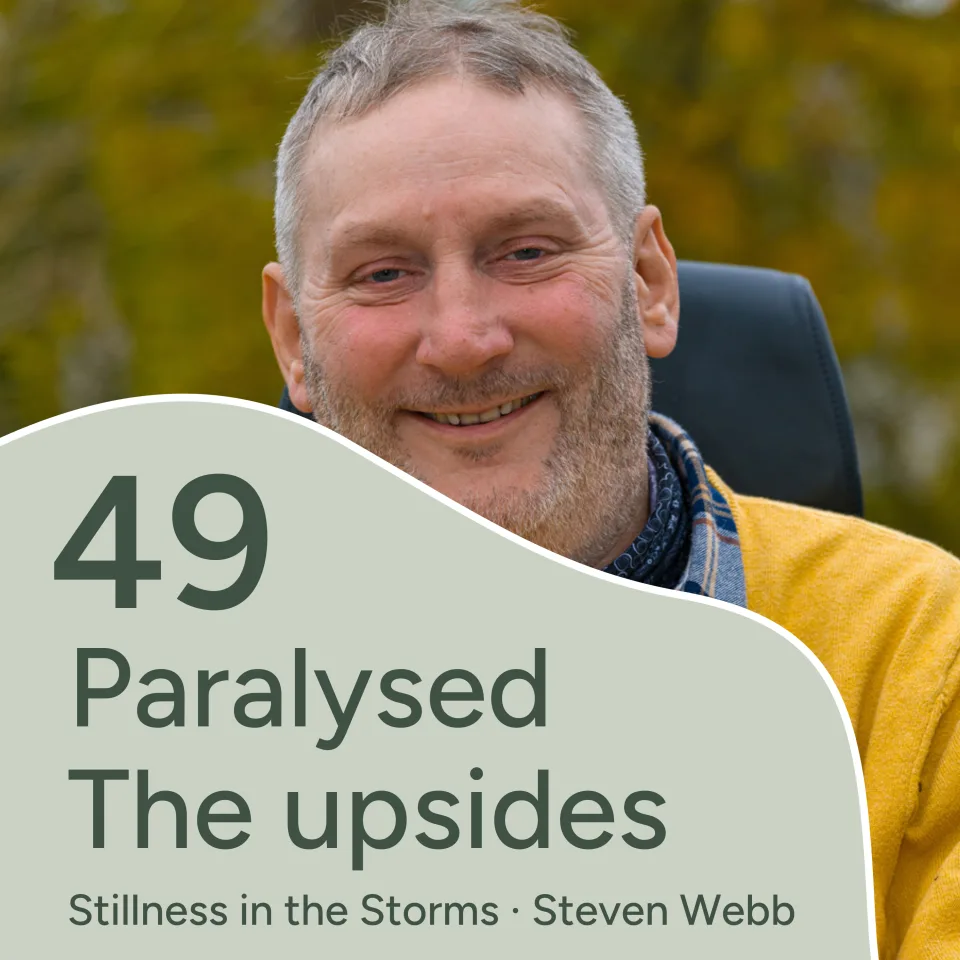
0:38 So, yeah, this week we're talking about the seven awesome things
0:42 about being paralyzed.
0:44 And one of the things I like to do is reframe things in life,
0:48 reframe when things happen to us.
0:50 And I'll be reading this week about the lives of the Stoics, a
0:54 book by Ryan Holiday.
0:56 And in that, the very first Stoic, apparently there was Zeno,
1:01 and he was.
1:02 Him and his family were merchants and they had a boat.
1:06 And if I were.
1:07 If I recall, the boat sank and they lost all their goods and everything.
1:12 And then when he was over in Athens, somebody said to him, that's
1:15 really unfortunate.
1:16 He said, well, not really.
1:18 I'm in Athens, aren't I?
1:19 And that looked like a great opportunity to him.
1:23 Then he happened to stumble across a library where someone was
1:28 reading some wisdom, and he got really into Stoicism and ended
1:34 up one of the first teachers.
1:36 And apparently where he used to teach is like the Painted Porch,
1:40 as known as.
1:41 And I cannot remember the Italian name for it, but in the Painted
1:45 Porch, the remnants of it is still there now, actually, which
1:50 is just incredible.
1:51 I had to look it up on Google when I read it to see if I could
1:56 see a picture of it.
1:57 Just how awesome is that?
1:58 How amazing.
1:59 Our history at two and a half thousand years ago, nearly about
2:03 two and a thousand years ago.
2:05 But yeah, he reframed things the way we look at things.
2:09 And if we look at it as bad luck, then it will always be bad
2:14 luck.
2:14 It'll always be a bad thing.
2:16 But if we just change the way we see it and there's positives in
2:20 everything, and I believe in finding the gift.
2:23 And no matter what happens, there's always a gift.
2:27 Just sometimes we gotta look a little closer, dig a little deeper,
2:31 wait a little bit of time.
2:33 But there's always, always a gift.
2:37 But yeah, I'm Stephen Webb, and this is the podcast Stillness
2:40 in the Storms.
2:42 And I help people just to see things a little bit different.
2:45 Find that little bit of calmness when you don't have it.
2:49 And I really do believe in reframing things is one of the most
2:54 important skills we have.
2:58 And I think it was Wayne Dyer that says if you change the way you
3:01 look at things, the things you look at change.
3:05 And I think that's really important.
3:07 So.
3:07 So yeah, this week we're talking about the seven awesome things
3:10 about being severely paralyzed.
3:12 And my regular listeners would know, I'm paralyzed just below my
3:16 neck.
3:17 I cannot feel anything from my nipples down.
3:20 Yeah, I said nipples.
3:21 Get over it.
3:23 We're all children at heart.
3:26 I don't know why I still gotta laugh when people say words like
3:29 that.
3:30 I've still gotta laugh at it.
3:32 I can't help it.
3:33 It's just the way it is.
3:35 I'm a city councillor and when people say stuff in council meetings,
3:39 I'm like giggling inside and I'm like, I hope no one can notice.
3:43 But hey, that's the way it is.
3:46 We're all children.
3:47 We shouldn't grow up too quick.
3:49 We should bring that childness.
3:51 Or childness, is that the right word?
3:54 We should bring that, that softness of the way we see things
4:01 to our adulthood a little more.
4:03 Have a little more fun with it.
4:05 But anyway, going back to the podcast, what's it about this week?
4:10 Yes, it's about reframing things.
4:12 Just before we get on to that, if you could, if you're watching
4:15 on YouTube, hit the subscribe.
4:17 That would be awesome and amazing.
4:20 One of my goals this year is to have a thousand YouTube subscribers.
4:24 And if you're listening to podcast on iOS or Apple or anything
4:29 like that, leave a review.
4:30 That'd be amazing.
4:32 So that would be incredible.
4:34 It doesn't have to be a positive review.
4:36 It doesn't have to be just an honest review.
4:38 You know, if there's something I could be doing better, let me know.
4:41 If there's something I.
4:43 If there's something I'm doing.
4:44 All of them.
4:45 Yeah, please tell me that as well.
4:47 We all like a little bit of flattery sometimes.
4:51 But yeah, I broke my neck or nearly 30 years ago now, and that's
4:57 left me paralyzed.
4:59 I use an electric wheelchair and I have 24 hour care.
5:03 I have people helping me to do almost everything.
5:07 You know, there's many things I cannot do.
5:09 I cannot bathe myself, I cannot wash.
5:12 I cannot.
5:13 Can I even go to a toilet by myself, for Christ's sake?
5:16 Don't even get that peace and quiet.
5:20 But the thing is, we cannot.
5:21 We can either focus on the things that we Cannot do.
5:25 Or we focus on the things we can do.
5:27 And I'm.
5:29 People look at me as an optimist and I wouldn't say I'm so
5:31 much as an optimist, but I'm just like in the middle where, you
5:37 know, the glass, not glass is not half full or half empty.
5:41 You got a glass, you're missing the point.
5:44 It's refillable, you know, go and fill it up yourself.
5:48 I think I've done a podcast about that.
5:50 It's your glass, fill it with what you want.
5:54 But yeah, let's get on with the seven awesome things about being
5:58 paralyzed.
6:00 So number one, not feeling my body and some of the aches and pains.
6:06 Well, I don't feel my hands really, I don't feel anything below
6:11 my nipples as I said in the intro.
6:13 And so I'm sat here all day in my electric wheelchair and I lie
6:19 in the same position overnight.
6:21 And if you think about it, the amount of time when you sit in the
6:25 same position, how much it must ache, how much it must hurt.
6:28 And I remember on the spinal unit I had several friends that were
6:33 incomplete.
6:34 And the difference between complete and incomplete spinal injuries
6:37 is when you complete, that means no information is passed in
6:41 that part of the spinal cord.
6:43 So that's a two way thing.
6:44 You get no feeling back.
6:47 So your muscles and your joints and everything, there's no
6:53 feedback to the brain, the brain doesn't know it's hurting.
6:58 And also the brain isn't able to tell it what to do either.
7:01 So one thing you cannot move and two, you cannot feel.
7:06 Whereas if you're incomplete, you get some feeling or you may have
7:10 some feeling or you may have some movement, you may have what's
7:13 called proprioception, where you know where your body's to without
7:17 looking.
7:18 Because if you think about it, if you move your foot with your eyes
7:22 closed, you kind of know where your foot's to, you know whether
7:26 it's bent up or your toes are curled down.
7:30 Whereas I don't.
7:31 You know, if I close my eyes and someone plays a trick and they
7:34 tie my legs up, I left my eyes and go, oh, who did that?
7:40 I wouldn't know.
7:42 So that's one of the.
7:44 So, so it's a bonus.
7:45 I, I don't get the aches and pains and like I said, my friends
7:49 on the spinal unit, they used to really suffer sometimes.
7:53 And I, I'm just wondering whether to tell you this or not.
7:57 I'll stuff it, I'll tell you anyway, I, I go toilet for a convine.
8:02 It's like a condom, but it's sticky, so they stick it on in the
8:06 morning and, and it sticks like anything.
8:10 Well, imagine putting that off.
8:13 Oh, that's a gift.
8:15 I cannot feel that.
8:20 And not everybody pulls it off the same way.
8:23 I can't believe I'm sharing that.
8:25 But it's too late now.
8:26 It's in number two.
8:29 I don't have to do the housework or any kind of mundane
8:33 task like that.
8:34 Yeah, I haven't hoovered the floor for 30 years.
8:38 Nearly 30 years.
8:39 I've made my bed.
8:41 I haven't.
8:41 Well, if that's a bad thing, really, we should make our own beds.
8:46 But I don't have to.
8:49 I don't have to do any of the housework or the dusting or the cleaning
8:54 and get on with the things I enjoy in life.
8:56 Reading books and watching Netflix and doing my podcast, stuff
9:01 like that.
9:03 Don't forget to leave a review.
9:05 All the hard work.
9:06 I'm skipping to do this podcast.
9:09 So, yeah, I don't have to do the boring stuff like put the bins
9:12 out.
9:13 So that's, that's a major bonus.
9:18 Number three.
9:19 This is quite an important one actually.
9:21 People's expectations of BE are lower and, and I think we all
9:27 do that if someone cannot walk or someone cannot do anything or
9:31 their chips are down.
9:33 In life where somebody may look at my position and go, do you
9:38 know what?
9:40 Everything he does is, you know, pretty damn good.
9:43 Whereas if I was able bodied, they would expect more of me.
9:48 Whereas if I just do the slightly better than normal, I'm
9:53 like, oh, he's awesome.
9:55 Well, that's the way I feel like anyway sometimes.
9:58 So the expectations are primarily lower of me if I literally
10:02 spent my life sat down, watching Netflix, doing very little,
10:07 spending some days in bed and just not really doing anything more
10:13 than just doing that with my life and smiling, happy, just always
10:20 been polite and happy with everybody.
10:23 They go, he's awesome, he's cool.
10:26 You know, he's an inspiration because he's quite happy.
10:29 So I think the expectations of when you're severely paralyzed or
10:33 when you've got something really wrong compared to normal,
10:39 I think the expectations are considerably lower.
10:42 I think that's for sure.
10:44 So that's a bonus.
10:45 You know, whatever I do do is looked at as pretty cool.
10:49 So I can fail badly and I'm okay.
10:53 You know, I don't even have to go and get a job if I don't want
10:56 to.
10:56 I can just do nothing.
10:58 And that's okay.
11:00 I don't think it's okay.
11:02 Personally for ourselves.
11:03 And in my last podcast, I spoke about it and you know, look,
11:07 take a measurement of where you're 2.
11:10 Do the best with what you got.
11:11 You know, don't compare yourself to others, which is what
11:14 I was doing then on number three.
11:16 But people do that anyway.
11:18 They are going to compare me to other people.
11:21 So at least, at least when I achieve something, it's like a. Whoa,
11:26 that's a surprise.
11:30 Number four.
11:31 Number four, I can tell a disabled joke.
11:37 Oh, I'm so tempted to tell a couple of disabled jokes right now.
11:40 But in this, in this time of woke and, you know, whatever culture
11:47 we're in, I don't know if I should publicly, I'll probably.
11:51 It would either go viral for the wrong reasons or viral for the
11:55 right reasons.
11:55 And I'm not sure which is virtuous and acceptable.
12:02 So I'm going to.
12:04 I will tell you one thing, and I think this is okay, but.
12:11 And it was because I used to call myself it, but so my daughter
12:15 calls me Wait for it.
12:16 And I've got a cape and I do go out late at night and I roam the
12:21 streets and.
12:23 And she calls me Smackman.
12:26 Come on.
12:28 I hope you're laughing because at this point, if I'm the only one
12:31 laughing, the world's in trouble.
12:34 Yes.
12:35 I've got my gold cape and I go out and I'm spag man.
12:42 Yeah.
12:44 I can't do music.
12:45 Yeah, come on.
12:47 Hopefully you're laughing.
12:48 Hopefully.
12:49 Hopefully you're not offended.
12:50 It's.
12:51 It's a joke.
12:51 It's just fun.
12:54 But I have some fun in life.
12:57 Number five, swiftly moving on.
13:01 I'm disabled enough to get support and get a good amount of
13:07 support, then this is, this is quite serious, actually.
13:12 I, I live in a country where, although my government can be a bit
13:16 of at times and current, especially the current government,
13:20 the, you know, violating human rights laws for disabled and everything
13:25 like that, and there's so much improvement and they're doing so
13:27 much wrong.
13:29 I am fully disabled for these.
13:32 I am disabled enough that I do get quite a bit of support and I'm
13:37 lucky for that.
13:38 So I think it's something that on.
13:40 On one side there's always more can be done on the other side
13:43 appreciate what is done.
13:46 It doesn't mean we should settle, but it does mean we can appreciate.
13:53 So, number six, I don't have to queue for concerts and I typically
14:00 always get the good seats.
14:03 That's definitely.
14:04 Well, most of the time we were going to a concert.
14:10 It's a pendennis Castle going to see Westlife and my daughter,
14:15 me, my daughter and my partner at the time, her mum was walking
14:19 across the grass and she looked up and goes, you've got to
14:22 go and sit with all the disabled people.
14:25 And she was only young.
14:26 My daughter's awesome.
14:27 I'm really painting her in a bad picture now, but I'm not.
14:31 She's.
14:32 She's awesome.
14:33 She's so amazing.
14:34 And I said, hey, you got to come and sit there with us.
14:37 And I think she appreciated it because the soon as the warm up act
14:42 went off stage and the Westlife come up themselves, everybody
14:46 started standing up and it meant she wouldn't have been able
14:52 to see.
14:53 So she could sit on my lap and she could stand on the back of the
14:55 chair and she could see brilliantly.
14:57 And we had the great seats.
14:59 And also talking about seats, I've got a comfortable wheelchair
15:03 seat.
15:04 So, like when we go to like local quizzes or when we go to anything
15:11 really, whether it's a pub or we go to some kind of charity do,
15:15 a local school, especially the primary school, everybody else gets
15:19 to sit on these little seats that their knees are virtually.
15:23 They're chewing on their knees nearly because they're sitting on
15:26 a seat that's made for like 5 year olds.
15:29 Whereas I've got my nice comfortable seat and okay, I look
15:34 like I'm the only adult in the room where everybody else sat down
15:37 on lower seats, but I'd still get the comfortable seat and it's
15:42 heated and it's got air fans and it's all awesome.
15:46 So.
15:47 And I've just had.
15:49 We just fundraised for a new one because it's broken down a little
15:51 bit at the back.
15:52 So perfect opportunity to say thank you to everybody.
15:56 Now, 2021 taught me a lot, really, about asking for help and
16:02 people willing to help if only you would ask for them.
16:06 That's a different podcast altogether.
16:09 And just before I go on to the last one, which is the most awesome
16:12 one of all, it's the most awesome superpower that I think we
16:16 have is, I want to say, one that I did not put in the seven and
16:23 that is having stuff done for me.
16:27 It's not really a bonus having stuff done for me.
16:30 People often think when you've got carers that do the housework
16:33 and do stuff for you and all that, well, I would rather do it
16:38 all myself because no one will do it the way you do it.
16:42 And that's whether you're cooking or whether you're.
16:46 And right down to like sorting my Sides out and putting my clothes
16:52 on and getting them straight and all that.
16:53 My carer is doing a phenomenal job.
16:55 Don't get me wrong, I don't look too bad today.
16:57 If you're watching on YouTube sometimes the jump is on backwards,
17:02 sometimes my trousers are on my head.
17:05 That's.
17:06 That's part of the course, I suppose.
17:09 Joking.
17:11 They're never quite that bad.
17:12 They're just backwards sometimes.
17:14 Not the carers, the clothes.
17:20 Oh, I'm gonna so get lynch for this podcast, don't I?
17:23 Oh I know I am.
17:26 Just forgive me.
17:27 Okay.
17:28 But yeah, I did not put it in because often people think and I,
17:31 I had certainly with like the authorities at times where people
17:37 well you've got carers, you know, that must be good.
17:40 Well, it's not good.
17:43 You wouldn't choose to have them in your home.
17:44 You wouldn't choose to have other adults in your home that isn't
17:47 your partner, isn't person you're in love with.
17:51 It's not easy for care has been in a home where there's a partner
17:56 and a daughter and things like that and a family and trying to fit
18:00 in and we have stuff in private.
18:02 You know, I can't open my post in people.
18:04 I can but then becomes a pain because at some point he's fighting
18:10 away and all those other things.
18:12 So really and, and like phones, you know, it's really hard
18:16 to have a conversation with people around all the time and so
18:19 it's very little private.
18:20 So it's not great having carers but I do appreciate my carers
18:25 deeply.
18:26 Set number 10, drum roll.
18:30 I'll add some music in a minute in post production or whatever
18:35 it's called.
18:35 I'll add some countdown music.
18:42 Number seven and really the number one superpower.
18:46 I've been severely paralyzed.
18:48 I can go for a pee in the middle of the night without getting
18:50 out of bed.
18:53 How cool is that?
18:53 Every able bodied person right here now is like ah, I, I wish I
19:02 could do that so I can literally go to bed, I can have a
19:06 cup of tea and then the carer.
19:08 So right now I have another cup of tea and I can have my water.
19:12 I could wake up in the night and down a cup of water and don't
19:16 have to worry about it.
19:18 Sorted.
19:22 Yeah, I don't have to get out of bed to go for a pee in the middle
19:25 of the night.
19:27 Amazing.
19:27 How cool is that?
19:31 So yeah, there's my seven awesome things.
19:34 I've been severely paralyzed.
19:36 Here's the thing.
19:37 I know this podcast is a bit of A joke and bit of a laugh and
19:41 we've had some fun along the way.
19:44 But if you do look at your life and you look at the things that
19:49 you cannot do or that set you at a disadvantage or whatever, and
19:54 you focus on the constant things that are bad about it, your
19:59 life will feel bad, your life will feel miserable.
20:03 You know, I lost my job and I can't do this.
20:05 Or this person can do this and this person can do that.
20:09 If I was taller, if I was slimmer, if I was so, you know, just
20:16 reframe these things.
20:18 Reframe what's happened to you.
20:21 And by reframing and finding the gift in doesn't mean it takes
20:26 away all the bad.
20:29 Not at all.
20:30 It just makes things easier to live with.
20:32 Because life is not fair.
20:35 You know, that's the first line in the Road Less Traveled by
20:41 Tom Pack.
20:42 Life is not fair.
20:45 You know, as soon as we accept that, as soon as we accept that we're
20:50 not going to be given exactly the good and bad and even kill, we
20:57 can start to focus on the good, focus on the positive side
21:02 of things, and have a laugh with the things when they go wrong.
21:09 You know, one of the greatest things about being a human is I develop
21:13 evolved sense of humor, as much as it is terrible and I still
21:19 laugh at the word nipples.
21:23 And as much as we say in private and tell jokes that we probably
21:29 shouldn't tell, it is one of the fundamental keystones that helps
21:34 humans cope with life.
21:36 And I think, I think we need to embrace that a little more.
21:44 So that's my podcast.
21:45 I'm Stephen Webb, the host of Stillness in the Storms.
21:50 And if you're watching this on YouTube, tap the subscribe and do
21:55 something with a bell.
21:56 I don't know what you do with it.
21:58 You have to click on it and find out.
22:01 Don't miss a video.
22:02 And if you listen to this on Spotify or itunes or something, subscribe
22:08 or do whatever needs to be done on there so you don't miss any
22:11 more.
22:12 My 50th episode's coming up next and I try to release a video
22:15 every video and episode every Friday, 11am Help you to reframe
22:23 your life a little bit, have a little more inner peace.
22:26 Take care, guys, and have an amazing week.
22:32 Namaste.