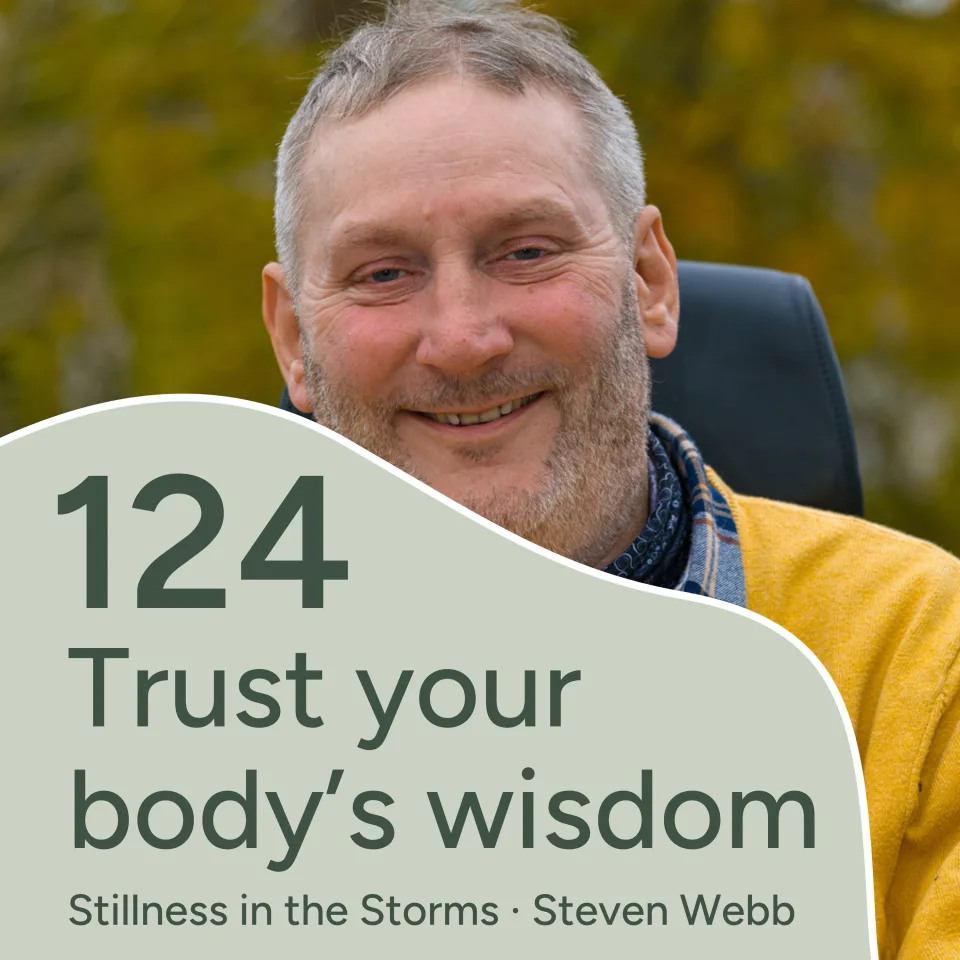
Episode 124 · 14 June 2024 · 6:03

Achieving Calm by Trusting Your Body's Wisdom

Does this moment really need you to do anything with it? Usually not. A short one, and that question is most of the content.

Subject: Anxiety, Overwhelm & Stress

Apple Podcasts Spotify

Stillness in the Storms · Episode 124

Does this moment really need you to do anything with it? Usually not. A short one, and that question is most of the content.

We so often feel we have to act. Take the step back instead and ask whether the moment actually needs you. Your body carries thousands of years of inherited knowledge and it has your back. It knows what to do without being told.

One thing to try: Ask it once today. Does this moment need me to do anything with it?

In this episode

  • (0:03) A smaller, bite sized version this time
  • (1:16) Becoming aware of the breath, and what matters about it
  • (1:51) Not forcing a feeling. The body knows how it should feel
  • (2:36) Take a step back. Does this moment really need me?
  • (3:23) Shopping, driving, and the mind doing five other things
  • (3:55) The brain thinks it has got everything covered
  • (4:36) Your body has your back, and it knows what to do

Support the podcast and join the Weekly Calm: stevenwebb.uk

Thank you for listening.

Steven

The question this answers

Does this moment really need you to do anything with it?

Usually not. This is a short one, under six minutes, and that question is most of the content.

The heart of it

  • Your body knows how to breathe and how to relax. Things go wrong the moment you get involved and start managing either.
  • The head has been handed far more information than it can hold. The body has thousands of years behind it and is not overwhelmed.

When it is all going wrong around us, the body is the one with the wisdom to handle it, and the head is too loud to hear that.

So this is what I do when I remember. It might be a few seconds, it might be three minutes. I become aware of my breath, and I do nothing at all to it.

Then the muscles. They know how to be in any given moment, the same as the breath does. Become aware of them and let them do what they want to. They will generally want to relax.

Then the question.

Does this moment really need me to do anything right now?

That is not putting things off. It is noticing that you can only ever do the next thing anyway, while the mind is trying to run five others at the same time.

The brain reads a book and thinks it has the thing. It has not. It has the words. The body only has it once you have actually done it.

One small thing to try

Ask it once today. Does this moment need me to do anything with it?

Breath first, then muscles, then the question. It takes under a minute and it works in a queue, at a desk, or halfway through a supermarket.

Questions people ask

Is this an excuse to avoid things?

No. Most of what feels urgent can wait an hour, and the ones that genuinely cannot are obvious. The question sorts them faster than panic does.

Why not control my breathing?

Because your body already breathes correctly for whatever is happening. Take it over and you start forcing a feeling instead of having the one you are actually in.

Why so short?

Because it is a bite sized one. I am doing more of these alongside the longer episodes, so you hear from me more often.
Read along

The transcript

It follows the audio. Press any line to jump there.

stress · mindfulness · present-moment

Read the transcript

Hello and welcome to a smaller version of my podcast.

I'm just going to do a few little bite size, I guess, versions

of stillness in the storms just to help us with that little

bit of peace when we need it.

And in this one, I just want to talk about the wisdom of the body

and to remember that the body has your back very often, that we

are trying to control the body all the time.

And when things are all going wrong around us, it's the body that

is screaming at us with the knowledge and the wisdom to be able

to deal with it.

But the head is just so overwhelmed and unwise at the moment

that years ago we had very little to do with our minds.

We could cope with a little bit of information we were getting.

Now we've just been overloaded with everything.

So this is just a little reminder.

What do I do in those occasions?

Well, when I remember, I just deliberately just take a little moment

out.

And this could be a few seconds or it could be two or three

minutes.

And all I do is I become aware of my breath.

And we can do this now, just I'm breathing in and I'm breathing

out.

But what's really important is I don't do anything with my breath.

My body knows how to breathe.

And if you're familiar with my guided meditations, especially my

more recent ones over the last year or so, I don't try to change

the breath.

Your body knows how to breathe in any given circumstances.

But the problem is the minute we get involved, we start changing

it.

We try to force a certain feeling.

The body knows how it should feel in any given moment.

So just become aware of your breath and just allow your breath

to be what it is.

And in a similar way, your muscles know how to relax.

They know how to be in any given moment, just like your breath.

So just become aware of the breath and be aware of your muscles

and just allow them to do what they want to do.

And you'll probably find they just want to relax and then just

allow them to do so.

Very often situations are where we feel we've got to do something

and if we just take that step back and, ah, let's just be here.

Does this moment really need me to do something right now?

Very often it doesn't.

Very often it can wait a few minutes or a few hours or a few days.

And I'm not talking about putting stuff off, I'm talking about

we've been overwhelmed with lots of things to do.

You can only do one thing.

You can only deal with the Next thing that needs to be done.

And when we're just shopping or when we're driving somewhere,

when we're anything we're doing, the mind is trying to do five

other things.

And just by doing this exercise, just, ah, what's my breath

doing?

What's my muscles doing?

What's my body doing?

And there's so much wisdom in our bodies.

There's so much more to know, more to learn from our bodies.

You know, the brain thinks it's got everything.

You read a book and the brain has it.

It's not until you put it in practice does the body actually have

it.

The body's been around a lot longer than the thoughts have been

around.

If you think about that, the brain and the mind's been around

a long time.

And if you read a book that's only been around, I don't know, 5,

10, 20 years, maybe 300 years, if you read Shakespeare, a lot of

the stuff that you read or you learn is brand new information.

But the body knows, the body has, you know, hundreds, thousands

of years of knowledge all inherited.

Your body has your back.

Your body knows what to do.

And if you remember this, it does give us that sense of calmness.

So that's my thoughts of today.

Just bring your attention back to your breath and just allow your

breath to be what it is.

Allow your muscles to be what they want to be.

If they want to feel relaxed, let them.

And you'll find you're a lot more stressed out and overwhelmed

in this moment than you have to be.

I'm Stephen Webb and this is a just a little snippet or I'll think

of a name for them in due course.

In the meantime, thank you for all your support.

I love you guys.

And I'm going to be doing a lot more of these little ones and

then the odd longer one, so you'll hear from me more often.

Take care.

Bye.

And I love.

Weekly Calm

One calm email.
Every Sunday.

A little space to pause, a practical thought to take into the week, and a reminder that you’re not doing this alone.

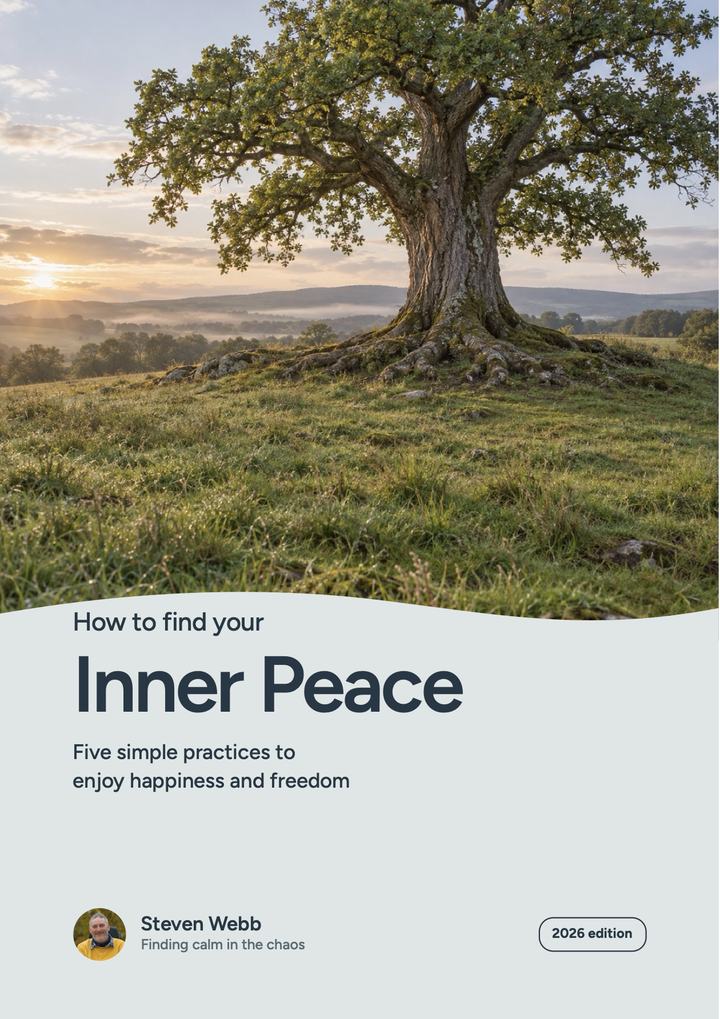
Join and I will send you my book, 5 Simple Practices for Inner Peace. Free, and yours to keep.