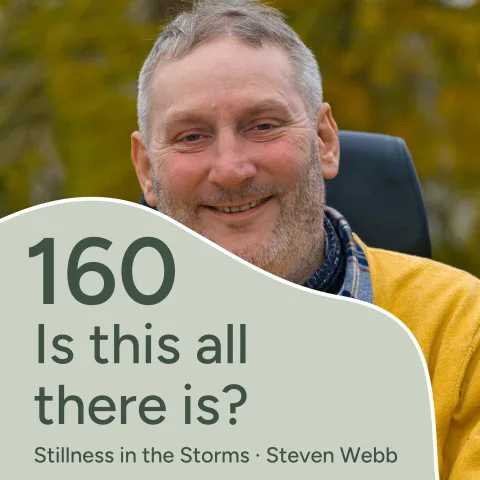
Do you need to be a Buddhist to find inner peace? I am not one, and I do not think you need to be either.
I am recording this three days after an operation and on painkillers, so bear with me. I collected the statues and the pictures and the apps and books I never read. What I was after was for the calm to rub off. But the practices do not need the beliefs. Meditation, awareness, compassion for yourself and for others, sitting with what is rather than fighting it. None of that asks you to believe in reincarnation or karma. Jun Po taught me that all of it starts at one point, and that point is caring.
One thing to try: Take one practice, not one belief. Sit with what is for two minutes and leave the rest.
In this episode
(1:18) We are all Buddhas when you strip the layers back
(2:34) The statues, the apps and the books I never read
(4:23) It would help, and it would only take a few thousand years
(6:37) Alan Watts, and the wisest people I know are not Buddhists
(7:52) It points to a stillness under the noise
(10:16) Reincarnation, karma, and what you do not have to believe
(11:32) The core practices, and what they actually ask of you
(14:10) Jun Po, and why it all starts at caring
(15:05) There is no point where you are finished
Support the podcast and join the Weekly Calm: stevenwebb.uk
Thank you for listening.
Steven
The question this answers
Do you have to be a Buddhist to find any real inner peace?
I am not one, and I do not think you need to be either. I am recording this three days after an operation and on painkillers, so bear with me.
The heart of it
The practices work without the beliefs attached. Nothing here asks you to sign up to reincarnation or karma.
Buddhism does not say life is meant to be comfortable. It says look at it clearly and stop turning away.
I had the statues and the pictures round the house long before I knew anything. I could not tell the big laughing one with his belly out from Siddhartha. I downloaded the meditation apps and used them about once a month. I bought books I never opened. What I really wanted was for the calm to rub off on me, the way it does when you sit in Truro Cathedral or in a park.
That worked fine until I was forty and at rock bottom, and a statue on the windowsill was not going to cut it.
What I found underneath all of it was one idea. Most of our suffering is not the thing itself, it is our argument with the thing. We do not like this moment, we want a different one, and we spend the day fighting something that has already arrived.
There is a difference between the philosophy and the practice, and Alan Watts put the distinction better than I can.
The menu is not the meal.
Alan Watts
The label, the institution, the tradition, all of that is the menu. What actually feeds you is the direct experience of the stillness underneath. That is the bit I am interested in.
So when I am in bed and it hurts, I look at what is under the pain. What colour is it. Where does it sit. Is it permanent. And when I stop fighting it the pain very often quiets down, as though it only had to keep shouting while I was refusing to listen.
Jun Po, one of my teachers, framed awakening as something that happens in the middle of an ordinary life rather than in a monastery. He also taught me that whatever arises comes from a point of caring. Angry about something in the news? Good. Write to somebody. Do something at arm's length that is peaceful.
I do not think you get to a point where you say, I am enlightened, that is it. If you think that, do not meditate for a week.
One small thing to try
Take one practice, not one belief. Sit with what is for two minutes and leave the rest of it alone.
Would a monastery help? Honestly, yes. No news, no outside world. But if you can find compassion at a family barbecue, or living with your parents again after ten years away, you are doing better than any monk in any monastery.
Questions people ask
Are you a Buddhist?
No, and not really a Christian either. I agree with a great deal of what both of them teach. Compassion, understanding, stepping back and choosing how you answer.
Do I have to believe in karma or reincarnation?
Not for any of this. Some strands of Buddhism lean into it heavily and it is a broad tradition. Meditation, awareness and compassion ask nothing of you except that you try them.
Is this a proper explanation of Buddhism?
No, and I would not pretend otherwise. I am not a scholar. This is what I heard from my teachers, which is not always what they said.
Read along
The transcript
It follows the audio. Press any line to jump there.
buddhism · spiritual-journey · acceptance
Read the transcript
Welcome to Stillness in the Storms. I'm Steven Webb. A very sore Steven Webb. I went in and had an
operation on Thursday, and it's now Sunday morning. And I am on painkillers. So who knows where this
podcast might end up going. But I want to talk about a question that I've had more than once, and
I've probably thought about it myself as well. Do you have to be a Buddhist to find real inner peace?
And
around my house, I've got Buddha statues, I've got pictures on the wall. And I love the whole Buddhism and
the way it gives you that bit of calmness around the house and just the teachings and things like that.
But I had them way before I really knew what Buddhism was about. I didn't know the difference between the
Chinese Buddha that's there with his belly hanging out and all his riches laughing and Siddhartha, the different
Buddha. In actual fact, I think he's the sixth or seventh Buddha. I didn't know at that point that we're
all Buddhas and we take away the noise and we take away the small mind. We're all Buddhas at heart
in some way when we strip away the layers.
And really, I just wanted that peace to like, I suppose, rub off on me in some
way. And it's the same way when you go into church and you sit down. We got true Cathedral locally,
and if I go and sit in there, there's just a calm presence about it, very similar to if you
go and sit in a park. The birds always seem nice and calm and nature seems calm. The river seems
calm but most of the time, unless we've had change of rain. So on today's podcast, I'm answering the question,
do you have to be a Buddhist monk or a real staunt Buddhist in order to find real,
genuine inner peace? So I'm glad you can join me. So, as I said earlier, welcome to Stillness in the
Storms. I'm Steven Webb, and this is a space for anyone navigating difficult times and looking for something deeper.
Not a quick fix, not a life hack, just a real conversation about finding inner peace and,
well, when you need it most, when you have it at least. So welcome.
So after collecting statues and pictures and different things with Buddhism, I've even had books
that I never read and just diving into the odd meme and sharing the odd meme on Facebook and downloading
apps for meditation, but not actually doing anything with them. I hit my rock bottom at the age of 40
and I was really suffering. And instead of, like, playing with this inner peace
and wanting a bit of quiet calmness in my life. I really needed it at that point. So that was
when I had to pick up the books and all that and go, do you know what? I can't just
rely on a statue on my windowsill anymore. That app I put on once a month and play the odd
meditation. I really need this because I am on a cliff's edge and I am at rock bottom.
And that's when I started understanding what Buddhism really was and the Four Noble Truths and the Eightfold
Path. And then I found a couple of my teachers and things like that. And it wasn't until then that
I understood, you know, there's a difference between the philosophical understanding of Buddhism and many other religions, and
then there's the practicing of it. And I think this is where I think it's really important to understand.
What Buddhism gives you is a teaching of just open your heart and be compassionate, be caring. But it also
gives you the practices in order to do that. It doesn't say you've got to become a Buddhist. It doesn't
say you've got to meditate four hours a day every single day, and go into a Buddhist monastery and study
script for the next 10, 20, 30 years. It says it would help. If you want genuine, real,
lasting inner peace, you need to do that. But it also says you need to do that for about five
six thousand years and you need to do that on the return every time you come back. And the
reincarnation, to some degree, it's not quite as simple as reincarnation but the spirit or the soul or whatever you
want to call it in Buddhism, it just comes back. And every, Every life that we do that
apparently is. This is, as far as I understand it, every life that we do, and we go deeper and
deeper, we just get a slight head start next time around And that doesn't mean that I don't know if
I subscribe to that, but which other way it is, that's basically the the continuation of Buddhism. So let's go
back to what Buddhism is actually. And I have to be a bit careful here because I'm not a scholar.
I am just somebody that wanted them in a piece and studied it. And I'm just repeating what I heard
from my teachers. It doesn't mean that's what they were saying. It's what I heard. And I may not be
right. And the core idea is that, and this is the bit I coming back to, that a lot of
our suffering is not from life itself, but our Relationship to it, from the clinging, our
resistance, the resistance that things should be different from the way they are. We don't like this moment. We want
it different. We're trying to change what we cannot change. The Buddha didn't say life is supposed to be comfortable.
He said quite the opposite. He said, look, clearly at this Experience Don't turn away
from it. See it as it is. And paradoxically, when you stop fighting it, something eases.
Not because hard things go away, but because you're no longer adding a second layer of suffering on
top of it.
The suffering of thinking that it shouldn't be happening to you. Does that require the robes and the rituals and
the name and a specific set of beliefs?
I really don't think so. And some of the wisest people I've ever encountered on this path would also agree
because they're not Buddhist either.
So Alan Watts, who I return to a lot, and I know a lot of you do too, as well,
that he spent a big chunk of his life doing exactly this, taking Buddhism, Taoist, Hindu ideas, and
translating them all into a language that ordinary Western people could actually work with. Not watering it down, just
making them livable and making them accessible. Watts had his wonderful ability to point something
quite profound and make it feel like, rather than just understand it intellectually. He'd say
something like, the menu is not the meal. And what he meant by that is that the concept of Buddhism,
the label, the institution, the tradition, that's the menu. But what you're actually put in your mouth, what
actually nourishes you, is the direct experience of stillness, of presence, of this moment right now. He
wasn't interested in the institution. He was interested in the experience the institution was pointing to.
And I guess that's where I am as well. It points to a stillness. It points to a quiet calmness
beneath all the noise. And that's what I'm interested in. That's that's what I try to return to as much
as possible when situations are difficult. When I'm lying in the bed and I'm in so much pain, I point
to what's beyond that pain, what's before the pain arises and you start to realise the
impermanence nature, that this pain won't be forever, later on today or later on next week. And then we suddenly
stop fighting. We go, okay, let's have the pain now what's the pain feel like? What colour is it? Where
is it to go? Real Western psychology on these kind of things. And then when we start fighting it, the
pain suddenly just, oh, he's took notice of me. Oh, that's all right then. I don't have to keep screaming.
It's funny how much the body screams at us when we don't take notice of that So just do a
side note. This podcast has no adverts, no sponsors. Nobody is paying me to tell you anything. The only real
reason Stillness in the Storm exists and the only reason these conversations keep happening is because of incredible kind people
who treat me to a coffee. These small donations pay for everything. The hosting, the editing, the equipment, all of
it. So I want to say a big huge thank you to the three new monthly supporters, Stephen, Kaylin
and Allison and then the one-time supporters although many of them have donated more than once. So
Femke, Hannah, Andrew, Tracy, Helen, Tiffany Lynn, Gem, Ulysses, an
anonymous supporter, Sujata, Jess, Leigh,
I'm not sure who how you spell or pronounce Griet, Cheryl and Krysia
Thank you. You are all awesome and you all keep this podcast free from adverts so I can go.
Let's get straight back into it. So I want to address the thing that I think but it's one of
the things that puts people off, and I'm not talking about the six hours of meditation and they go into
the Buddhist and shaving in the head and all that. I'm talking about some of its beliefs. Because when people
hear about Buddhism, I sometimes hear that you have to believe in reincarnation. You have to believe that you lived
before. You have to believe in karma as a kind of universal system, justice. And a lot of people, people
that have come especially from the science background, people who've had complicated, painful experiences with
organized religion, people who just don't want to swap one instead of dogmas for another. There's a wall there and
I can really understand it. And I want to be very honest with you. Some strands of Buddhism do emphasize
these beliefs. It's a diverse tradition they're a father they're mayayana the Tibetan,
the Zen. And they're not all the same. Some of them lean into the metaphysical belief beyond and
quite heavily into it and But here's what I keep coming back to. The core principles.
Meditation, mindful awareness, compassion for self and others, sitting with what really is
rather than fighting it. None of these require you to believing anything at all. But here's what I keep coming
back to the core practices. Meditation, mindful awareness, compassion for self and for others,
sitting with what it is rather than fighting it. And none of these require you to believe in anything at
all. They're just experiences, experiments. They're things for you to try Things for you
to notice what happens. The laboratory is really your own experience and Jun Po Denis
Kelly, my teachers can't believe he's passed away five years now. But through a mondo Zen process,
he really did open my heart and he just helped me to understand what's happening in our
bodies, in the world. And just by just by framing things a little bit different in a way that I
understood made a huge difference. He frames awakening not as something that happens to religious people or
monasteries, but as something that can happen in the middle of an ordinary human life. How
do I find my inner peace? Well, I I pick and choose and I cherry pick with what feels right
for me. And I I often say that if you've got more compassion for yourself and you're being kinder to
yourself, you're kinder to those people around you, you're having experiencing more inner peace.
You're seeing things as as they are. You're not getting caught up in rows and you're not getting caught up
in arguments and things like that. Then it's working, you're on the right track Jun Po Denis Kelly my,
probably one of my main teachers, he would, he taught me that whatever feelings arise you're
gonna look at the feeling, but you don't have to do anything with it or if you choose to do
something do something productive with it. So if you're angry, that's brilliant. Write a letter to the governor. If you're
angry about the Trump situation or another situation in politics, great. Do something peaceful and compassionate.
Show a different story, write a letter, do what you can at arm's length. You don't have to use that
anger to do something violent so And the same as with loneliness, if that occurs, just be lonely for a
little bit, that's okay. And if you have an overwhelming need for lust or desire, sit with it, be okay
so ah this is what's arising right now. And he just made me understand the point that
where all this arises is a point of caring, a point of compassion. And
we all have that in us. Every single one of us from a really small age can
pinpoint a time when we had a compassionate response to a situation where it could have gone the other way.
So we're all capable of being enlightened, having enlightened moments, and we're all capable of not having enlightened
moments. The only difference is the more you meditate, the more you study, the more you work on seeing
what's arising and intercepting it with that bit of a gap and responding in a compassionate way,
you have less unenlightened moments. And you have more enlightened moments. There's no such thing.
And I really and I really do agree with jumpo on this. I don't think you get to a point
where I'm enlightened. Now, that's it. I can stop doing my training, I can stop doing my meditation. I'm now
going to be kind and compassionate to everybody. If you think that's the case, don't meditate for a week. You'll
quickly find out that I need to return to the cushion.
When I say return to the cushion, I don't mean you've got to go on retreat and you've got to
sit down cross-legged and hum. I mean just that, put on a guided meditation at least a couple of times
a day. Just sit down and observe your thoughts. Just take time out properly. If you're sat next to a
river, listen to the river and understand that your ears cannot hear it and your mind is just interpreting
the
signals from your ears. Your eyes don't see anything. Your eyes just have a mirrored image of
what's outside in the world and it goes on to the back of your eyes and ascends into your brain.
Your brain translates everything and your brain doesn't see everything. Exact. That's why we all see different colours. That's why
we'll argue with our relatives that, well, that's not the way I seen it, not the way I heard it.
Because we're interpreting everything, our whole lives either. And this is what gives us more in a piece
It gives us less arguing, it gives us less confrontation and more compassion. We
understand that the other person may have it wrong, but not because they're wrong, but because they've seen it or
felt it differently. Or we could have been wrong, we could have seen it and felt it differently.
And there's just as much chance that we've seen it or heard it differently than they did. That's compassion. It's
understanding. So do you need to be a Buddhist? Do you need to go into monastery? Yes. It would really
help. When you haven't got the outside world and you haven't got the news and you haven't got that doing
it in the real world is really hard. Doing it at a family barbecue is really, really
hard. That is, if you can manage to do it living at home with your parents after you moved out
for 10 years, then you're doing better than any monk in any Buddhist monastery.
Because if you can find compassion in those circumstances, then you got it, you're doing all right.
So I gotta be honest, I'm getting tired now, and I want to wrap this up, but I really wanted
to get a podcast out to you and I don't know how coherent this podcast has been. I've got to
go and edit it in a minute and I got a feeling I've jumped around everywhere. I want to leave
you with this. I'm not myself a Buddhist, but I agree with many of their teachings. I'm not really a
Christian, but I agree with many of jesus's teachings and I don't think I'm religious really in
any big way of any any of them. But I agree with all of their teachings I agree with compassion,
I agree with understanding. And I agree with just taking a step back, seeing what's
arising, and choosing to respond in a compassionate and caring way. And if you're doing that
more often today than you were last year, you're on the right direction. Don't worry about whether you become a
Buddhist or whether you're a certain religion or anything. It doesn't matter. I'll tell you what, the world means more
now of anything else. Compassion, understanding, more love. So
I'm gonna leave it there for today.
I'm absolutely exhausted um and I hopefully I'll get this out in the next couple of hours that
I'm Steven Webb and if this episode meant something to you, please share it. If it helps anybody else,
please head over to StevenWebb.uk the message. The website is in the show notes
and you can join my weekly Calm newsletter. And I'm just gonna leave it there and just thank you
and take care of yourself. Stay curious and I love you.