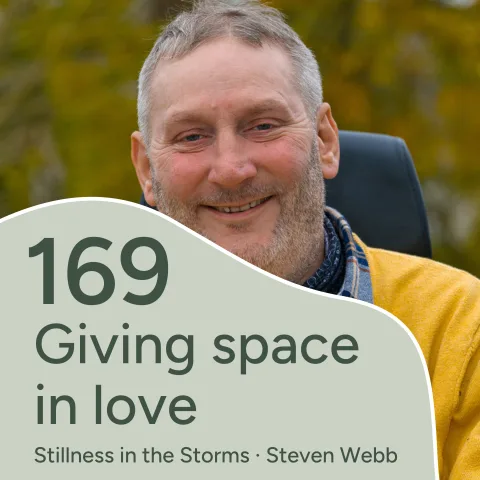
When somebody treats you badly, why does who you are matter more than who they are?
Let no man pull you so low as to hate him. That is Martin Luther King, and it is the whole episode. Somebody slams a door on you, cuts you up on the road, and you want to phone everybody and post it. Two hours later you wish you had not. Nobody made you angry. You chose it, fast, but you chose it. Strong words are expensive to your own peace. If their behaviour decides your behaviour, you are not free at all.
One thing to try: Pause and take one breath before you respond. Then ask who you want to be in this.
In this episode
(4:16) My daughter, the van, and a heated text row
(5:06) When we are triggered and we want revenge
(6:42) Two hours later, I wish I had not said that
(7:41) Did they make me angry, or did I choose it
(9:16) Be that person, whatever life throws
(11:53) Compassionate, caring and wise. What I aim for
(15:13) Anger is expensive to your inner peace
(16:34) If they control your reaction, you are not free
(21:16) The Buddha, the poison and who drinks it
With gratitude to
Senga, Holly, Trish Murphy, Blackwell JK, and Steven Webb, my namesake
Support the podcast and join the Weekly Calm: stevenwebb.uk
Thank you for listening.
Steven
The question this answers
When somebody treats you badly, why does who you are matter more than who they are?
Let no man pull you so low as to hate him.
Martin Luther King
That is the whole episode really. Everything else is me working out how you actually do it on a Tuesday.
The heart of it
Nobody makes you angry. You choose it, very fast, but you choose it.
Strong words are expensive to your own peace, and you are the one paying.
If their behaviour decides your behaviour, you are not free. You are being run by them.
My daughter was about twenty two, in the back of the van, in a heated exchange with friends by text. She asked me what she should reply. I said, who are you? What would you say if you spoke from the heart? She said, but they have been mean. Yes. And you are still the one deciding what happens next.
My teacher Jun Po used to ask a room, has anybody ever made you angry? Every hand goes up. Then he asks again, and the hands go halfway, because now you suspect a trap. Ask it a third time and you get there. Nobody made me angry. I chose anger, in a fraction of a second, before I noticed.
I used to think of karma as an enormous scorekeeping department somewhere, taking notes on anybody who was rude to me. It is not that.
Your karma is how you treat them. Not what they did.
Somebody cuts you up on the road and you want to ring everybody and put it online, and you build a whole story where they left the house early specifically to ruin your morning. Two hours later you wish you had said nothing. And I am no better. I reverse my wheelchair over people's toes more often than I would like, usually while looking at a shelf, and what I want back from them is exactly the patience I struggle to give.
Here is a way to think about the cost. Imagine every word you said had a price on it, and the angry ones cost more. Would you still have the argument? Silence might be the best value in the shop.
As I walked out toward the gate that would lead to my freedom, I knew that if I did not leave my bitterness and hatred behind, I would still be in prison.
Nelson Mandela
He invited one of his former prison guards to his inauguration as a guest of honour.
One small thing to try
Pause and take one breath before you answer.
Let them finish. Nothing you fire back in the first two seconds ever helped, it only adds fuel. Then ask the only question that matters here. Who do I want to be in this?
Mine is compassionate, caring and wise. I miss it constantly. What has changed is that the gap before I react is a little wider than it used to be.
Questions people ask
Am I supposed to just take it?
No. You can say the hard thing, and you can walk away, and you can set a limit. What you do not have to do is become the thing you object to in order to do it.
What about cutting negative people out of my life?
Sometimes the negative person is a family member, and sometimes it is you. My daughter struggles like anybody else and I am not casting her out for it. Some people need somebody to sit with them, not a door closing.
Does this get easier with practice?
Less often triggered, never not triggered. The Dalai Lama sits for four hours every morning, and when asked why, given how calm he is, he said that is precisely why.
Read along
The transcript
It follows the audio. Press any line to jump there.
compassion · anger · relationships · breath
Read the transcript
Let no man pull you so low as to hate him. Martin Luther King.
Hello, and welcome to another episode of Stillness in the Storms. The podcast that helps you to find a little
inner peace and some inner strength during challenging times.
I'm your host, Steven Webb. And I'm so grateful to... There's a number of you that's bought me a coffee
this week. And it really does make a difference. It helps me too.
in actual fact, I've purchased a little bit of software that will help me to edit the podcast and help
me to break them down a little better. And that's thanks to you guys for donating the coffees. So let's
go through and have a look who's donated the coffees this week. So, first of all, to Senga Senga, you
support me all the time. Just a big hug and a big thank you. Thank you to Holly. Thank you.
To Steven Webb, my namesake um I originally found you in Googling. Your name I've I've
Googled my name. I do confess I've Googled my own name. But he's got Steven Webb. He donated three coffees
to me, but he's got his own website, stevenwebwriter.com, and he has some awesome poems on there that he writes.
I just wanted to give him a bit of a shout out. And we've got a couple of anonymous people
that have bought me a coffee. So thank you very much to them Trish Murphy, thank you very much. And
someone called Blackwell JK. Just thank you guys that makes a huge difference. And if you head over to
thankyousteven.com you can do the same if you want you don't have to you know I don't have no sponsors
for the podcast or anything like that, but what I have, I've added something on my wish list over there.
I do confess it's rather expensive. In fact it's crazily expensive but it's an Insta 360 camera.
And I added to my wish list because I had an older one years ago and I sold it because
it wouldn't go live and it wouldn't do a few things I wanted to do. But this camera I can
attach to my wheelchair, I can put it recording, and I can record all around me and everything I do,
and I can come home and edit the edit the video and upload it. So if I have a moment
of inspiration, if I just suddenly think, oh, that's a good thing to think, and I want to share it,
I can do it without having to drag my phone out and record it yeah It kind of kills the
moment, doesn't it you know Nothing worse than having to do all that if like feeling in the mood. But
yeah. So over there on the page, thankyousteven.com, where you can buy me a coffee. I've also got a wish
list, and you know I I do apologize. Capitalism, and it is quite expensive, but it's a pretty awesome bit
of kit and yeah. So anyway, let's move on to today's podcast. That's more important. That's why you're here.
Don't we hate long introductions?
Today I want to share some thoughts on being yourself and not allowing others to drag you down. We've all
been in situations where we felt the need to retaliate or perhaps even begin passive-aggressive and mimicking the behaviour
of those struggling with as we'll explore today, it's not who they are that's important, it's who you are.
And I started today's episode with a quote, and I just think it perfectly fits the theme for today is
let no man pull you so low as to hate him. Martin Luther King
when we encounter challenging people or situations, it's natural to want to defend ourselves I get it.
Even seek revenge. However, when we do this, we're essentially just allowing them to define who we are
instead of embracing our true selves. It's crucial that we recognise our actions and you know it's crucial
that we don't end up doing the one thing we don't like them doing. And I always remember I sat
in the back of the van and my daughter was there, and my daughter was in a quite a heated
discussion with her friends on text. I don't know quite what it was about and you know teenagers things like
that. She's about 22 at the time, something like that. She asked me the question. She asked me, what would
you do in this situation? What would you reply? What would you do? And I just sat there and I
thought about it. I just said, well, who are you?
What do you want to say? If you were to speak from the heart, how do you how would you
approach a situation? How would you like them to approach it if it was the other way around and that
and she was quite angry, she said, yeah, but they've been mean. They're doing all these things and all that
I just want to I said, yeah, but it's you are that's important. And I think this is so important.
When someone slams a door on us, when someone huffs and puffs or you know we've been treated
quite unfairly and we do want to take revenge, we do want to have a go at them we're triggered
by it. And fair enough you know if I'm screamed at or shouted at you know some people just have
a different way of communicating that they've learned they're screaming and shouting They've learned they've just been rude and just
saying it you know I've spoke to people and they just go, well, I'm just not like because I speak
my mind. Well, fair enough, that's what you do. But I'm not like that. I'm a people pleaser. I like
to keep people happy. And I'm trying to get seven billion people in the world to you know have a
little more inner peace, try to be a little more happier you know Join the fight with me you know
I can't do this alone. Now, I'm only joking all you guys that share this podcast and all that. You're
doing a brilliant job, but just bringing it back. The point is who are you you
know in all these situations? When they arise, when we're triggered by narcissist or somebody that's just struggling
and we want to we almost want to do the same as them, we want to take revenge, we want
to shout back and the last thing we want to do is be nice and compassionate and kind. Well, the
thing is, perhaps they need that. Perhaps they need to be shown a different way. Perhaps you know And if
you do end up being like them, how does it make you feel? Does it make you feel better? Do
you feel joyous of the fact normally you sit back two hours later I wish I hadn't said that. I
was so mean, I couldn't believe it. I wouldn't do it normally, but I was so angry at the time,
you wouldn't believe how angry they made me and god jumpo my um amazing teacher, one of my
amazing teacher asked the brilliant question in part of his Mondo Zen. He looks up and says, has anybody ever
made you angry? And most of the time, yeah, loads of people. It's like, okay, I'll ask you again, has
anybody ever made you angry? And the hands are like because you know he's asking a question, then you know
you're probably not on the right track, but you half stick up your hand. Well, yeah. No no I'm
serious. Has anybody ever made you angry? And then you start to step back and you go, wait a minute,
what is he really asking? Has anybody ever made me angry? Okay, so when I've been angry, did they make
me angry? And then you come to the conclusion, no, I've chose anger. Albeit it might be
so quick at the time, we may not even recognise it. We're triggered and boom, it just happens you know
Someone says something nasty, we side swipe back we get so triggered and we get so we wanted all these
things We spend most of our lives trying to hopefully karma sorts them out you
know I've spent most of my life thinking karma was a load of, I don't know, animals with billions of
typewriter somewhere in the universe keeping score, but in a um some kind of score sheet on people that upset
me. Like as if the universe really cares whether anybody upsets poor Stevie or not. But yeah, I've thought it
for ages. Karma is some kind of this brilliant mechanism that's going to get anybody that's ever a bit rude
to me, really. Karma is right there, right then you know Your karma is how they how
they treat you in that moment. Your karma is how you treat them. Not what they did, it's what you
do. That's the karma, instantly. Now then, if you are kind-hearted
compassionate loving, genuine, authentic person and you don't want to go around screaming
and been nasty at people, be that person. So no matter what life throws at you, be that person. And
that's why I say it's more important who you are and in your actions than it is them. But
how do we do it you know well Pause and take a breath you know When faced with conflict you
know take a moment to pause. Let them finish, let them happen let that let whatever is
going on in their head, let them spew it out. You don't have to fight back immediately. In
actual fact, it probably won't help because it just escalates and pours more fuel on the fire. And cultivate compassion.
Remember that everyone is dealing with their own challenges and struggles you know By cultivating more
compassion for others, you're less likely to be drawn into their negativity. You can't avoid negativity. You can't go
your whole life just come in encounter with happy people you know They don't exist. Nobody's happy all the time
you know all this I talk about it quite often on my podcast or this well, let's just avoid negative
people. Let's kick negative people out of our lives. Or sometimes the negative people are us. Sometimes a negative person
is a family member. I love my daughter deeply, but sometimes she's negative, sometimes she's struggling. I'm not
going to cast her out. At that point she needs me more than ever to sit with her and and
and to pour over the negativity, maybe just be with it. And of course, I've done. Podcasts on negativity
isn't necessarily a bad thing. Sometimes we have to focus on the negative bias in order to survive
you know I use the example all the time I don't know why I use this example, but I use
the example of two bears running towards us. One with a machete and one with donuts you know you bet
you're better off concentrating on the one with the machete you know not the one with donuts. Because you'll never
get the donuts if you don't take notice of the one with the machete. That conjure up an image. I
don't know why I always go back to that example. It's never happened anywhere, ever. But
you're never there So really it's about focusing on your values. What are your values? Stay true to your
principles you know if I if I ask you now to list your three main principles, what would they be
your Three main things. What do I show up as? Compassionate, caring and wise.
I like to show up as those three things. Do I always know? Do I struggle with it all the
time?
Do I get triggered by people? Yeah, all the time. All the time. I'm triggered less. But what it is
is that little gap that well, wait a minute, if I step back you know if I'm if I'm driving
down the street and somebody um pulls out in front of me and all that you
you know it makes me want to be angry with them, makes me want to lash out with them. And
very often they might flip a bird to me and they'll shout at me or something like that, because they'll
blame me. I then want to do the same back to them and it ends up and then I want
to phone everybody and post it on Facebook and phone everybody. You can't won't believe what happened to me today
when I was driving in my car, this person left home deliberately to make me late. And it was all
planned. And the universe had ready for me at that corner just at the right time you know We tell
the story, don't we? We go down this hilarious long story.
Yeah, it's funny. It's funny when we see it from the outside, but when we're in it, it's not so
funny. But you know if I pull out in front of someone, or if I make a mistake in the
wheelchair and all that, and I almost run over someone's toes and all that, and I do it sometimes, and
sometimes I don't even realise the amount of times anybody's ever spent some time with me driving around you know
The amount of times I reverse into people. I'll be there looking at the shelf or something like that, and
I just reverse. And someone's with me, no, don't go back, don't go back. And by then, I've already drove
over someone you know So luckily, most people are quite polite and goes, no, don't worry about it's. Fine. And
I'm like feeling like pants I'm like Don't like this I didn't I didn't mean to run you over Sorry
but it happens. Well, I don't want them to return with the same thing. Well, I'm going to run you
over now No, I want them to be understanding and compassionate so when people make mistakes, we can
show them there's a there's a way of handling the mistakes. It's fine. And the other thing is, choose your
battles wisely. That's the everything and Not every conflict is worth engaging in
you know Is it really worth your time? Is it worth your blood pressure is it you imagine And I've
often thought this. Imagine if every single word you had to pay a penny or pay a cent for.
Would you have all those arguments?
Would you argue back with people?
Okay, you might flip them the bird, but what if that was a whole pound or a dollar so and
certain words you know depending on if you are more compassionate, that was cheaper words, and you're more angry and
revengeful. They were more expensive words because they are really to our inner peace and our inner karma. The words
we use have a sense of currency. I'm thinking about this on the fly. I'm coming up with a metaphor
on the fly here. But if you think about it, it's true you
know The stronger the words, if you're swearing and you're shouting and you're using anger towards people, that's
expensive to your inner peace. But if you use kind, compassionate and some most of the time, no
words, maybe that's even the best currency.
Nelson Mandela is the perfect story for illustrating this. The way he was imprisoned for
trying to end the apartheid and all that. Then it's controversial. The way you know before he went to prison
and all that you know was he a terrorist? Was he there depends on the perspective you take. But whichever
way his story after the 25 years of imprisonment is the real what we really learned you know
instead of coming out and seeking revenge. Because bearing in mind, when he come out, he had a lot of
power he ended He had the media, he had the emphasis on his side. He ended up becoming president
you know but when he came out he said, as I walked out the door toward the gate that would
lead to my freedom, I knew if I didn't leave my bitterness and hatred behind, I'd still be in prison.
And
you think about that. It's true. If we allow other people their anger and their um thoughts and
their actions and all that to control our actions, we're not free at all were being controlled by them,
completely controlled by them you
know nato Mandela understood that if he held on to this anger, it would serve to drag him down and
prevent him from achieving his goal of a united South Africa. One famous example was when he was
invited invited his former prison guard to his presidential inauguration as a guest of honor.
Think about that. Could you do that?
And there's a story of a woman that had a child murdered, and yet she went to meet the
guy that murdered her child when he came out of prison, and she hugged him and he said, well, why
do you want to hug me? He said, well, one person died that day. I didn't want two people to
die.
God, that's powerful, isn't it?
So it's about who you are, and that's what's really important. And that's what I wanted to share today. So
if someone's annoying you someone pisses you off in the moment or anything like that, remember who you are.
And yeah it is easy to get caught up. It's easy to make mistakes and jump on it. Don't worry,
move on. Accept that we're human accept that being human is quite difficult at times.
It's quite a struggle, and you know we're all working at it. Anybody that says they're sorted, anybody
that says you know I'm all done, I'm all at peace, I'm enlightened nothing like that, yeah, look closely uh
I I know Zen Masters I I know some incredible teachers and people that are the probably the
most enlightened people on the planet. And they're struggling too. They have to fight with it every single day.
The Dalai Lama meditates for four hours every single morning. When someone said, well, why do
you meditate? You're one of the calmest you know compassionate people on the planet, he said, well that's because I
meditate you know There's a lot of people out there that push my buttons. I've got to you know I've
got to chill I've got to have my downtime, I've got to reframe things. And I'm not saying you've got
to go and meditate like the Dalai Lama you haven't got You haven't got the shit to deal with, he
has to deal with. But you know in your life, you've got what you've got to deal with. And we'll
come across these people that will push our buttons, that will annoy us, that won't that are wrapped up in
their own world wrapped up in their own
problems you know just don't end up being like them. So you know if you remember one phrase from today's
podcast, remember this one.
It's not important who they are and what do they do. It's important of who you are. Make sure
your actions are from your heart and where you are. If your actions are
constantly from there, then you've got nothing to worry about. Because I know by listening, you listening to this podcast.
I know I I have I have emails from so many of you you know I've met many of you
and things like that. And I know what a compassionate, caring,
loving community we are. That's why I can say at the end of the podcast, I love you so I
know I do. I accept you for what you are.
And that's what love is. Acceptance you
know We're all struggling. We all make mistakes you know come back again and again and try again and be
less hard on yourself, but show up as you are. That's the thing. Who am I? How would the
genuine, loving, caring person an eye for an eye only ends up making the whole world blind? I
I hear you all. You all went Gandhi because you all know that quote, but so real isn't it It's
true that is a quote you know
tick now hands says another quote you know when another person makes you suffer, it's because he suffers
deeply within himself and his suffering is spilling over. He does not need punishment. He needs
help.
So we don't have to do the same as what they're doing.
And I'm going to end with one quote by the Buddha.
Holding onto anger is like drinking poison and expecting the other person to die.
That's brilliant, isn't it? That really cuts through all the, you know, I should have just done a podcast and
just said that one quote and said, that's your lesson for today you know Focus on your values. Choose your
bowels wisely cultivate compassion, and you won't go far wrong. Recognise your triggers.
Recognise your triggers before they happen. Pause and take a breath. I'm
Steven Webb and this is Stillness in the Storms. And if I do help you to think differently in some
way you know drop me an email, head over to thankyousteven.com. You can download my little small book
5 Simple Practices for Inner Peace. You can treat me to a coffee, but you can also email me. I
email nearly everybody back. If I forget, email me again in a few days. I do that magic thing of
replying in my head and then realise when I go back to it, I haven't done it.
That's. thankyousteven.com. Take care. I love you.