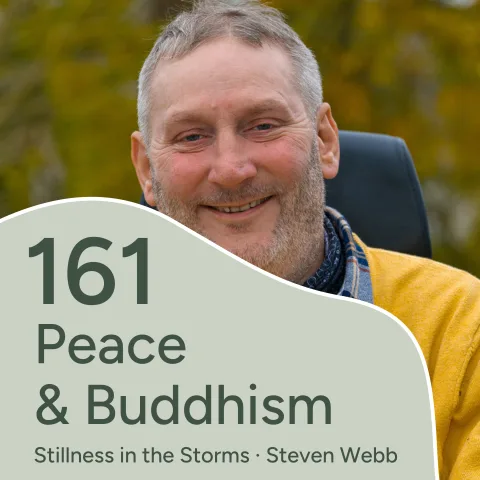
The Kensho That Transformed My Journey: A New Year’s Message
What one thing changed my life most? A book. As a Man Thinketh, and the line that I am not my thoughts, which raises a far better question straight after it.
What one thing changed my life most? A book. As a Man Thinketh, and the line that I am not my thoughts, which raises a far better question straight after it.
If I am not my thoughts, then who is having them? That question went deep and never really left. We are the awareness of the thoughts, and the who I was turns out to be the important half of it. This is also a New Year's message, and I would rather you did not set resolutions. Find some balance and enjoy it instead.
One thing to try: Ask the question once and let it sit there. If I am not my thoughts, who is aware of them?
In this episode
(0:02) Looking for a New Year's message worth making
(2:09) Proud of them both, and out of hospital today
(3:21) The book that changed things more than anything else
(5:22) You are not your thoughts. So who is having them?
(6:58) Never having separated my thoughts from who I was
(8:49) Gandhi, and the answer he gave
(10:26) The breakthroughs coming, and what humans have not seen yet
(12:10) Working out how the mind runs, then bending the rules
Support the podcast and join the Weekly Calm: stevenwebb.uk
Thank you for listening.
Steven
The question this answers
What one thing changed my life most?
A book. As A Man Thinketh by James Allen, and one line in it: you are not your thoughts. Which raises a far better question straight afterwards.
The heart of it
If you can be aware of a thought, you cannot only be the thought. You cannot see the box while being the box.
The interesting half is not what you are not. It is the who that is doing the noticing.
I read it at about forty. I had barely read anything since school, having been diagnosed dyslexic in the seventies, when a diagnosis mostly meant being told something was wrong with you. I had to go over the same paragraph several times.
I did not start meditating then, because I was sure I could not. My mind goes everywhere. I have about a hundred books here I never got past the thirty percent mark of.
But the line would not leave me alone. If I am not my thoughts, who is having them?
We are just the awareness of the thoughts. And the who I am is the more important part, which I still have no answer to.
What it gave me was permission to stop taking any of it so seriously. A ridiculous thought arrives and I can smile at it. A fairly bleak one arrives and I can smile at that too. Then it spread to feelings, which was the bigger gain.
I held my granddaughter for the first time yesterday. Five pounds. Koa Emily. And it struck me that nobody arrives here able to manage without other people. Somebody had to be there for you for the first couple of years, whoever that was.
Everybody has somebody to thank.
Even Gandhi, asked why he did what he did, said he did it for himself. And I think that is honest rather than cynical. I do this because it feels good. If I am unkind to somebody I feel bad. That is what actually drives us.
One small thing to try
Ask the question once and let it sit there. If I am not my thoughts, who is aware of them?
You will not get an answer, and that is not a failure. Sitting with it is what loosens the grip.
And on the New Year part: do not set resolutions. Find some balance and enjoy it instead. Pick three words you want to show up as, and let those do the work a list never does.
Questions people ask
Whose idea is this?
Not mine. I think the phrasing comes via Ken Wilber and it is far older than that. I am a conduit. I work out what helps, and pass it on.
What does it actually change day to day?
You stop being welded to whatever arrives. A thought turns up, you look at it, and you decide. That gap is where most of the peace lives.
Should I read the book?
It is short and it is over a century old, and one line of it did more for me than most of the shelf. Whether it lands for you I could not say.
Read along
The transcript
It follows the audio. Press any line to jump there.
zen · spiritual-journey · mindfulness · personal-story
Read the transcript
Hello and welcome to a new episode of Stillness in the Storms. This one, a New Year's message and I
was trying to think of what I could record in a New Year's message that would have the biggest impact.
And I thought, what's had the biggest impact on my life? So in this episode, I'm going to share the
one thing that I learned really did change my life and my thinking more than anything else. That one moment
that I just like, oh wow. This changes everything. So I'm going to share that in a couple of minutes.
But just before that, welcome. I'm doing hell of a lot better now. I'm going more hours and more days
without painkillers. I'm not suffering so much. I'm getting energy back. And if you didn't know, I've been in hospital
the past... Well, not for the past couple of weeks. I've been out for the past couple of weeks. But
I was in hospital before Christmas. I had quite major surgery and it's been kind of a tough year but
Oh wow. Just so much better things that are happening at the moment and I held my granddaughter
for the first time yesterday She's so small. I was like, oh, like proper head, make sure it's okay. It's
like she's five pound and it's like, oh wow. And it made me realise that nobody comes into
this earth that doesn't have to rely on other people. So although we think we do everything ourselves and although
we think we go through life and we're the ones that have to do everything,
somebody had to do something for you and help you through the first couple of years at least. Whoever that
was, whether it was a parent or an auntie or an uncle or anything. You know, someone had to be
there for you at some point. So everybody's got someone to thank.
Everyone has someone to thank. So it just made me just really appreciate what life is and growing up and
seeing that baby is ah you know. I think I did take a picture. Maybe I'll post a picture in
the notes or something I linked to it. But yeah made me very proud. Well done, Cameron James. You know,
I'm so proud of you both. And you've come out of hospital today. You've been in hospital now for well
over two weeks as well. So I come out of hospital and my daughter goes in. So, yeah. Very proud
of you. And thank you very much to all the sponsors and everybody that buys me a coffee. And especially
in the past two weeks, so many of you have put money towards the camera that I'm trying to raise
money for and just buy me a coffee and say thank you and the kindest of words and You say
that you like my smooth voice and things like that. It's like nobody likes their own voice. And whenever I
pay it back and I'm editing, I'm like, really? But thank you for the kind words. It really does land
well and makes a difference. So deeply appreciate that. Deeply appreciate donations. And anybody that leaves a review, anybody
just shares this podcast or just listens, just tunes in and doesn't foresleep Really appreciate you.
And if you do foresleep apparently I've got a real talent for that. And I've got another podcast called Inner
Peace Meditations that helps you to foresleep helps you to have a little more inner peace. And I will link
to that in the show notes as well. But let's get on with today's podcast. And the one thing that
changed my life more than anything else is when I read the book As a Man think of by James
Allen. It's quite an old book. But the one thing that stood out in there was, and I really had
trouble reading. So I had to read the paragraph several times with my dyslexia since I was born and it
was diagnosed at school. And in the 70s when you're diagnosed with something like that, you know, you don't get
much help. You're just diagnosed with something that's wrong. You know, you're broken in some way. So I didn't read
for the next, I don't know how many, until I was about 40 years old and I started reading this
book. And I hope you can hear me. The rain is really pelting it down now, but I don't want
to not record this podcast. I want to just get on with it um I want to get it out
for you tonight and what's a bit of rain? We can't wait for everything to be shiny and positive and
happy before we do anything. So hopefully you can hear me through the rain. So going back to the reading.
So one of the messages that really stood out in the early chapters was you are not your thoughts. I
was like, okay I have no idea what that means.
And I kept reading more and more. And it kept mentioning about meditation, things like that. I didn't start meditating
at that point because I thought I couldn't do it. I thought I can't silence my mind I It's overactive.
It's thinking. It's always going on tangents. You know, I've got that shiny object syndrome. Literally, I'm going anywhere. And
I'm like, oh, look at that. Constantly.
You know, I can't focus on one thing. I start 10,000 things. I rarely finish anything. I'm really, I've got
probably, I don't know, 100 books here that I didn't get past the 30% mark.
Going back to you are not your thoughts. So I really didn't understand this concept. You are not your thoughts.
And the more I read the book and the more I thought about it, the more I thought, well, if
I'm not my thoughts, who is thoughts? And it just made me... Deeply think reflectively about what
thoughts are and how they come and go and all that. And I suddenly realised I had this realisation, well,
if I am my thoughts, how can I be aware of my thoughts? It's
like if you are the box,
how can you see the box? Well,
you're clearly not the box if you could see the box on the floor. So if you can be aware
of the thought that's happening, you're not your thoughts. So therefore you can leave your thought, come and go, do
whatever you want with it. Not always easy. And I've got a wonderful train analogy for that um I
think I've shared it in one of my podcasts before.
And if I have, I'll dig it out and put a link to it. But the the whole concept of
you're not your thought. So you have a thought, you observe it, it comes in. But
I'm not that thought, so I don't have to do anything with it. And this really sunk in and it
extended to my feelings and my emotions.
And it really just moved on from what I was thinking in the hospital bed when I broke my neck.
So I spent the first six months lying flat on my back in a hospital bed and I used to
look around the ward and I used to spend much time thinking about, well, I'm just a brain I'm here
thinking and I'm doing all these things. But at that time, I never separated my thoughts from who I was.
But
what's really interesting is the who I was. That's the more important part. We're just awareness of
thoughts. So who I am, really, I have no idea because I don't have thoughts. I'm just aware of them.
And this gave me so much of a breakthrough that I suddenly started to play with my thoughts and play
with my ego and self. And I didn't take it so seriously. And because I didn't take it so seriously,
it just gave me that little inner peace that, oh right, I can have a thought and it's crazy and
it doesn't matter and I can smile about it. I can have a really quite a depressive, not very nice
thought and I can smile and be okay with it. And over time I learned to
just observe thoughts and be entertained by it just like as if and in the chimp paradox book he
talks about The ego as a chimp. So my thoughts and my ego are just like this laughable,
happy chimp doesn't care about people. It doesn't care about anything else. It cares where the next banana comes from.
Instant gratitude. It cares about having fun doesn't care about people's feelings. It just cares about itself. And that's really
what the ego is. You know, we can kid ourselves and say we pretend to Care about everybody else and
we love everybody and we do all that. In reality, we like the feeling that it gives us when we
do care about other people. So really, we're doing it for ourselves. You
know, even Gandhi when he's asked, and I love using this analogy and anybody that, not analogy I love using
this quote. And anybody that's listened to my podcast more than a couple times would know that I use it
quite often but Even Gandhi, when he was asked, why do you do all these wonderful things and bringing everybody
along with you? And you talk about peace and you talk about all this wisdom. Why do you do it?
He says, I do it for myself.
They were like, what do you mean do it for yourself? You're the most selfless person in the world. And
he went, on the contrary. I don't think he said that actually. But what he actually meant was, no,
I do it for myself because it makes me feel good. And
that's the reality. We do things because it makes us feel good. If I'm not very nice to someone, I
feel bad. If I'm nice to someone, I feel better. And that's what drives us. So if I have a
thought that I like, I feel better. If I have a thought that I don't like, I feel bad. So
if I spend too much time with a thought that I don't like, I feel even worse. If I spend
more time with thoughts I do like... I feel better. Sometimes even they can become obsessive and
overthinking and too much. And vice versa, you know. We can be stuck in the desire thought pattern.
The desire that controls us. The same as we can be stuck in something like the victim and the depression
and all those things as well. So just because it feels good doesn't mean it's all good
so I've already covered quite a bit in this podcast, but if there's one thing you go into
2024 with, because 2024 is going to be a crazy year. You know, we're going to have so many breakthroughs
the next year. It's going to be the ride of our lives. Humans, I don't think, have seen anything yet.
We're going to have destruction, but we're going to also have incredible breakthroughs in medicine and
the way we deal with things the way we deal with social problems and There's so much promise to come
and there's just a lot of heartache as well. And humans are very good at
extremes. We're not very good at finding balance in the middle. And if there's anything I can help you with,
it's just you're not your thoughts. And that gives you the ability to just find balance in the middle. I
have a thought. I don't have to do anything with that thought I Extend it to your feelings. I have
a feeling. I'm not those feelings.
And I want to thank somebody that's just donated because they give me the idea for the episode because she
said about how much it really means to her when I say about in one of the meditations, I have
thoughts but I'm not those thoughts. I think those words come from Ken Wilber actually and it may have come
from...
Older teachers than that over the last two, three thousand years. But you know it's not my words. It's not
my that there's nothing I'm teaching you here. Nothing. Everything is just handed down. I'm just a conduit from people
from before me. But I I decipher work out what works for me
and I share that with you. And if it reduces my suffering and if it helps your understanding and helps
my understanding then great. And one thing I like doing is working out how the mind works. And
when we really work out how things work, we can then bend the rules. We can play with it a
little bit. Like the mechanic that knows all about his car, he can play with the car. He can bend
the rules a little bit. He can adjust it. He can speed it up because he knows how it works.
So if we know how the mind works and the way a thought comes in and we are not those
thoughts and all that, you can play with them. You can have fun with them and you can genuinely have
a lot more freedom in your life because you're not constrained by the thought that you think is you and
therefore you don't have to become attached to it
you know It's much like going to a supermarket and you can choose which fruit to pick up. You know
have fun with which ones you're choosing this week. Okay, picking up fruit at a benchmark isn't exactly fun. But
in a supermarket isn't exactly fun. But you get the point. You know, I like my analogy sometimes. Sometimes
they're terrible
yeah from the
whole depth of my heart, just a deep, deep thank you. This past year has been a hell of a
roller coaster. I never realised how poorly I was. And now I I do And now I'm getting my energy
back and now I've had the operation. I've got my stoma bag. I don't have to worry about making a
mess and having to find the toilet all the time and been paralysed That really is problematic. Problematic
for anybody I've been paralysed is really problematic for me and my carers. So that's why I bailed out the
chili eating contest at Three chilies because I was thinking, yeah, I don't want to do this to the carers
later and to my body.
Yeah, maybe next year I'll do maybe next year I'll do four chilies. No, don't think so um
My ego is not that big. I have to eat chilies to prove to the world I'm something.
Anyway, I'm rambling now. I'm just, yeah, I hope you can feel the more
energy in my voice and in my body.
I'm so grateful to my body for being here and allowing me to enjoy it.
As long as I possibly can.
You're not your thoughts. You have thoughts. You are not your thoughts.
That will change so much in your life when you really grasp that concept.
Thank you to all my donators. Thank you to each and every one of you for listening. Thank you from
really really open heart. I am so grateful to you all.
Happy New Year.
Don't set resolutions. Don't do any of that stuff. Just... Be a can if you want, I guess. It's never
worked for me. Just enjoy it. Find balance. Find those three words
that you are. Show up as them. And remember you're not your thoughts. Take care. I love you.