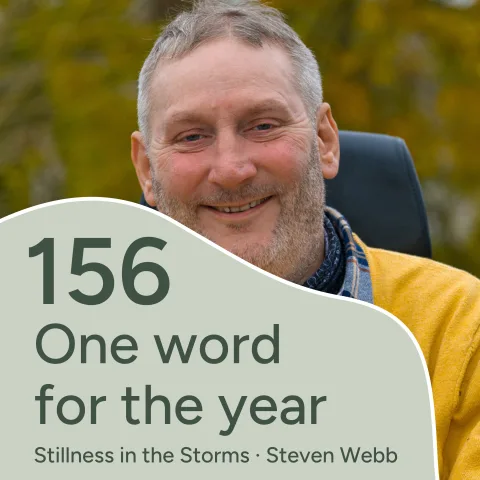
Is your knowledge worth anything if you never use it? I have a confession, and it involves a shelf of unread books.
We buy the salad with good intentions and throw half of it away. We buy the book that will change our life and flick through the first few pages. Knowing how to be compassionate is worthless unless you are compassionate. Everybody knows the carrot beats the chocolate. I am dyslexic. I would read a page and not know what I had read. As a Man Thinketh took me three months and it is forty pages. That reading counted, because I did something with it.
One thing to try: Take one idea you already know is true and do it once today. One is enough.
In this episode
(1:46) The salad we buy and throw away
(2:50) The book that was going to change everything
(3:49) Knowledge you never practise is worthless
(5:01) The wheelchair broke and I had no idea what to do
(6:43) Reading a whole page and knowing none of it
(7:39) Three months for forty pages
(10:13) Knowing how to be compassionate is not being compassionate
(11:19) Everybody knows chocolate is not a carrot
Support the podcast and join the Weekly Calm: stevenwebb.uk
Thank you for listening.
Steven
The question this answers
Is your knowledge worth anything if you never use it?
I have a confession, and it involves the fact that I opened Amazon halfway through planning this episode and bought two more books.
The heart of it
The person with a shelf of unread books has no advantage over the person who cannot read.
We always choose the improving option for our future selves and the easy one for now.
Knowing how to be compassionate is worthless. Being compassionate is the thing.
Look at my shelves, my Kindle and my Audible library and you would conclude my life must be entirely sorted. It is not, because I have read a fraction of them and acted on fewer.
It works the same with the shopping. We order the salad with genuine intentions and throw half of it away.
There is a good reason for it. Ask somebody what film they want to watch next Thursday and they pick the worthy one they feel they ought to see. Ask them an hour before and they pick the comedy. We are generous towards our future selves and we always choose the quick lift for right now.
I did not read at all for twenty years. I was labelled dyslexic at seven or eight and stopped bothering. I could say the words out loud and reach the bottom of a page with no idea what I had just read.
Then at forty I hit rock bottom. My chair broke down in a shop doorway with a wire through the tyre and I sat there in the street sobbing, forty years old and completely stuck. A security guard came over and squeezed my shoulder and said nothing at all, which was exactly right.
After that I started reading, and it was hard. Some paragraphs six or seven times. The first book took three months and it is forty pages.
That one counted, because I did something with it.
Have you suffered enough?
Doshin
That is his question, and it is the honest answer to why any of us ever act on what we already know.
One small thing to try
Make one rule. No new book until you have read the last one and put one thing from it into practice.
Not read it. Practised something from it. That second clause is the whole rule.
Everybody knows the carrot beats the chocolate. Nobody needs another book about it.
Questions people ask
Does this apply to fiction?
No, and I say so. A story is doing something else entirely. This is about the self help shelf, the videos, the courses, all the material bought as a substitute for doing the thing.
What if I read slowly?
Then you are in good company. Three months for forty pages, and that book changed my life while faster readers were finishing their fifth of the year and doing nothing with any of them.
Is this aimed at me?
Mostly at me. I said so in the episode. I bought two books while thinking about the subject of an episode about buying too many books.
Read along
The transcript
It follows the audio. Press any line to jump there.
purpose · values · personal-story
Read the transcript
On today's podcast, I'm going to confess something, something I've
just done and I cannot believe I'm going to confess to you.
And I'm also going to answer the question, knowledge is worthless
if.
Well, it's not really a question, but I'm going to tell you
why knowledge is worthless if you do not do something.
But I confess.
I've just opened up the web and I've just gone to Amazon again,
and it's just put up a book recommendation and I bought it.
And then I bought another book and I bought the Audible to go with
it.
And I'm going to be really excited about reading it at some
point, and I believe it's going to sort my life out.
I believe one of them was called Unfuck My Life.
Sorry for the swearing, but that's the title of the book.
Of course, they put an asterisk on it.
Here's the thing.
If you look down from my Audible books and you look down through
my Kindle and my bookshelf behind me, if you see on my YouTube
channel, you would think my life would be absolutely sorted if
I just read 10% of them.
There's the problem.
We buy these books, we do the Audible things, we listen to a little
bit of them, and even if we do, we don't do anything with them.
That's my confession today.
I buy too many books.
I get them through.
I have all the intention.
And that's the thing.
I believe everybody has the intention to sort their lives out,
to become fitter, to become healthier.
We do shopping online and we order the salads and we order the
healthy options.
And then when it comes to eating them, we're like, I'll just
have that tonight.
And we end up throwing away half of the salad.
I may be rejecting here.
This may be just what I do, but it's like they've done a survey.
At some point, when we make a decision for our future time, we
always tend to pick the options that are healthier and better
for us.
So if someone come up to you and said, what movie should we watch
next Thursday night?
You're more likely to pick a movie that you haven't watched, but
you would like to watch, but it's not that stimulating.
It's one of those movies that I should watch at some point.
But if you.
If it's just Thursday night and it's about an hour to go and
you say, what movie we going to watch?
We'll pick a comedy, we'll pick a lighthearted one, we'll pick
an instant gratitude one as opposed to something that's a little
more a documentary or a little more taxing, something that's going
to make us think that we ought to watch.
So when you go to buy a book, you tend to buy the books.
That's going to improve your life and things like that, and you
tend to come home.
But when it comes to sitting down and reading the book, you'll
tend to flip through Facebook or YouTube because that's the thing
that's going to pick us up in that moment as opposed to the other
way around.
We're always after that instant.
Pick me up that instant.
How do I feel better in this moment?
I'm Stephen Webb and this is Stillness in the Storms.
And although I talk about having a little more in life, it's
also about self improvement.
It's also about working on ourselves and how can we have a better
life ourselves, more freedom, and how do we become whole so we
can deal with life's storms?
That's what this podcast is all about.
And today, you know, knowledge is great.
There's three steps to it.
You know, the book has the knowledge, we read the book, so then
we have some of the knowledge.
But then if you do not then practice the knowledge and put it
into play, it's worthless.
There's no point.
You know, the person that has the bookshelves and all the books
has no advantage over the person that cannot read if you don't
read them and put them in place.
And even the person that reads the books and even the person that
watches the documentaries, watches the self help programs, buys
the fitness videos, does all those things, if they don't put them
into play, they've got no advantage over the person that doesn't
even have books.
They cannot read.
They cannot.
We have to do something with the knowledge that we gain.
And it's like when I hit my rock bottom at the age of 40, I found
myself single.
I found myself totally with no money, no prospects, not knowing
where to go or what to do.
And I was sat in a shop doorway and I was bawling my eyes
out.
I was 40 years old.
I was in an electric wheelchair that just broke down and
I was crying like someone that had a complete breakdown.
Well, I did have a complete breakdown.
The chair had just broke.
A wire had just gone through the tire and I had no idea how to
repair it.
And I was there by myself and I didn't know what to do.
So I called my carer and they come down and helped me and Got me
home.
A security guard walked over and just squeezed my shoulder.
And you know, I'm very thankful of him for that time because
I'm sure.
I don't know whether he was deeply wise or just did not know
what to say, but whichever way, his comfort was perfect.
If there was ever a perfect moment of somebody just being there
for somebody without having to say something, that was the perfect
moment.
I don't know who he was.
I've never seen him again.
Perhaps he didn't exist.
Perhaps he was a.
Perhaps he wasn't even there.
Perhaps it was just my own.
No, I'm joking.
He.
He was real.
I never go past that shop now without thinking about that Saturday
afternoon when my life just.
Well, my whole body and everything, my mind.
And I said, do you know what?
Fuck it, Stevie, I cannot do this for you anymore.
I've been trying for 40 years.
You gotta do something with your life.
And that was it.
My rock bottom began.
I look at it now as a gift.
But then a few weeks later, I started reading books.
And it's unusual for me because I never really read since
school, because I was labeled dyslexic when I was about 7 or 8
years old.
And because I was labeled dyslexic at 7 or 8 years old, I never
really put much effort into reading everything I read.
I never really understood.
My dyslexia was.
I would read a whole page and I wouldn't know what I just read.
So I'd have to read it again and again and again.
And I could read the words like I could read them out aloud.
Okay.
A lot of the words would really mingle into one.
And I would read it as the.
Let.
As the letters.
I wouldn't read it as what they would really read.
So.
But that's going slightly off topic.
So I spent most of my life just not bother reading.
Then suddenly, at 40 years old, I was so desperate.
And they say when you're suffering enough, you do something
about it.
So that's why one of my teachers, Doshin, says, have you
suffered enough?
Because if you haven't, you won't do anything about it.
And I guess that's part of this topic of this podcast.
If you suffered enough, you'll not only go out and get the knowledge,
you will also do something with the knowledge.
But I was reading book after book and it wasn't easy.
You know, sometimes I'd read the same paragraph six or seven times.
The first book I read took about three months and it was only
about 40 pages as a Man Thinketh by James Allen and basically
told me, you're not what you think.
And I was like, wow.
Just boom.
It just hit me.
But the thing is, that was knowledge.
What did I do with it?
Did I sit with that in meditation?
No, because I didn't think I could meditate.
I tried it when I was 27 years old, and I lasted about two minutes.
That's it.
Cannot shut my mind off and gave up.
Little did I know that had nothing to do with meditation.
It wasn't about shutting your mind down.
But there I was reading all these books, and they were all telling
me to meditate.
And there I was.
Here it is, the solution.
And it's not.
It's not there for me because I cannot meditate.
So the perfect solution in all of these books, and it's not available
for me.
Well, when one person tells you something, you can kind of go,
okay, I can dismiss it, or not.
When another person says, maybe there's some truth in it.
But when every single book you read, you turn the page.
Meditate, meditate, meditate.
At some point, you gotta go, okay, there's gotta be something
in this.
Everybody else cannot be right and I be wrong.
So I started looking into meditation a little more.
I started doing it.
I did realize that.
Well, I thought for ages I was a terrible meditator.
I wasn't.
I was.
I was just somebody that was perfectly normal, that thinks quite
a bit.
My mind does its job perfectly fine.
It thinks.
It has a constant train of thought.
Well, almost constant.
That's what it feels like, only to find out that's perfectly
normal.
You know, that's what the mind is designed to do.
Just like the heart.
The heart is a constant beating.
Good.
That means you're alive.
You won't want your mind, you won't want your heart to stop beating.
So you don't want your heart.
You don't want your mind to stop thinking.
So there I was learning that meditation wasn't about stopping
the thinking.
It was about understanding the thinking.
It was about gaining knowledge of what's happening in your body
and what's happening around us.
Seeing the truth of things.
And when you see the truth of things, you can then do something
with it.
But knowledge, that knowledge of understanding that unless you're
putting it into practice, the knowledge of how to be compassionate
is worthless.
Unless you are compassionate.
Unless you put it into practice, the knowledge of how to
read is worthless.
Unless you read, the knowledge of how to meditate unless you meditate
is worthless.
And I could cut off Another million examples.
And I think you just get the point.
You know, knowledge is one thing and it all begins with knowledge.
I understand that, but unless you put it into practice, you know,
you have the knowledge of eating healthy.
Salads and fruits is good for you, builds up your immune system,
makes you healthier, gives you more energy.
You have the knowledge of go to bed earlier, sort your sleep out,
get out of bed earlier in the mornings, don't nap too much during
the day.
You have all that knowledge, you know, that you don't need another
10 books to tell you all those things.
Well, everybody knows all those things.
Everybody knows chocolate's not good for you and you know a carrot
is.
But unless you put it into practice, you know, I'm here paralyzed
just below the chest, but I know exercise is good for me.
And okay, I cannot run up and down the stairs, I cannot do all
those other things, but I can wave my arms around like a guy directing
airplanes.
Do something with the knowledge you build up.
Don't just read the next book and then put it down and move on
to the next book because you think the next book is going to sort
your life.
You know, instead of buying the next book, agree that you will
not buy another book like I did at the beginning of this podcast,
until you've read the last book.
And not only read the last book, put at least one of the things
in that book into practice.
And of course I'm talking about non fiction here.
You know, if it's fiction and the book, the book is like it's a
story that's a little bit different.
But I'm talking about self help books.
I'm talking about meditation books and knowledgeable books.
Things that, things that grow us and open us and gives us more
knowledge in the way that we can improve our lives.
Unless you put one of those things in practice, don't bother
buying another book.
Make that a rule.
Make that a golden rule that I have to read the previous book.
And not only read the previous book, I have to put at least one
thing into a habit on a daily basis.
Knowledge is worthless if you do not do that.
You know, you can know how to solve every problem in the world.
Unless you actually put it into practice, it's worthless.
You're no better than the person that doesn't even bother reading
or doesn't even bother doing anything.
Okay, lecture over.
And this is, you know, this podcast is as much aimed directly
at me as what it is at you.
Okay?
I'm not just making out that you're building all this knowledge
and not doing anything with it, although that is the motivation
here.
Do something with it.
Stop reading book after book, stop going through YouTube after
YouTube video unless you're going to put it into practice.
And that is my lesson for myself for today.
And hopefully you get something out of it as well.
Take care, guys.
I'm Stephen.
Welcome, Web.
You can check out other things I do on stephenweb.com spelled the
V. Take care.
Love you guys.
Thank you for spending the time here with me today.