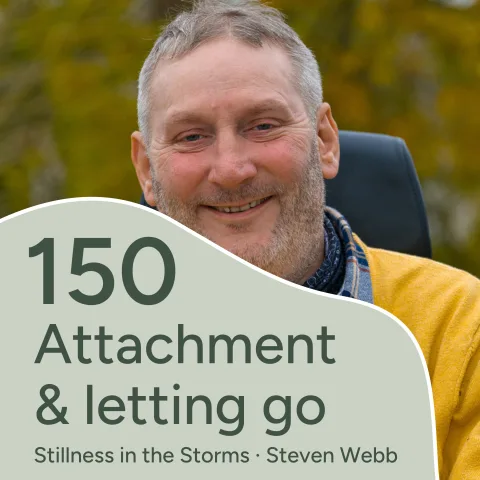
What is the difference between letting go and letting things be? One is a shove. The other is what actually works, and it took me a long time to tell them apart.
What is the difference between letting go and letting things be? One is a shove. The other is what actually works, and it took me a long time to tell them apart.
People kept telling me there were other pebbles on the beach. I would sit listening to lonely songs until the emotion overwhelmed me. Some things you fully influence, some things partly, and some things not at all. The weather is not yours. A little scepticism is healthy as long as it stays in proportion. If you like a thought, enjoy it. If you do not, let it move on.
One thing to try: Put the thing bothering you into full influence, partial influence, or none. Then act only on the first.
In this episode
(0:13) Accepting things, and letting them be rather than letting go
(4:51) People telling me there are other pebbles on the beach
(6:33) Lonely songs, and being overwhelmed by them on purpose
(9:03) Not being able to get up without somebody having a go
(10:51) Paralysed, bankrupt, cheated on. I could list them
(13:15) The phone rings and you are on the toilet. Murphy's law
(15:37) Full influence, partial influence, and none at all
(19:56) You need a little scepticism, but keep it in proportion
Support the podcast and join the Weekly Calm: stevenwebb.uk
Thank you for listening.
Steven
The question this answers
What do you do when letting it go is simply too difficult?
Stop trying to let go and start letting be. One is a shove. The other actually works, and it took me a long time to tell them apart.
The heart of it
You have to accept a thing before you can put it down. Everybody skips the first half.
Trying not to think about something requires you to think about it first.
Suffering is the resistance rather than the event.
At forty I texted somebody I was seeing to say she did not reply the way she used to. The answer came back that she did not know what she wanted, and I had been dumped enough times to know exactly what that meant. By the end of the day it was over.
Then everybody says the same thing. Plenty more fish. Other pebbles on the beach. Just let it go.
Let it go how? Tell yourself not to think about somebody and you have to picture them in order to know what not to picture. It is the flying pink elephant problem, and it fails every time.
I got a long way into loneliness before I noticed I was feeding it. I would put on sad songs until the feeling was big enough to fill the room, then draw the curtains, sit on the floor with my head on my knees, and want everybody to leave me alone.
Any emotion you ignore will eventually run you. That is what being overwhelmed actually is.
Suffering is our psychological resistance to what happens.
Dan Millman
A tree bends with the wind and survives. A tree that fights the wind breaks.
There is a useful sorting in The Little Book of Stoicism. Three levels. High influence: your judgements, choices and actions. Partial: your health, your wealth, your relationships and how things turn out. None: the weather, your height, other people, the traffic.
Most of our energy goes into the third column.
You cannot even eat a doughnut and decide where it lands.
One small thing to try
Watch your thoughts arrive like trains at a station, and decide which ones you get on.
You cannot change a train once it has pulled in. You can decline to board it. Thank you for the thought, but I will wait for the next one.
Do that for a couple of minutes a few times a day and something quietly shifts. Your subconscious keeps sending more of whatever you give weight to, so the ones you climb aboard are the ones it will bring back.
Questions people ask
Is this the same as giving up?
No. Once you stop fighting the weather you have all that energy back for the coat, the route and the timing. Acceptance is what frees you to act rather than what stops you.
Should I try to think more positively?
Not by converting bad thoughts into good ones, which does not work. You need some pessimism anyway. It is the person who says stop, be quiet, what was that noise, who keeps the group alive.
What if the feeling keeps coming back?
Then it has not been listened to. Feelings that get acknowledged settle. Feelings that get ignored escalate until you cannot do anything else.
Read along
The transcript
It follows the audio. Press any line to jump there.
letting-go · acceptance · forgiveness
Read the transcript
Hey, how is it going?
I'm Stephen Webb, and this is Stillness in the Storms.
And I want to talk to you about accepting things and letting
things be as opposed to letting things go.
We always get told to let it go, move on, forgive, forget, and
all those things.
It doesn't really work.
It's.
So I'm going to talk about that on today's show.
And this is Stillness in the Storms.
And I talk about anything that really gives us a little more inner
peace, things that change our perspective, things that allow us
to go deeper into our understanding of ourselves.
I cannot remember who said it about wisdom is knowledge is knowing
other people.
Wisdom is knowing ourselves.
And stillness in the Storms really is about getting to know ourselves
so we can be that stillness in a storm.
And, yeah, that's what it's about.
So, yeah, don't forget to subscribe.
Hit the whatever button.
I don't know if you'll.
If you're on Spotify, hit the follow.
If you're on itunes, I don't know, because I haven't got an iPhone.
So whatever platform you're on, don't forget to do it.
And I do recommend one platform.
Good pods.
That's awesome, because you can follow me on there and you can
find out what podcast I listen to, what helps me, what do I wake
up in the morning to, things like that.
So, yeah, anyway, let's get on with today's show.
We're talking about accepting things, and we've got a president
in America refusing to accept reality.
And what does that do when you refuse to accept reality?
Gives you suffering, right?
It's painful, you know, when you lose, it's painful.
And then you got to suck it up and do something about it, and then
you've got to, like, go, okay, fair enough, I lost.
And there might be the odd ballot there and here and there.
And there's always.
When you cast 160 million ballots, you know, every.
There's going to be a few out of sync.
You know, fair enough, we're humans.
But there isn't going to be 6 million.
You know, he's lost.
Suck it up.
And I. I don't want to make this political on this podcast, this
particular one, I do talk about politics sometimes, but not
on this one.
I want to talk about the difference between accepting things
and trying to let things go.
And letting things go really is, to me, whenever we try to let
things go, it's like an action that we got to try to do.
We're pushing something away, and it's not easy to do it really
isn't easy to do.
So I can remember when I was 40 and I hit my rock bottom.
I was just.
It wasn't.
I don't know, it was a few months after my 40th birthday, and
one morning I text the girl I was seeing at the time, and I said,
you don't always reply to me like you used to.
And I got the message back saying, well, I don't know what I
want.
Well, I've been dumped enough times in my life to know exactly
what that was.
That was a dumping.
I'd open the door and boom.
By the end of.
The end of that day, it was over.
She's left.
She walked out crying.
She picked up her things and I was crying, and I sent her a Dear
Wasn't a Dear John letter.
It's not as a Dear John letter is like, I'm finishing with you.
What do you call the letter that you give to that person that
you just tell them how much you.
Your, your heart's breaking and they're your world and everything
is like, yeah, I was about to not let something go.
I was going to grab hold of everything.
Even if I suffered.
Well, I was.
That was the beginning of my rock bottom.
Wasn't quite at the rock bottom, but two or three weeks later
it was.
But, yeah, for a few days I felt nothing.
For a few days, I was really numb.
And then when I come back out of it, I was angry.
I didn't want to let things go.
I was thinking about her and doing all these other things that
I wanted to do with her.
You know, you do.
Like when, when you're not with that person and you're thinking,
they're so living the life with somebody else that I want to
live the life with them.
So that was all in my mind.
I couldn't sleep.
My brain was going over time, and people will say to me, oh, there's
plenty more fish in the sea.
You can't even say that without thinking about Internet dating,
now, can you?
Plenty more fish in the sea.
Anyway, going back, I might tell you at the end of this about
an encounter I had on plenty of fish.
Anyway, going back to this, I, I just.
People kept saying, there's, you know, there's other people, more
pebbles on the beach.
You know, there's other people.
You just got to let it go.
Well, it isn't easy to let it go.
It.
It really isn't.
You have to accept it before you let it go.
And everybody always thinks about their forgiveness.
Not just forgive them and let it go.
It just doesn't work like that.
How do you let.
How do you get your mind to stop thinking about something that
you're trying to stop your mind thinking about?
It's like me saying to you, right, think of a pink elephant flying.
And now I tell you, don't think of a pink elephant flying.
And I remind you, in five minutes time, oh, don't think of
the pink element flying.
Well, you've got to bring it to mind to let it go.
So it doesn't work like that.
So it's about accepting things.
And at this point, I'm reminded of Dan Millman and was it
in the way of the warrior?
He says suffering is our psychological resistance to what
happens.
Isn't that true?
Yeah.
Suffering is our psychological resistance to what happens.
So like Trump, now, he's suffering because he's accepting
to give into it or not give into it.
He's struggling to accept this present situation.
And that's what you're doing.
You're trying to fight it.
You know, if a tree accepts the wind, it can bend with it, but
if it tries to fight the wind, it's going to break.
And it's the same with dealing with loneliness.
You know, after my rock bottom, for a long time, I really
had to deal with loneliness.
I would sit and I would listen to lonely songs and it would really
be overwhelming.
The emotion would come up and eventually it would overwhelm me
and I would feel more and more lonely.
I was almost growing it until I was overwhelmed by it.
Until you get.
You get to a stage where you just want to draw the curtains and
lock the front door, turn off the lights.
You sit down in front of the sofa and you bend your knees up and
you sit there and you just place your elbows and your hands
on your knees.
You put your head on your hands or something and you just want
to cry.
You want to shut the world out.
Don't text me, don't phone me, don't you dare.
I. I'm fine, but just leave me go.
That's when we're overwhelmed with emotions.
That's when our emotions are then controlling us as opposed to
we're in control of the emotions.
And any emotion that is ignored or any emotion that we don't
take seriously will overwhelm us eventually.
It'll keep coming back.
I got some good meditations on my website, StephenWebb.com that
would help you with that.
And in an app that I'm going to be a teacher on soon, Aura, they
will have some really Good meditations about dealing with strong
emotions.
Not quite on there yet, but you can go to my website and there'll
be a link to it and you'll get an extra special offer.
But anyway, going back to accepting things, it reminds me also
of the Serenity Prayer.
God, grant me the serenity to accept the things I cannot change
and the courage to change the things I can and the wisdom to know
the difference.
And whenever I'm reminded of that, whenever I say it, read it,
or someone says it to me means something different.
The older I get, the wiser I get.
Well, I'm not sure if I'm wise, but certainly the older I get,
the more.
More it has a deeper meaning or the more I understand it, I think.
Or is it the more that maybe because I'm understanding what I
can and cannot change.
You know, when I was a teenager, the only people I knew
I couldn't change was my parents because they did my head
in.
They were wrong about everything.
They disagreed with everything I did.
I must have had a nightmare to them.
But they disagree with everything I did.
I literally couldn't get out of bed in the morning without them
having to go at me.
Okay, granted, I was lying in bed until 11 o' clock in the morning
and they were shouting at me for two hours to get up.
But hey, I was a teenager.
I was tired, you know, I didn't need breakfast.
I was out of bed till questions what time in the morning?
Get off my back.
But yeah, I just wanted to change my parents.
I wanted my parents to see the world the way I did.
And it would have been much easier.
I had so much resistance when I was a teenager.
How about you?
I bet you had the same thing, didn't you?
Yeah, so much resistance when you were a teenager.
I bet we're trying to fight the world.
We're trying to fight the weather, the world, and any people
we like, our teachers.
We've got the whole world against us.
Any wonder teenagers find it hard?
When I was a teenager, I only had to compete with the kids in my
class and my school and my estate.
You got to compete with the whole world.
Now, God wouldn't want to be a teenager.
But yeah, going back to the Serenity Prayer and the older I get,
the less I'm trying to be in control of the things around me,
outside world.
For a start, I. I spent, you know, after I hit my rock bottom,
I learned about meditation, I learned about things that would help
me have less stress.
And it didn't take long before I was trying to change 7 billion
people to the way I was thinking.
And now I just live that way.
And if I invite people to live in a similar way, and if they don't
want to, that's fine, but they often come back and go, hey, can
I have some of that inner peace that you've got?
And I just think I just share how it works for me and been paralyzed
like I am, and been bankrupt, been cheated on, been.
You know, I could list all the things.
I'm sure.
I'm sure you've had plenty of things happen to you as well.
It's not a competition who's had the most things, but we learn.
We learn what we can change what we cannot.
And the older we get, the less we try to change things.
And if we focus on what we can control and just take the rest as
it happens, you know, just, hey, this is what's happening.
It's like the weather.
It's raining.
I can either put on a coat or I can jump up and down and complain
about the rain.
Hey, it's cold.
It's still cold, whether you like it or not.
Yeah, it's like me being paralyzed.
I'm still paralyzed whether I accept it or not.
Trump's lost the election, whether he accepts it or not.
And that's where all our pain is coming.
You have to accept things before you let them go.
You cannot change this present moment.
You cannot change a thought once it's arisen.
You cannot even change your feelings.
Take a breath and then try to change that breath.
You can't.
You can only influence the current breath.
You can only influence the next thought, the next thing, the
thing you're responding about, you know, and when we start accepting
these things, we suffer a lot less and we move from I cannot believe
the glass is broken to, oh, the glass is broken.
You know, whichever way, whichever concept you want to do
of it and whichever way you want to feel about it.
The glass is still broken and it needs cleaning up.
Brilliant.
Well, wonderful opportunity for growth.
This is the worst day of my life.
Cannot believe this is happening to me.
Or interesting test for my emotional wisdom.
How can I be stoic on this day that's testing me?
It's still a day that's testing you.
It's still the worst day of your life, whether or not you deal
with it or not.
Someone answer the damn phone.
I can't believe they're phoning when I'm on the toilet.
Ah, the phone is ringing and I'm on the toilet.
Murphy's Law in It.
That's what they call that.
And that's just.
That's the way things work, you know, you can wait all day for
the phone call and the moment your mum gets on the phone, the doctor
phones.
At least we got cool waiting now.
Or you can wait all day near the phone and say, I won't go toilet.
I'm bursting for a pee.
And the minute you go to toilet, the phone rings every time.
It's guaranteed.
So the answer is, if you want the phone to ring, go toilet.
If you're waiting for the doctor to phone, you go toilet.
And the doctor will phone.
Just pretend to go toilet.
Just go in there and hold the door slightly ajar.
Yeah, I knew it.
And you can run out and go, yes.
Just a different perspective.
Just accepting things the way they are and it makes a big difference,
you know, I got carers that barely any of them can make toast
the way I like it.
I had to get some good toast today, though.
I give them the Jew.
And of course, bread's different because my bread that I
had at the moment is a bit dry from the freezer.
I don't know why.
So.
But yeah, it's, you know, I have to accept certain things.
They're not going to shower me the way I would shower myself, but
I can guide them.
They're not going to dress me the way I would dress, you know,
sometimes I end up my trousers on my head now, it's not that bad,
but it's not far off.
It actually, you know, my underpants backwards.
Hey, they've got Superman on the front.
Seriously, can you not even get that right?
Yeah, trust me, that happens.
They're not my genes.
You got my shirt on backwards.
It's okay.
Anyway, yeah, let's go back to what we can control, we can't control.
And in the little book of stoicism, which timeless wisdom and
gain resilience, confidence and calmness, they say about the
three levels of influence we have on different things.
High influence, our choices in judgments and actions, you know,
our thoughts, you know, how we.
How we think about things.
Partial influence.
Partial influence.
Health, wealth, relationships and outcomes of our behaviors.
No influence.
The weather, our skin color, our eyes, you know, how tall we are,
and most external circumstances, how that person thinks,
what that person does, the traffic, things like that.
So really, when we realize what we can influence and what we
cannot influence, we stop trying to influence.
We stop wasting our energy trying to influence the things we
have no influence over.
Stop trying to change the weather.
Stop trying to change different things, you know, you cannot
even eat a donut and decide where that weight's going to go on.
So you don't even have full control over your body.
You know, your health you can influence, but you cannot have full
control over it.
But you can have control over what you do with your thoughts.
You don't even have control over what your next thought is.
You can only influence it by giving weight to it or not.
And it's the same with any skill that we home in on.
Take a golfer, you know, the golfer can practice all the time
and he can be brilliant.
You know, even Tiger woods have.
It has his day.
And I watched someone do a hole in one the other day, and they
went to hit the ball and they must have missed, hit it, and it
went down, it bounced along the water, skimmed the water three
times, jumped up on the bank, it went all the way around the green
and eventually into the hole.
There's no chance in hell he would ever have planned that.
Even a computer couldn't work that out.
You know, you practice, practice, practice, and then the
moment you hit the ball, when the ball was left that club, you've
got no influence.
It's down to the weather, it's down to the thing.
So preparation, you can influence it as much as you want.
You know, as soon as you throw it out there, what happens with it
is not your business.
We just either get the rewards from it or not.
So accepting things the way they are really, and knowing what
we can control and change.
I know this, this podcast has gone slightly off topic, away from
the letting it go and let it be.
But if we do accept the things we cannot change, we can really start
taking control of the things we can change.
I'll give you a little bit of hints and tips.
We all want to think positive.
We all want a more positive mindset.
So first of all, you need to have some form of negative mindset
for the simple fact that will keep you alive.
If you're in a.
If you and a group of friends go to a forest camping out one night
and you've got Mr. Pessimist and Mr. Optimist and three o' clock
in the morning and you're around the fire and you're playing
guitars and roasting marshmallows and the romance and
you're cuddling into each other and all that, and you're a
bit tired and then suddenly there's a roar in the background
or there's a big crash, say.
And Mr. Pessimist says, shut up.
Everyone stop.
Silent.
Stop.
What you're doing.
We need to know what this is.
And Mr. Optimist goes, don't worry about it.
It's just a tree.
It's nothing to worry about.
Well, Mr. Optimus might be right and you might live.
But I'd rather take the chance, I'd rather not take the chance.
I'd rather listen to Mr. Pessimist, the doubter, the negative
mind, and check whether or not it's some kind of beast that's going
to eat us.
And that's why the negative mind over years has won out.
You know, it's kept us alive.
More often than not, the optimist will get us killed.
So don't be down on your mind for being a little negative.
You need a little negative, you need a little skepticism.
But it has to be healthy and relative.
And when I mean relative, I mean there has to be relative and
imbalance to what you're doing, you know, you know, sometimes
been a little over cautious in this world, it's a little too much.
And I think, you know, I mean, I don't need to come up with an example
for that.
Partly because I cannot think of one right now.
In all the millions of examples, I cannot think of one.
So I said I was going to give you a little help on negative and
positive thinking.
Well, look at thoughts as trains.
So you're sitting down here and you're waiting for the next train
in the station.
Your mind is the station, your subconscious mind is the station
down the road.
And you're waiting for the trains to come in.
And when the train comes in, you can go, ah, that's a positive,
that's a negative, that's a happy, that's a miserable, that's
a sad, that's a, a clever thought, whatever you want to name
them.
And you can choose to get on them or not.
And something magic happens when you sit down and play that exercise
for a couple of minutes every few hours a day, you start training
your mind into what change you want to get onto.
Now, I'm not going to tell you say, get on negative, get on the
positive.
Happy chains.
I don't know, you may want to think negative more than some other
people, but you cannot change a negative thought into a positive.
You can't change the thought once it's there.
Once the train's in the station, it's the train, you can't
change it.
Suffering is trying to change a train.
What we do is we just allow and accept the train that arrives
and go, I'm not going to get on that.
Or I am going to get on with that.
And then eventually your subconscious mind will give you more
trains of what you give more weight to, the ones you get on and
give more emotion to.
So if you really like a thought, give more emotion to it,
enjoy it, revel in it, and vice versa.
If you get a thought that you don't really want, allow it to just
move on, ask for another thought.
Thank you for the thought, but can I have another one?
And then just sit back and wait for it?
You know, that'll make all the difference.
So this is Stillness in the Storms.
I'm Stephen Webb, your host and hope you enjoyed it.
And if you did, leave me a review.
You know, I really do want this podcast to be huge, and I want
it to help as many people as possible.
So if you can leave a review, that really helps and if you can
share it, that'd be amazing.
And, you know, just suffer less.
Pain's inevitable.
It's going to happen, but we can suffer a lot less by trying to.