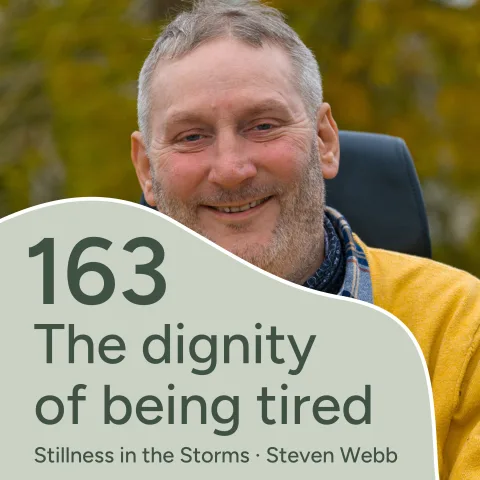
What does it actually mean to become whole? I turned fifty this week, which is something I never expected to see.
For years I could not ask for help. Somebody said I had a chip on my shoulder about being disabled and it landed hard, because underneath it was shame. How do I ask for help when I am the one who dived into the pool? Becoming whole is not denying the bits you dislike. It is integrating them. And here is my favourite part: opposites do not attract. The person who cannot decide dates the person who decides everything, and neither of them grows the muscle they actually wanted.
One thing to try: Name two people you admire and the trait you admire in each. Those traits are yours to grow, not to borrow.
In this episode
(1:45) The funerals, and Claire Brooks in her thirties
(7:32) How do I ask, when I was the one who dived in
(9:06) Integrating the bits you do not like
(11:28) We are not attracted to opposites
(13:04) Dating the trait instead of growing it
(18:00) The exercise: two people, and what you admire
Support the podcast and join the Weekly Calm: stevenwebb.uk
Thank you for listening.
Steven
The question this answers
What does it actually mean to become whole?
I turned fifty the week I recorded this, which is not something I expected to see. Lying in that hospital bed at eighteen I thought five or ten years sitting down would do me. Thirty one years later, here we are.
I spent the evening of my birthday at the crematorium at a carol service. You could not plan it better.
The heart of it
Becoming whole is not getting rid of the parts you dislike. It is bringing them in.
The thing somebody said that made you furious is worth sitting with later, quietly, on the chance they were partly right.
Opposites do not attract. What you are drawn to is usually the thing you have not grown in yourself.
For years I could not ask for help. Somebody offered and I said no thanks before I had finished hearing the offer.
An ex sat in my dining room once and told me I had a chip on my shoulder about being disabled. It made me furious, and my usual move would have been to argue. I did not. I thought, if it bothers me this much, there may be something in it.
She was not entirely right. What was down there was shame. I did not feel I had earned the right to be disabled, because I was the idiot who dived into the pool. Other disabled people were doing well against something that happened to them. Mine was my own fault, so none of the help was owed to me.
That is what held me back for the best part of thirty years, and it never once announced itself.
It has not gone. What has changed is that it is inside the tent now rather than running things from outside it. When somebody calls me an inspiration I can hear what they actually mean, which is not the diving, it is what came after.
Then my favourite part, and the bit that surprises people.
Instead of growing that muscle themselves, they date somebody who does it for them.
The loud one on stage marries the quiet one on the front row, and it looks like opposites. It is not. The loud one wants their own quiet, and the quiet one wants their own voice, and neither is building it. That is why a break up in your twenties feels like half of you leaving. You had outsourced half of you.
One small thing to try
Name two people you admire, and the one trait you admire in each.
Mine would be somebody who can talk to a room and hold it, and my teachers, who stay calm and wise while everything falls over.
Those traits are not theirs. They are yours to grow. Write them down and then ask what the smallest version of that would look like this week. If decisions are your weak spot, make a small one today rather than hand the next big one to somebody else.
Questions people ask
Does becoming whole mean I do not need anybody?
No. It means you are not asking somebody else to be the half of you that you have not built. A good teacher gets you to the point where you do not need them, and a good relationship is not two halves propping each other up.
Is there an end to this?
No. There is an old Zen line about getting to the top of the mountain and continuing to climb. Anybody who tells you they have arrived is selling something.
Am I supposed to accept criticism that is unfair?
You are supposed to sit with the ones that sting, later, when you are not defending yourself. Most of them are partly wrong. The part that made you flinch is usually worth the look.
Read along
The transcript
It follows the audio. Press any line to jump there.
In this episode
acceptance · healing · gratitude · personal-story
Read the transcript
So I turned 50 years old this week.
That's something I thought I would never see. And whenever birthdays come up, I'm always very much, hey, let's celebrate
it. I've never been one of those ones that thinks, oh, no, I'm 40 or, oh, no, I'm 30. I'm
like, yes, I made it to 50 years old. And being paralysed since 18 years old. I
was lying in that hospital bed. I thought, do you know what, If I have five, ten years in paradise,
sitting down, my body, the way it ended up, I thought I would. I thought that'd be good. Five, ten
years. I thought I'd be pretty good with that. But no, here I am, 50 years old, 31 years in
a wheelchair, I think I have to do it. That's going pretty damn well.
So, yeah, thank you, body. Thank you, life. Thank you. much. Gratitude to every cell in my body that you
know just works tirelessly to keep me here and keep me alive and give me this wonderful experience of life.
And I thought with a wonderful irony and a twist. I spent the evening up at the
hematorium on a carol singing evening it's a lovely evening. It was a wonderful reminder of the people we lost.
Wonderful reminder of Jesus been born and the life cycle. I was just thinking, we often look at 50 years
old as halfway through. If it is halfway through and I've got another 50 years left. Brilliant boy. I
I don't think that's But yeah, 50 years old sat at the crematorium. What a time for reflection. I
did. Many people I've said goodbye to there, including my friend Claire Brooks, you
know, in the 30s And I said goodbye to many other people, Mrs. Knowles. There's so many other funerals that
I've been there and Mrs. Knowles funeral. I was really saddened, actually, because there was not very many people there.
I said to the vicar at the time, isn't it really sad that not many people came to a funeral?
And he goes that's not sad. I mean, she outlived many of her friends. I looked at it completely different.
I thought, wow, yes. And
I I thought about whenever you see these huge funerals with literally hundreds and sometimes thousands of people, it
means that they died too early, maybe. I don't know. The universe, what the universe does is way above my
pay grade. But yeah, I just, it was a wonderful reflection on our legacy. So I thought, that's my next
podcast because I want to talk about our legacy and what we do and. And, you know, we
all want to leave a legacy of some kind, but I'm not going to go into detail with that. I
want to talk about becoming whole. I said to a friend that emailed me and talked to me about this
and she said about being single and becoming whole. And I just thought, let's do a podcast about it. And
this is my favourite subject. I love it. Whenever I come alive, whenever I'm talking about becoming integral, becoming whole,
becoming the best possible human. What does it mean? What does it look like? How can we do it? Does
it improve our relationships? All those things? So we're going to cover those topics on today's podcast. And today's podcast
is about becoming whole.
So I'm Steven Webb. This is Stillness in the Storms. A podcast that helps you to get through the most
difficult times in life. A podcast that helps you to expand your mind and expand the way you live and
really become more whole, enjoy life more, to improve your relationships, improve
just the way you live and just get more joy out of it. And I
really want to cover the subject of what does it mean to become whole? So why is it important? Let's
cover that to begin with. And why is it important? Well, it will improve every aspect of your life. The
more you integrate
being human and the experience here of being human, the more you will start to love life and enjoy life,
the more gratitude you'll have for every moment. It
won't always be great. You won't get to that place of peace, joy, enlightenment and be happy ever after. You
will end up having more sad and lonely times as well. But you'll also have the better, happier, joy, peace,
enlightenment times as well. It's about integrating both. You'll become less of a victim. You'll. You'll recognise
your feelings more often. You'll take notice of them. And what
does it mean by becoming whole? Well, for many, many years, I suffered from shame. And I never knew
I did. Not me. I haven't got a chip on my shoulder. I'm not one of these people that suffers
from shame and things like that. I'm doing really well in life. I'm always happy. But I would. I couldn't
ask people to for
help. If someone offered me help, I would say, no, I'm okay, fine, thanks. And I
never realised why. And then I was looking at trying to fundraise for a new electric wheelchair and One of
my fellow councillors said to me, why don't you just ask people? I can't ask people I'm gonna ask people,
I've got to give them something. He said, no, you do many things for people. Why don't you just ask
Them to fundraise um ask them to donate towards a new electric wheelchair for you. You deserve it. I said,
no, can't do that. I've got to, like, raise money for charity. I've got to do this, got to do
that. And I asked and they gave. And a few months later, I bought a new electric wheelchair. And
it made me think about something an ex said to me one day, and we were sat in my dining
room,
and I cannot remember the discussion. She said something to me and it triggered me. She looked up and goes,
there's a problem. See, you've got a problem with being disabled. You have, like, this chip in your shoulder. And
she didn't say it in that way. I cannot remember the exact sentence she said.
But I. It really pissed me off.
And my normal reaction would be, you're wrong that's all Yeah you have no idea. You
don't know what you're talking about. And I would argue it and I'd fight it, but I didn't. I sat
there and thought, you know what? Maybe if it affects me, maybe if it bothers me, maybe she's right.
Maybe there's something there now then I don't think she was bang on right. However, she was right
that I had this deep shame about my disability. I didn't feel like
I had earned my right to be disabled.
Bizarre. Here I am, severely paralysed, but when I see other people that are disabled, I'm like, wow, you do
so well in life.
But I had this deep shame about I was the one that broke my neck, and I was a dumbass
that did it. So I had a real shame about that.
Asking people for my help it's like well, how can I ask someone for my help when I was the
one that went and dived into the pool? I was a dumbass that night. So when anybody says to me,
you're an inspiration Steven and you're doing so well and you're doing so amazing, I
just. I didn't believe them. I thought, no, I'm not. I'm the dumbass that dived into a pool. I created
my accident. I don't deserve all this help. I don't deserve all these things and all these great things that
people do and help me with and fund for me and things like that. I
feel that I've got to pay my way and pay it all back because I don't deserve it.
And there it was. There was my shame, holding me back for 30 years,
29 years, maybe. I can't remember quite when this was. And suddenly I felt free. Suddenly I could see it.
Do I still feel shame? Yes, that voice still comes up, but I've integrated it as part of my life
now. I
still feel shame about the action that I did that night. I was a dumbass that dived into the pool.
But
because I integrate that and that feeling, I now have the ability to go, you know what?
It's not that that they're complimenting me on when they say, you're an inspiration. It's because the other things I
do since then is what I've done with it. So I integrate that. So becoming whole is about not denying
the bits you don't like or the bits that affect you or bother you. It's not trying to disprove people
that trigger you and bother you. It's about, oh, there's something there let's integrate it. Let's put it as
part of my life. And I do have a shame about my accident the way I did it,
and that's okay to have that. But it no longer controls me. It no longer affects me in my
daily things. So when someone offers to help me, my original trigger used to be nope deny it, walk away
nope say no, I'm fine I don't need it now. My initial reaction is, okay,
help me. And yeah, so when someone pays me a compliment, now I take it and I I I'm grateful
for it.
So when I say about coming whole, integrate the things we don't like as well because they're the things
that are holding you back more than any first They're the things you fear going. Someone says something that pisses
you off, go there,
sit down peacefully, don't argue. I'm not saying argue back and say they're wrong I'm saying sit in silence later
that day and go, maybe they're right. Maybe
they're right. And with that, with that attitude of openness, we listen to more
voices within. And the more voices we listen within, you know, those quiet ones that are screaming out that
we're trying to deny, and those loud ones that we hear all the time that we tend to focus on
way, way too much. You integrate them all and you're kind of leveling them out. Instead of denying the ones
we don't want, we enhance them a little more. And instead of giving all the attention to the ones that
we enjoy, we
lessen them a little bit. Doesn't mean to say we don't enjoy them. But where does this really help us?
And I'll tell you one place this really helps us becoming home is in relationships and being single I've Been
in a relationship. Now then this is one of my. This is where my favourite subject really comes alive and
that is we're not attracted to opposites. No
we We have this old thought that opposites attract and it feels like it and it looks like it.
But bear with me a minute. Let just, just open your mind for a moment and consider this. It
looks like it from the outside when you look at couples. So you'll look at that band member that's on
stage singing and they tend to date someone that's quite quiet on the front row and I want
it
Quite quiet on the front row. And so you've got the extrovert on stage dating the
introvert on the front row and it looks like they're completely opposite and they are
to the person looking from the outside. But really that one on stage wants to enhance that quiet voice inside
of them and the one in the front wants more of that louder voice. They want to become that.
So what we do is we end up dating somebody that looks opposite to us. That narcissist
dates the really quiet person with the quiet voice that isn't controlling,
that isn't able to take control of situations and make decisions, seem to be attracted to the person that makes
decisions and take control and vice versa. And it's because that person wants to have more control and make decisions.
But instead of them enhancing it and growing that courage and muscle in themselves, they date somebody
that does it for them and vice versa. That narcissist. That. And
I'm saying narcissist. Look, we're all narcissists in some respect. I'm not talking about a psychopathic narcissist. I'm not talking
about the worst kind I'm talking about the teenage kind of narcissist is all about me, that kind of person.
And we can all be there sometimes. You know, we all, we all should embrace that that
healthy narcissistic empowerment voice within us. But not the unhealthy one let's not Let's not mix
those two. And if you'd like me to do a podcast on that healthy and unhealthy narcissistic control, things like
that,
I'm more than happy to do. So let me know. Email me. Let's go over to StevenWebb.uk and you can
message me I'm More than happy to do that. It's a really interesting subject, but going back to.
So the person that makes all the decisions wants somebody to.
That they don't want to make decisions all the time. They feel they have to so therefore, they date someone
that cannot make decisions, whereas really they want the opposite. They want somebody else to do the opposite to them,
but it's because they want to embrace um They feel like becoming whole. They have to have
somebody else to replace what they aren't. And that's where it comes down to. I've got a bit meddled up
now my thinking, but if you think about you as a person, as you're developing, if you've
got a quiet voice, and you tend to date narcissists or things like that, is it really that you are
attracted to them, or is it that you really want to have a little more control in your life and
you want to have that voice and you want to start making decisions for yourself, but you fear doing it
sometimes. So instead of embracing that fear and becoming whole and it. And integrating that voice,
you tend to date somebody. They'll
do it for you. And that's why in our 20s or 30s, when we split up in a relationship, it
feels like half of us ripped apart because the person we're dating completes us.
Yeah, that lands like a wow. It did for me. So in my 40s,
I started integrating in all those voices, and I'm still working on it. There's nowhere to get to, I'm afraid.
When you get. When you think you got there, keep going. There's an old. There's an old um ancient Zen
saying. When you get to the top of the mountain, keep climbing. There's always somewhere to go. There's no enlightenment
at the top of the mountain. But becoming whole, you integrate every part of your life, you
know, right? From the grief, the shame, to the peace and the joy and the love, the desires. You don't
deny any of these feelings. You enjoy and embrace all of them. They'll come and go.
Like the poem by Rumi, you know, it's like these emotions will come and go and they'll clean out your
house and they'll do all these things, embrace them all, as if they're a gift from the gods. And it's
a gift of being human. You imagine getting to the end of your life, and we've relied on everybody
else to complete many things that we are not. And you get to the end of your life and someone
says, you know that your favourite band, but they had another 10 album that you never heard, or you you
know, clothes, things like that, and there was extra clothes, or there was all these other modes in your car
that you never switched on because you never knew about. But that's what it's like. We deny all those extra
modes, we deny all these other feelings because a bit uncomfortable. But
when you embrace slight uncomfort, you don't only unlock that, you unlock the opposite. At the
same time,
you. When you embrace making decisions, if you find it difficult,
you. unlock the ability to take control of your life as well. Rather than having someone control your life.
I hope this makes sense. So how do you do this? One of the things you can do is think
of two people that you admire. It could be famous people, it could be just somebody from history or somebody
your friends or anything like that. Think of two people you admire and you can write this down. This is
a really good exercise. Write this down and email me um But two people you admire and think of the
traits that you admire about them.
Then for me it would be like Bill Clinton and I love the way he talks and the way he.
He embraces what seems to be the wisdom and the talks and the. And the openness to be able to
communicate really well despite politics. Put politics aside for a minute and Jun Po, my teacher
and Doshin and many other teachers that I've had, you know, their calmness and ability to stay
wise and calm when everything is going really wrong now I really admire them. But I'm
learning to do that in my life. And then things are okay, things are becoming more whole and
you just integrate it. And then the more you integrate, the more skills you have, the more ability to be
able to do all these things. Suddenly there you are, not worried about life, not worried about what comes up,
because you already have the skills. You don't need the other person, a different person and You don't need your
teacher. You don't need any of those things. You know, the perfect teachers don't. They don't say, right, I'm not
going to teach you anything, but I'm going to hang out with you just in case you need that. The
perfect teacher teaches you to use those skills.
And that's the point of becoming whole, is don't know become your teacher yeah be
better than your teacher, but integrate it in your life. Don't rely on somebody else. Don't rely on life. Don't
rely on the government or anybody else else Integrate everything in your life. You know, listen to those quiet voices.
Invite the quiet ones to speak up. If you find decisions hard, start making smaller decisions
and then grow that muscle to do that. You know, by not becoming whole, what you're doing is you're asking
someone else to go to the gym and do the running for you and you hang out with them in
some weird way that we think well we'll get the benefit from that he went he went So that's what
I talk about when I talk about becoming whole. Let me know if that helps. I'm gonna go up to
my parents right now because they've organized a kind of party for me for my fifth year and I'm already
about a minute late, so I'm gonna have to go. And they're what they're waiting for me. So look I
love you guys. You guys are awesome. Become more whole. Integrate everything. Listen to those quiet voices. Stop looking for
somebody else to do it for you. Stop looking for your teachers to hang out with you just in case
you need them, you
know, Embrace all those quiet voices within. Soften the louder voices within that you always go to.
Embrace the good and bad times. Make it all part of it. And if you didn't listen to my last
week's podcast, I talked about the stick, the bow fence Stop chopping the stick down. Listen to last week's podcast
and you'll know what I mean. Look, take care, have an awesome week. Head over to StevenWebb.uk if I help
in any way, treat me to a coffee. That would be awesome. It helps me with editing, it helps me
with paying for the platform that my podcast goes out on,
and it helps me to build my email list so I can email you and let you know all those
things cost a little bit of money. So if you head over to StevenWebb.uk and treat me to a coffee.
I don't really buy a coffee, just helps me do all these things, the editing, things like that. So really
appreciate it. Otherwise, look, just have an awesome week and I will see you next week.