Episode 76 · 7 December 2022 · 22:46

How I Handle Toughest Times (probably shared too much here)

Have you ever been so low that euthanasia started to sound reasonable? I got there this week, and I had never been there before.

Subject: Hard Times & Resilience

Apple Podcasts Spotify

Stillness in the Storms · Episode 76

Have you ever been so low that euthanasia started to sound reasonable? I got there this week, and I had never been there before.

This is raw and I am leaving it raw. Autonomic dysreflexia sends my blood pressure to around 250 over 150 because my body cannot get a message past the break in my neck. It feels like a hundred needles going in wherever you touch me. I was put on the bed and back in the chair over and over until quarter past twelve, head pounding, sweating, freezing. Afterwards I watched ten minutes of Homes Under the Hammer because I could not bear to move. In a couple of hours it gets better. In a few days it gets worse again.

One thing to try: Stop chopping the ends off the stick. Cut the bad end and the good end goes with it.

In this episode

  • (3:00) What autonomic dysreflexia actually is
  • (5:23) The signal that cannot get past a broken neck
  • (6:23) 250 over 150, and a hundred needles
  • (7:40) Quarter past twelve, and the worst of it
  • (9:09) Ten minutes of daytime telly because I could not move
  • (11:27) What I do while I am lying there
  • (12:47) In a couple of hours it will be better
  • (13:45) Chop off the bad end and you lose the good one
  • (16:17) Deny one feeling and you deny its opposite

Support the podcast and join the Weekly Calm: stevenwebb.uk

Thank you for listening.

Steven

The story behind this one

This is an unscheduled episode and I have left it raw. I say in the first minute that I am probably sharing too much, and I meant it, and I put it out anyway.

You may notice my voice is flatter than usual. I was exhausted.

The condition is autonomic dysreflexia, and most people with a spinal injury at my level have it. If something goes wrong below the break, the nerves send a signal to my brain and it never arrives. So the body panics in a loop, like sound feeding back through a microphone, and it throws the blood pressure up to something like two hundred and fifty over a hundred and fifty.

That is not a headache. Touch my skin anywhere and it feels like a hundred needles going in. Pins in my eyes. Something punching the inside of my head with every heartbeat. It can end in a stroke, and it can do it inside half an hour.

It happened Tuesday night, Wednesday morning, Wednesday lunchtime, and again on Thursday. Every time it was the same cause and every time I had to be put on the bed, cleaned up, and hoisted back into the chair.

By quarter past twelve on the Wednesday my head was pounding, I was sweating and freezing at once, and no painkiller touches it. And I said something to my carer that I have never said in forty nine years. If that three hours was all my life was, I would understand why somebody would choose euthanasia.

I want to be clear, because I was clear in the episode. I was not considering it, I am not advocating it, and my life is good. What happened was that I understood something I had only ever heard about.

Then I watched ten minutes of Homes Under the Hammer, because I could not bear to move.

What it taught me

What gets me off that bed is not courage. It is remembering that this is not all of it.

In a couple of hours it will be better. And in a few days it will probably be worse again.

Both halves of that are the point. On one hand I am Mayor of Truro, living something I never expected. On the other I have soiled my trousers and need cleaning up. Those two are usually about twenty minutes apart.

Which brings me to the stick, and I keep coming back to this one. Imagine a stick with the best things you will ever feel at one end and the worst at the other. We all want to saw off the bad end. But you cannot cut one end off a stick. You just get a shorter stick with both ends closer together, until nothing is far enough apart to tell apart, and the whole thing goes to mush.

There is a thing my daughter did that says it better than I can. We watched a film when she was five where the dog died. Emma and I both had tears, and Kemba laughed at us, because it was a film and none of it was real. Two or three years later she came out of that room unable to catch her breath. Same film, same dog.

Nothing about the film had changed. She had.

Questions people ask

Is this episode too much?

It is the most detail I have gone into about the day to day of a spinal injury, and I say so at the start. If you want the teaching without the medical part, take the stick and skip the middle.

Are you all right?

Yes. That week was hell and it passed, the way they do. I do not put these out from the far side of anything. I put them out because pretending it is all sunshine would be no use to anybody.

Is there anything wrong with medication or a drink to get through it?

Not for a stretch. I took antidepressants for a year after the business went under and they helped, and I used drink to get to sleep for a while. It becomes a problem when six months on you still cannot face anything at all, because by then you are not dampening the pain, you are dampening the lot.

Read along

The transcript

It follows the audio. Press any line to jump there.
In this episode

resilience · suffering · pain · personal-story · disability

Read the transcript

Have you ever felt so low that you've literally realised that you've got to the point where you even

think euthanasia is like an understandable thing to do?

I got to that point this week and I've never been there before.

I'm 49 years old and I never thought for a minute that anybody should ever even consider something like that

when we have this wonderful life here. And at 12.15 one lunchtime this week,

I felt like that and I said it to my carer. And I want to talk about this week on

this podcast. It's an unscheduled podcast. I'm going to do a podcast next week that is really important about becoming

completely whole, especially when you're not in a relationship. And I think the best thing we can do as humans

is become as whole as possible to integrate as much of us, our being as possible and the universe and

everything. And not in a magical way, but more in a. In a practical, wise, wisdom way.

But that's on next week's podcast. But this week I just want to. I I want to be a bit

raw and just to share this week with you. And there's a reason for me sharing it. And

I'll tell you the reason more later in the podcast because I've got to give some context to it. But

bear with me, and you might realise my voice is slightly more subdued than usual. I'm knackered. I am really

tired after this week um I even feel my breath slightly more labored than usual um

But I want to share the story. I want to share what I've been through this week. So I'm Steven

Webb. This is Stillness in the Storms. And this is the podcast that helps you get through the most difficult

times in life. And the reason why I do this podcast is because my life really truly is up and

down. I get some of the hardest possible days and some of the best possible awesome days. On one hand,

I'm the mayor of true experiencing that role and living the dream life. On the other hand, I'm paralysed below

the neck and I mess my trousers I need to be cleaned up. And there's my two extremes and very

often they're not very far apart, normally 20 minutes or so, to be quite honest. And yeah,

let's get on with the podcast. So. So this week I had a quite quiet week this

week. So I didn't have that many appointments, I didn't have that many meetings like which is a kind of

a good thing. So I started off with finance now on Monday and but come Wednesday Morning for some Reason

I I kept going dysreflexic. Now then, this is a condition that most spine injured people

suffer if they broke their back or their neck. And what it basically means is if if anything goes wrong

below the level of injury. So I don't feel anything from my nipples down. I don't feel the lower part

of my arms. I don't feel my hands. So if you're watching this podcast on Youtube, you can see that

my hands are paralysed. I'm

always sat in a wheelchair. I use an electric wheelchair for getting around for everything. I use a hoist to

get in and out of bed. I have 24 hour care and I need help to literally, I need help

to cut my food up, wipe my bottom, the, the bloody lot. Okay.

And Monday I went toilet load Tuesday I went loads and And just. This

is probably way too much information, but it's really important that you get the context of this because, you know,

we're all human and I just want to share the

other side of being disabled um I do this sometimes on my podcast. I believe in keeping it raw and

keeping it real, being authentic. So that's what you're here for. You know, stillness in the storms is about not

having um not living an unrealistic life that you're all sunshine and roses, is all happy and

tree hugging and let's, let's find the gift in everything and be all happy and all that all the time.

Yes, I believe in there's a gift in everything but I don't believe that it's always realistic that you're just

going to always feel like as if you're just on top of the world. Sometimes. Some days are really bloody

tough and sometimes we need to sit in them. Sometimes we need to be okay with that really tough day.

And when we accept those things, they're a lot easier to deal with, trust me.

So this week I, I had a real, real problem. And

when, when something goes wrong with the autonomic dysreflexia of the body, your body goes into this panic loop. So

if you feel pain on your legs or someone comes along and sticks a pin in you or something like

that, or you've got something rubbing or you're sat on something, that those nerves will send a signal to your

brain, your brain would go, it's okay, I know what it is, and just move your leg and you'll just

deal with it. Well, with me or many other spinal injury people and some other spinal injuries um it sends

a signal to the brain, but it doesn't get there because of A broken neck. So then it gets this

feedback loop, much like sound in an audio. It just gets worse and worse and worse and the body goes

into panic. So what the body does, it sends the blood pressure sky high And we're not talking about, oh,

a little bit of a headache, we're talking about. And it can be measured. It's like, last time I had

a really bad attack. I didn't measure it this time, but the time before that, when we were waiting for

the paramedics for nearly 90 minutes. We need to get that sorted in this country. You know, the Nhs is

really crumbling under the pressure. As much as they're amazing and they're heroes, they need, they need help and

I'm in full support of the nursing strike something like that. But I digress. Let's get back to my dysreflexia.

So it sends the high blood pressure like 250 over 150. It fluctuates around there

and you go blue. It feels like if you just literally move or touch the skin anywhere, it feels like

someone just sticks a hundred needles in you. Your eyes are literally like pins sticking in them. It

feels like someone's punching you in the head from inside every time the heart beats

and it's just horrible. It's hell on earth. And what the carers need to do is find out what's causing

it, relieve that, and you can take some medication for it, but it don't really do that much effect. It

hasn't it really has very minimal effect or it might take the edge off it um but it's so incredibly

uncomfortable and it could result in a stroke or death within like 20 minutes, half an hour. So I had

this on Tuesday night and again Wednesday morning, and then I had it again

Wednesday lunchtime. And

every time it was the one thing it was, I needed to go toilet. And it got to the point

where I I was on the bed and my carer had to clean me up several times. It was just

getting worse and worse. So come quarter past 12, after been put on the bed, put in the chair several

times, my head was pounding, I was sweating, I was freezing cold it's just Oh, the worst possible

feelings.

And no painkillers touch it. Nothing does anything like that at those points I'm looking up to my care

at the point and go, do you know what? If this was my life, this last three hours, if that

that was my life, I would understand why someone would take the option of euthanasia

um I use euthanasia deliberately because it's different suicide. I've done A podcast about suicide

um And when I

thought about taking my life, but this is different. I, I wasn't advocating it. I don't agree with it. I,

you know, each to their own. And I'm not about to do anything like that. Okay, I'm not there. I'm

not even considering my life is pretty damn good. But what I'm saying is, for the first time, I really

understood. I'll turn my chair off a minute. I really understood

being severely disabled,

that if that's all my life was, then I would really struggle.

But then I sat there and watched about 10 minutes of daytime TV because I couldn't bear to move.

Homes under the Hammer I was on or something. I don't know.

But I watched it anyway. And

so, yeah, sometimes it can be really, really tough and. But what I try to do when I'm lying on

the bed and I literally cannot be touched anymore, my head is pounding that bad and I'm worried about a

stroke or worse. I remember that this isn't all my life. And later on, in a couple of hours

time, things will be different. I'll get an email off somebody that it's a really nice email, or I'll get

the opportunity to meet somebody in the community that's doing great things, or I get the opportunity to help somebody.

And I think this is what partly where we're trying to go wrong. We're trying to get a life that

is so brilliant and wonderful and happy. We're trying to be all enlightened forever and happy, or we're trying to

be right I'm happy now, and there we go, rest of my life I'm going to be happy. We know

it's not realistic, we know it's not possible. But as children we go, what do you want to be when

you're When you're older, you know, if you get over, I want to be a dinosaur, I want to be

an astronaut, I want to be a doctor, or all these other things. And you say, well, I just want

to be happy. As if it's a place to get to rather than just an experience. And

just the same as that happy experience comes and goes, or the experience of desire and joy and

real enlightenment from her all those things are just temporary. They're just experiences that you have. Like going to a

music concert you go to you go to see a favourite band, and even during that band, you don't have

one experience or evening, they might play a favourite song and you'll have a happier experience than the next song

that you don't like. So much,

somebody else two or three rows down might be loving the next song and they're having a different experience. So

happiness and joy and all those things are just experiences, but so are the worst possible days.

So is when I'm lying on the bed and having to be cleaned up and having to go through that

real severe pain and fear and to be pulled around, and it really is hell on earth.

It really is.

I lie there and I close my eyes and I'm like, I don't want to open them. I don't want

to see the world. I just can't do this. And this week it happened again on Thursday. So this week

it's been hell.

It's been the toughest week.

But it's temporary. It comes and goes.

And as long as we remember that when we're faced with the most difficult situations, the most painful,

even when my partner cheated on me and it was terribly painful when I ended up single or broke my

shoulder, or when I went bankrupt and lost the business, things like that, all those things are temporary,

albeit they feel very permanent at the time. Like as if that's it, the rest of my life. So when

I'm lying there on that bed Thursday morning, Wednesday morning, Friday, I know it's not permanent. I

know in a couple hours time my life will get better. And I know in a few days time it

will probably get worse again.

So I just wanted to share that with you. Just.

Life is a fluctuation of experiences, and we have to embrace them all.

Trying to deny the bad feelings, trying to deny the unpleasant ones, push them away. I don't want. That

means you're pushing away the joyous ones as well, because they almost go hand in hand it's I

love the analogy of a stick we pick If you imagine picking up a stick and on one hand

is the most pleasurable joys in life, and on the other hand are the most dire, difficult, horrible situations you

can imagine. Well, what we want to do is we want to chop off the end of the horrible situations.

That leaves us just with the end of the good. But the problem is,

the more you chop that stick, you don't end up with just one end. You still got two ends, but

they're just closer together. And the more we try to chop that stick away, the more we try to even

out the bad ends, the more those bad ends get closer to the good ends, until it's so mixed up

and the stick isn't long enough for you to tell a difference anymore, your life becomes a blurry mess. Of

good, bad and everything else, and you end up not being able to distinguish the differences. So therefore you think

your whole life is what it is. You

know, have a long stick,

experience the biggest joys at the furthest end of the stick, and experience the deepest of lows.

And that's what it's about like becoming whole it's about experiencing the depth

of

who we are, the depth of our feelings. You

know, if you ask the average person how many feelings do they have, they'll go five or six. Happy, joy,

desire, sadness, anger. But

there's hundreds of other ones. There's hundreds are subtle ones all in between, and we never stay at any of

them for more than a few seconds.

Just become aware of it, enjoy it. Embrace the fact that

you're somewhere at any point in time, somewhere along this great big long stick, and at any time you could

slide down to the end you don't want to be, or you could be given a ladder up to the

other end. It's nice and loud isn't it as well that reminds me of um you know, that's life. It's

about embracing everything. And

unless we embrace everything, unless we embrace what it means to be a whole human, to

experience all of these feelings. Because

although I, I don't, I try to live in a non-dualistic way as possible in, in the way of

everything's good and bad, or to me it's a lot fuzzier than that, healthier and unhealthy. And I talk about

it on the podcast a lot.

There's an unhealthy way of trying to deny feelings. But the problem is, while you're denying some feelings, you're denying

the other end of feelings at the same time.

But it's so subtle, we don't always see it.

Don't deny either end. Embrace them. Include them as part of your life. And then you'll suddenly find out

there's way more powerful feelings. You know, I remember my daughter, when she was about

five, six, we watched a film with her and there was a really sad ending about a dog died or

something like that. I can't quite remember the film and the dog passed away or got lost or something and

I had a tear in my eye. I was trying to cover it up in a man, you know, and

Emma had a couple of tears in her face and

Kemba was just laughing at us, just like I was like, how can you be laughing? That's really sad. And

she goes, it's not.

I said, I'm like the Dog's died. She goes, it's a movie. And she

just wasn't bothered if it's a movie. It's not even real. And then about two, three years later, we

were in the kitchen and she came out and she was bawling her eyes out in the most, like, you

know, that kind of you cannot catch your breath kind of crying when like as if the whole world has

collapsed, like the only thing that existed was this kitchen. And she just witnessed the end of the universe.

And I said, are you all right And she goes, no I'm not All right. And I said, what's wrong?

She goes, the dog died.

And I went what She goes, the dogs died in the movie. That movie. You know that movie The dog

died. And what's really interesting is the fact that this was a movie she watched loads of times and

yet she never, she never felt the feelings before because she'd never

experienced them herself. So you've almost got to experience the pain in order to just

go deeper, to go there,

you know, we very often want to dampen our pain out. You know it's what antidepressants do. It's what alcohol

does and drugs and things like that we We dampen our pain, we disconnect

because we don't like to. We like the joyous ones, we just don't like the other ones. So we're trying

to get rid of them then. There's nothing wrong with a little bit of alcohol I I did it for

quite a while, nursing myself to sleep when I was really suffering. And there's nothing wrong with antidepressants to get

you over. I, I took them when I closed the business down, when I went bankrupt in 2001, and I

think I took them for about 12 months since I can't remember quite when. You know, sometimes you need that

hand just to. Just to recenter yourself Nothing wrong with that. But when we're getting to a point where we

literally cannot face life on a. In a prolonged away so six months later, we still cannot face any

kind of adversity.

That's where we're not helping ourselves by not experiencing it in a similar vein to

loneliness. I sit down with my loneliness quite often if I'm feeling lonely, sit on the edge of the bed.

Well, I don't sit on the edge of the bed I'd fall off. But um if you can sit on

the edge of the bed or you lie there and just think how lonely am I. Go to the point

of the. The only person in the universe really experience what it's like to be alone. Imagine everybody that ever

existed is gone, including nature. And you're not even there with any trees anymore. And what the body would do

after a few like tens of seconds with that, they would go you know, I'm not lonely anymore. Stuff that.

So it has a. So when you include it, you feel a whole lot better. So instead

of me going, I don't want those bad days, which

of course I don't want them, I don't wish them on myself. But if I didn't have them, how would

I recognise the good days?

You know, if we didn't have the crimes, how would we recognise non-crime Probably not a

perfect analogy, but you know what I mean um So that's my podcast this week. It's just embrace

becoming a whole human. And I'm going to talk about that a lot more next week in the context of

been single and things like that um because somebody emailed me and I mentioned last week that I was going

to do a podcast on this um but I want to do this podcast instead in the meantime because boy,

this week has been tough. And

embrace toughness, embrace the strengths that we have to endure that. But also recognise that it's okay to have

a hard time. It's part of becoming whole. So look, head over to StevenWebb.uk

that's my website. There's a link there to my main website, my blog, you can treat me to a coffee,

you can download my little book, you can see my other podcast with um or the meditation app which got

all my meditations on it. But right now I'm tired so I'm gonna go.

I'm probably gonna, I don't know, just do some air tech and take a deep breath, close my eyes for

a little bit um But have an awesome one. Thank you guys for listening. StevenWebb.uk

I

love you guys and thank you for being there. Thank you for being part of my journey and I deeply

appreciate it. Bye.

Weekly Calm

One calm email.
Every Sunday.

A little space to pause, a practical thought to take into the week, and a reminder that you’re not doing this alone.

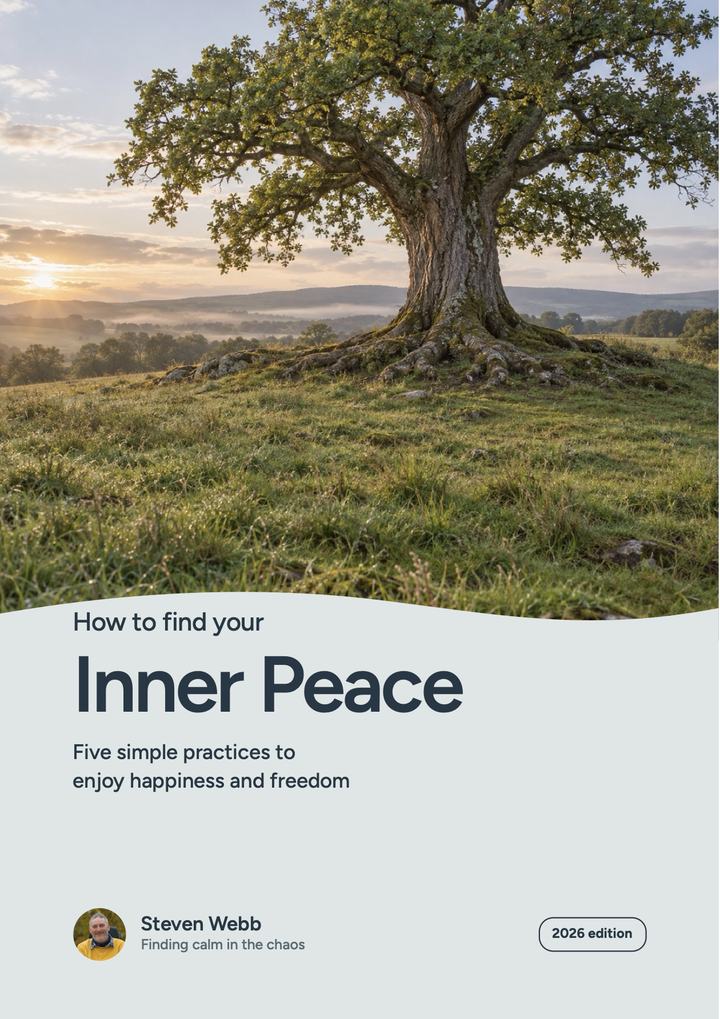
Join and I will send you my book, 5 Simple Practices for Inner Peace. Free, and yours to keep.