0:00 Ask almost anyone how they are this week, then listen to the first word they say.
0:07 Most I've spoken to have said this week they're tired.
0:13 Not sleepy, not the kind of tired that after a long walk or a run or a day in the garden, but world-tired.
0:24 Mentally tired, I suppose.
0:27 The kind that a night's sleep doesn't even touch So the last time we talked about the news and how to
0:35 care without drowning.
0:37 This time, I want to ask a bigger question, the question underneath it: Why is everybody so damn tired
0:45 at the moment?
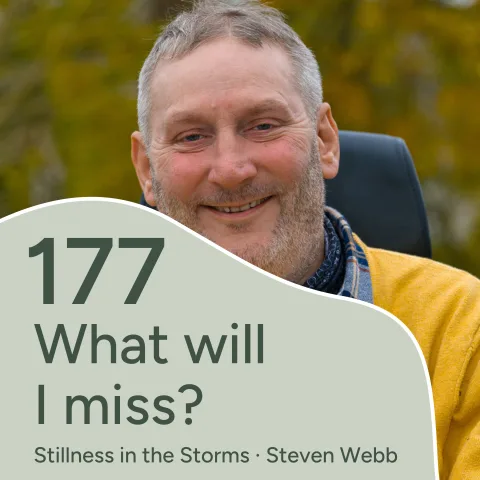
0:47 Hi, I'm Steven Webb, and this is Stillness in the Storms, the podcast that helps you through difficult
0:53 times.
0:53 This is really part two of A Tired World.
0:57 Part One was about the news, and if you missed it, you can just go back one episode.
1:02 And today, I'm going to use the word I don't think I've used on this podcast.
1:09 And I'll tell you what that word is a little later.
1:12 Do you know what?
1:13 First of all, you're not imagining it.
1:17 In America, the CDC asked adults how often they felt very tired or exhausted in the last three months.
1:26 More than seven in ten of them said yes, at least some days.
1:31 And about one in six said most days or every single day.
1:38 In Britain, a charity called Mental Health UK asked about stress.
1:43 Nine in ten adults said they felt high stress or extreme pressure or some kind of stress in the past year.
1:52 Nine in ten.
1:53 Some of you are tired for body reasons.
1:56 An illness, a pain, poor sleep, looking after someone, grief.
2:01 That's real.
2:03 but this talk isn't saying it's all in your head.
2:07 That's a slightly different thing.
2:09 If you've been worn out for weeks, please go and see a doctor.
2:13 What I'm talking about today is the extra tiredness, the kind the world piles on top.
2:21 So why now?
2:23 Well, there was a writer called Alvin Toffler, and it was back in 1970, before I was born, he wrote a
2:31 book called Future Shock And what he said is, "When things change too much, too quickly, people get worn
2:41 out."
2:41 And that was in 1970.
2:44 Nobody had a phone in their pockets.
2:47 Nobody had 24-hour news then.
2:50 Nobody had a constant connected world.
2:53 Now think about this year.
2:56 Prices, work, computers that can write and draw and talk and talk back to you, and, you know, we've got
3:04 the strange weather, we've got angry politics, we've got...
3:08 And then you have the personal things, your bills, your work.
3:12 Ugh, it just, everything adds up.
3:15 Your car breaks down, and you got a birthday to organise.
3:19 It's just...
3:20 I only say a birthday to organise because I met my daughter yesterday, and she said, "We've got to organise
3:27 Koa's birthday."
3:27 So we're gonna do that.
3:29 If you're listening to the podcast, Kim, I have emailed the town clerk about renting a space.
3:36 But there's also those 10 jobs on your to-do list that you haven't done.
3:41 Any of those we could cope with.
3:45 All of them, all at once, all year is a lot.
3:50 We can't do it.
3:51 And here's the part that's easy to miss.
3:53 You don't have to be rushing about to be worn out.
3:58 Your body can be on the sofa, and your mind can still be on its feet, rushing around.
4:04 Keeping watch, checking the road ahead, what's coming next, what if it goes wrong?
4:10 The watching never clocks off anymore, and it's tiring, even when you're sitting still doing nothing.
4:19 There's a polling company called Ipsos.
4:21 Since 1997, they've asked people in Britain if they fear that new technology is destroying our lives.
4:30 This year, more than six in 10 said yes.
4:34 The highest it's ever been.
4:37 So it isn't only you.
4:40 There's a lot of us that are bracing ourselves.
4:43 You know, just with the AI, it's just you can't keep up.
4:47 And I'm trying to embrace it, but I just can't keep up.
4:52 It's too much for me.
4:53 And there's one more sneaky thing.
4:56 Being busy works a bit like a painkiller.
4:59 While we rush about, we can't feel how tired we are.
5:04 Then we stop, and then it all arrives at once.
5:07 I think that's why so many of us just, we just don't dare to stop.
5:13 If we do stop, we think it's just gonna pile up behind us, and we're just terrified of doing it.
5:20 So there's the answer, all three parts of it.
5:24 Too much is changing too fast.
5:27 Our minds never come with an off switch, and we stay busy so we don't have to feel it.
5:34 So what do we do?
5:36 Slow the world down?
5:37 Well, I've got a meditation for that.
5:40 You know, stop the world, I wanna get off.
5:43 We can't.
5:45 I've often really wanted it.
5:46 If there was such a superpower, the superpower that I want is to freeze the world, let me catch up a little
5:53 bit, and then unfreeze the world once I've just caught up.
5:56 You know, even if it's just a simple, "Let me catch up on my emails."
6:01 somebody says to me now at work or someone, "What are you doing at the weekend?"
6:04 And I say, "Well, I got a quiet weekend."
6:08 And they go, "Oh, that's good.
6:09 What you doing?"
6:10 "Catching up on emails."
6:12 Yeah, that's my quiet weekend.
6:14 And I think we're all the same.
6:16 We're all, just trying to catch up with stuff.
6:19 We're spending our lives fully on catch up at the moment.
6:23 And years ago, you took 100, 150 years ago, they would come in from the farm or come in from what they
6:29 were doing and work, and they didn't have the TV, they didn't have these other things, so they sat down
6:34 and read a book.
6:35 They sat at the table, they had a conversation, they stopped and they rested.
6:39 They went for a walk.
6:40 They took notice of nature.
6:42 We just don't seem to be doing any of that anymore So what do we do?
6:48 Slow the world down?
6:50 We can't, like I've just said.
6:52 And I've talked about a rest a lot this year.
6:57 Rest is good.
6:59 Rest matters.
7:00 But today I want to try something different.
7:03 So here's the word awe, A-W-E.
7:08 Awe is the feeling when something is so big or so beautiful or so good that you just stop and stare.
7:17 Your mouth falls open a little, you go quiet, and you feel small in a good way.
7:25 You know, whether it's the night sky or the sea or a massive field, you're like, "Ah, I'm just here."
7:33 The storm over the water, you know, those kind of things.
7:36 Why would that help a tired mind?
7:39 Well, because when we feel small in a good way, our worries get smaller, too.
7:46 For a moment, they don't vanish, but they stop filling the whole room.
7:53 Scientists have been looking into this for a long time.
7:56 One of them, Dacher Keltner, collected stories of awe from people in 26 countries, 2,600 of them in total.
8:07 I didn't finish the book, but I finished a lot of them.
8:11 And what was the most common thing that it brought out?
8:16 Not mountains, not sunsets.
8:18 Other people, their kindness, their courage And there was a study in America in 2020.
8:25 60 older adults, once a week for eight weeks, they took 15-minute walks, and they were asked to look at
8:32 things that filled them with wonder.
8:36 And as the weeks went by, they felt more joy and less everyday worry And if I remember, they took selfies
8:43 too.
8:43 And as the weeks went by, they took up less of the picture and they smiled more.
8:49 They showed more of the world behind them.
8:53 Now, it was a small study.
8:55 I'm not saying it's magic, but I think it's telling us something Now, and I know a little about this and
9:04 a little bit about awe.
9:06 When I broke my neck, I spent months indoors, the same ceiling, the same ward, no fresh air at all.
9:13 And then the very first time that I was actually got out of bed, I was only out of bed for 15 minutes.
9:19 That's all I was allowed.
9:20 And they pushed me outside.
9:24 I wanted to stay out way longer, and they pushed me outside, and it was, I think it was late.
9:32 it was really cold anyway.
9:33 I can't remember exactly which month it was off the top of my head.
9:36 And I went outside and all I could see in front of me was a car park.
9:41 But the cold air on my lungs, that was like, wow And in that moment, the worries of being paralysed for
9:50 the rest of my life, the worries of I'm not gonna walk, what's gonna happen?
9:54 How's my life gonna be?
9:56 Just all vanished.
9:58 And for days and weeks, that moment stayed with me.
10:02 I wanted more of that moment And I went back to bed on cue, I think it was about 20 minutes, and I was
10:11 ready.
10:12 I went back to bed, and I slept for 24 hours.
10:16 It was the first time that I truly relaxed, albeit I've been lying in bed with a mind racing for months
10:24 and months and months.
10:27 Yeah.
10:28 Find that awe moment sometimes, even if it's just seeing a butterfly land somewhere.
10:33 Even if it's just, you know, seeing a, wave break or whatever's near you.
10:41 Find that awe moment And I think what was more magic about that is that it was a car park, but the air
10:49 was crisp and the sky was blue, and that feeling.
10:53 So it doesn't have to be anywhere amazing, or it doesn't have to be a mountain or a lake And just a another
11:03 quick one.
11:04 In the museum in Truro, there's some gold necklaces made 4,000 years ago right here in Cornwall.
11:12 Every time I see them, I'm a trustee of a museum, so a bit of a plug here, but every time I see them,
11:18 they're so ornate and beautiful, I just think, 4,000 years ago.
11:22 That's 2,000 years before Jesus.
11:24 Come on.
11:25 If that doesn't strike you as something incredible I'll post a picture.
11:31 I'll send the picture in my Weekly Calm this week because that's something special And it's these little
11:39 moments that you remember as time goes on.
11:43 This podcast's moved to little moments, but it's really important.
11:49 And remember that Dacher Keltner found the most common awes were from other people The time someone's
11:58 kindness was kind, someone that smiled, someone that opened the door, someone that pointed something out.
12:06 We don't have to climb anything.
12:08 We can just notice sometimes a neighbour carrying someone's shopping, a stranger holding a door, someone
12:17 who keeps going with a smile when you can see that it's hard.
12:22 That counts, too.
12:24 That's awe, too So now the practice.
12:27 It takes one minute, and you can do it today.
12:31 Pick one thing that's bigger than you.
12:35 The sky, the sea, an old tree, the stairs of an old building.
12:40 Whatever it is, go and find it.
12:42 Can't get out?
12:43 That's fine.
12:44 Look out of a window Or just find a patch of sunlight and watch the dust floating You know, even the dust
12:52 jump around in a little shiny bit of light A tiny speck of dust dancing in the sun is an amazing thing
13:00 if you just let it be So just one minute That's your task this week.
13:05 That's what I'd like you to do.
13:07 And let me know in the reviews or let me know by messaging me.
13:11 I always read them all.
13:12 And wherever you are, just look up or look out and find that, something that's a bit bigger or older or
13:24 finer, and just let it be.
13:28 You don't even have to name it.
13:29 Don't fix it.
13:30 Don't do anything about it.
13:32 Just look But notice how small you feel next to it.
13:38 It's not about feeling insignificant.
13:41 It's about seeing the big picture and seeing how incredible it is beyond all the politics and the bickering
13:50 and the worries and the things you gotta do, your little to-do list And then you can ask yourself, what
13:57 do this week's worries look like compared to this?
14:01 It might not shrink or it might not make a huge difference, but in time it will.
14:08 And Marcus Aurelius, the Emperor of Rome, just what, nearly 2,000 years ago, he notes to himself in his
14:14 Meditations, and we still read them today.
14:17 I love his book.
14:18 And if you're gonna pick up the Meditations, pick up the Gregory Hays translation.
14:23 It makes it so much easier.
14:24 But in Meditations 4.24, he says two lines from the same passage.
14:31 He wrote, "Most of what we say and do is not essential.
14:37 Ask yourself at every moment, 'Is this necessary?'" The irony.
14:43 I'm here talking into a podcast now, but it's true.
14:47 He wasn't saying stop.
14:50 He wasn't saying do less.
14:52 He was saying do it better.
14:55 We can't slow the world down, but we can choose what gets our attention.
15:01 And even if it's only for a minute Look, before I go, thank you.
15:09 This stays free 'cause of a few people that buy me a coffee or give a little each month.
15:15 Thank you to Kasia, Jane, Christine, Danielle, Lindsey, Katherine, Vicki, Fiona, Rebecca, and Lorna.
15:23 You're all awesome.
15:24 Thank you very much.
15:25 And there's a few anonymous supporters.
15:28 Thank you to you, too.
15:29 And a warm welcome to Raquel and Jane.
15:32 You've become monthly supporters.
15:35 And I do have to give a little shout-out to Jenna and Mia.
15:41 You've just raised yours, so thank you so much.
15:45 You're all awesome.
15:46 You're awesome for just listening and getting this far in the podcast.
15:52 You know, it wouldn't be here without you, and it'd be full of adverts or not exist.
15:58 So...
15:58 And if you'd like to join them or just fancy sending me a message with an idea of a podcast or anything,
16:04 just go to stevenwebb.uk, spelt with a V.
16:09 There's courses there, too, that you can choose how much to pay.
16:12 And I've been working on a new course for a while now, but it's nearly ready.
16:18 And here's the thing I'd like you to try this week.
16:21 Just spend one minute occasionally.
16:22 Just find something and you go, "Wow."
16:26 Find something you're in awe of.
16:29 Look out for something big or old or just something kind, and let it be big.
16:36 Let it be the big occasion.
16:38 Let it fill your heart with what it is.
16:43 So when the world feels too loud, you'll have somewhere to go just one minute away And if you'd like some
16:51 company with that, this meditation that goes with this one is Wisdom Within the Storm.
16:56 That's out on Inner Peace Meditations.
16:58 Have a listen just when you can So here's my question for you this week.
17:05 What's the last thing that made you stop and stare?
17:10 I'd love to know.
17:12 Reply on this video or reply on the podcast, or anywhere in your comments on Spotify or in the reviews
17:21 on Apple.
17:23 We can't slow the world down, but we can let it be big in a good way.
17:29 And sometimes the big world is the very thing that makes our worries small enough to carry And finally,
17:37 if this does help at all, send it to someone that looks a bit worn out this week or someone that when
17:42 you asked how they were just said, "I'm tired."
17:46 Take care of yourself and each other, and I love you