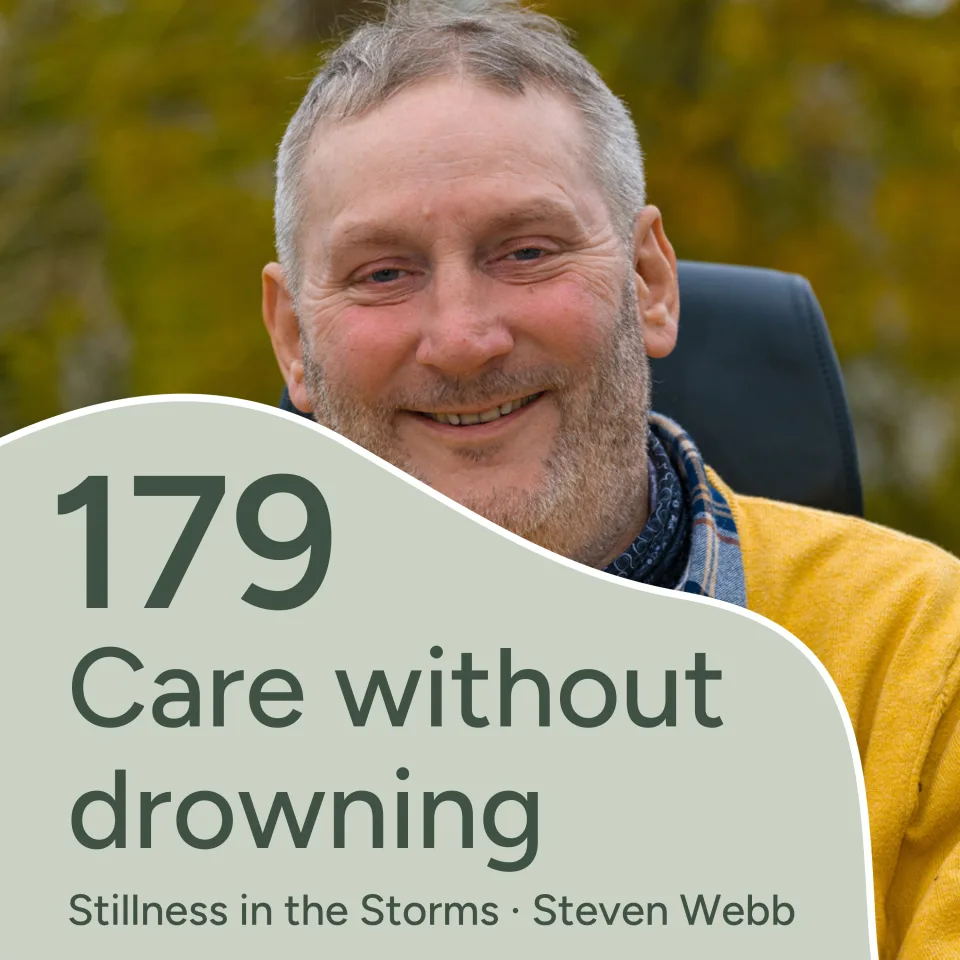
Episode 179 · 4 October 2026 · 14:25

Overwhelmed by the News: Caring Without Drowning

How do you care about what's happening in the world without it dragging you under? Practice first, news second. Then do one small thing and put it down.

Subject: Anxiety, Overwhelm & Stress, Love, Empathy & Other People

Apple Podcasts Spotify

Stillness in the Storms · Episode 179

How do you care about what's happening in the world without it dragging you under? Practice first, news second. Then do one small thing and put it down.

Support me with a coffee and join my Weekly Calm every Sunday: stevenwebb.uk

The night I broke my neck, I only had to get through the next breath. My family were stood in the corridor with nothing to do, not knowing if I'd see the morning. That's the harder seat, and now we're all sat in it, every day, on a phone. Our hearts were built for a village, not 24 hour news. After the Boston bombing, people who watched six hours of coverage a day were more stressed than some of the people who were actually there. I'm a terrible news junkie myself, so I talk about the feed I keep deleting and putting back, Sid Owen from EastEnders, and why the brain can't tell the telly from a war zone. Underneath the anger there's usually a deep caring. The way through isn't caring less.

One thing to try: Before you scroll in the morning, sit quietly for ten minutes and write a small gratitude list. Then read the news, let yourself feel it, do the one small thing if there is one, and put it down.

In this episode

  • (0:03) The night I broke my neck, and my family in the corridor
  • (1:31) Our hearts were built for a village
  • (2:07) The Boston bombing study: six hours of news a day
  • (4:50) The brain can't tell the telly from a war zone
  • (6:14) Caring without drowning: what you can do at arm's length
  • (7:32) Under the anger there's a deep caring
  • (9:51) Rabbi Tarfon: you can't finish the work, but you can't walk away
  • (10:55) Thomas Merton and the frenzy of the activist

With gratitude to

Tamsyne, Bridie, Orsolya, Paul, Ciaran, Cynthia, Sarpa, Jens, Linda and Genevieve

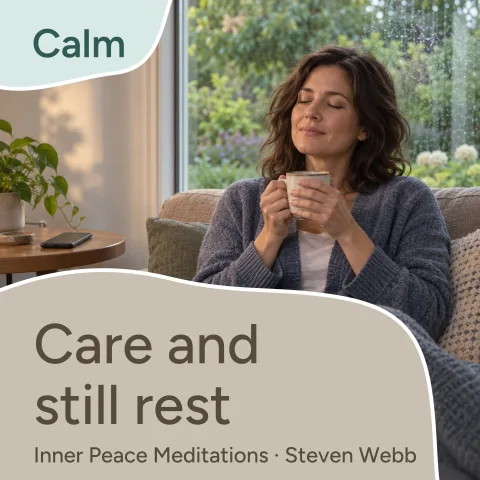
The companion meditation: When the News Is Too Much: A Meditation to Care and Still Rest

Support the podcast and join the Weekly Calm: stevenwebb.uk

Thank you for listening.

Steven

The question this answers

How do I keep caring about what's going on in the world without being dragged under by the news?

The night I broke my neck, I only had to fight for the next breath, or the next ten minutes. My family had it worse. They were on standby in the corridor, not knowing whether I'd survive the next hour. Helpless. I think the sidelines are the hardest seat, when you can't do a thing to help.

That's where we've all got to now. Every day, on a phone, with the world going to pots and very little any of us can do about it.

The heart of it

  • Your heart was built for a village. A few friends, fifty, sixty, a hundred people at most, and the news was the wise elder saying what's going on. Now it comes 24 hours a day.
  • Your brain can't tell the telly from the real thing. After the Boston bombing, people who watched six hours of coverage a day were more stressed than some of the people who were actually there.
  • Feeling someone's pain in your own body, hour after hour, wears you right out. Caring that does something tends to lift you instead.

I'm a terrible news junkie. I've deleted the news feed on my phone several times, and a few weeks later it's back on. Then I'm scrolling for half an hour in the morning, asking what I'm even looking for. Something to pick me up, I think. It knows what winds you up, and it feels like you can't escape it.

I walked past Sid Owen from EastEnders once, in London. I said, "All right?" and he said, "Yeah, all right." Only afterwards did I think, oh wow, that's Sid Owen. I don't know him at all, but it felt like a friend, because I see him on the telly every day. The brain doesn't know it's a TV, or that a war zone is on the other side of the world.

Underneath the anger at the news and all the doom scrolling, there's usually something quieter. A fear, a sadness, and under both of those, a deep caring. That's why we watch. It isn't a bad thing. It only becomes one when it brings us down.

Practice first, news second.

Caring without drowning is remembering what you can do at arm's length, with what you have. Some days a smile, or a "Hi, how are you doing?", is enough. It may be all the energy you've got, and that's allowed. You'd be surprised how little good acts of kindness make a huge difference.

There's an old rabbi, Rabbi Tarfon, with a line I remember. You are not obliged to complete the work, but neither are you free to walk away from it. You're not going to sort the war out. You're not going to lower the gas prices. Your vote isn't going to change everything overnight. But that one small, real thing nudges the needle, and enough of us doing it every day makes a huge difference. Keep it about the load people are carrying, not which side they're on. The load is enough.

The frenzy of the activist neutralizes his work for peace.

Thomas Merton

It doesn't mean you don't act. The frantic doing, the doing that comes from panic, cancels itself out. Slow down enough to actually help. That's not the same as not caring. It might actually be what caring looks like.

One small thing to try

Practice first, news second. Before you scroll in the morning, sit in quiet for ten minutes. Write a small gratitude list, or journal a little bit. Then, when you do come to the news, read it and let yourself feel it. Do the one small thing if there's a thing you can do, and put it down if you can't. I'm going to try the same.

There's a meditation that goes with this one, When the News Is Too Much, on Inner Peace Meditations, if you'd like some help with the putting it down part.

Questions people ask

Why does the news make me so anxious when I can't do anything about it?

Because your heart was built for a village, and now it gets the whole world, all day. The brain doesn't know the difference between the telly and the room you're in, so a war zone on the other side of the world feels like it's next door.

Does caring mean I have to feel everything?

No. There's a difference between feeling someone's pain and caring about them. Taking it into your own body hour after hour wears you out. Caring that does something, even something small, tends to lift you instead.

What can I actually do if I can't fix any of it?

Start at arm's length. A smile, a "Hi, how are you doing?", a kind word to the person in front of you. Then the one small, real thing that's yours to do, and put it down. You were never going to sort the whole thing out, and you don't have to.

Do I have to stop following politics to protect myself?

No. I'm a politician, so I'd say that. I think more people should be into politics, spiritual people included. You can't avoid it, but you've got to do it in a way that doesn't bring you down.
Read along

The transcript

It follows the audio. Press any line to jump there.

overwhelm · politics · compassion · stress · gratitude

Read the transcript

The night I broke my neck and ended up in a hospital bed and then

going to theater and having my halo drilled into my head and me

just trying to fight to survive that night.

It seems like it would have been a terrible night for me and

it wasn't the best.

But for me, I only had to fight for the next breath or the

next 10 minutes.

For my family and those around me, it was awful.

They were passive.

They couldn't do anything about it.

They were just on standby in the corridor not knowing whether

I'd survive the next hour.

They must have felt helpless.

They must have felt, you know, useless in the moment.

It must have been awful.

And I think it largely is for the people that are on the sidelines

that are not able to help.

And I think that's the place where we got to in the world now.

We are all now sat in that sidelines.

We're all now in that corridor with the world going to pots in that

theater and there's very little we can all do.

And it's a difficult place.

It's a difficult seat to have.

Hi, I'm Steven Webb and this is Stillness in the Storms.

This is part one of two, a Tired world.

And this one's caring without drowning.

Now look, let's be honest.

Our heart was built for a village.

It was built for a community.

It was built for just a few friends.

Whether a cow got sick or whether someone gave birth or someone

passed away or someone fell out with someone.

It was, you know, maximum fifty, sixty, hundred people.

And the news was just the wise, elder maybe just saying what's

going on?

And that's what we evolved to have.

That was the news.

Now we've got news 24 hours a day, literally.

And there was a study in the Boston bombing where they asked people

years ago about how much it affected them.

And the people that watched it for six hours a day were more stressed

and more affected by it than the people that are actually there

and experienced it.

And that makes total sense to me now.

The 24 hour news cycle is just relentless.

It pops up on your phone, the scrolling, you get to the bottom

of the page.

You used to, but now it loads a new page in, it's loading before

you get there.

It knows what your pause on, it knows what your triggers are,

it knows what you like or dislike primarily.

It knows what winds you up and it almost feels like we cannot escape

from it.

I've deleted it on my phone, on the Samsung, if you swipe to the

left on the home screen, you get A news feed.

And I've deleted it several times.

I've disabled it, and then a few weeks later, I've put it back

on.

I find myself just scrolling endlessly through it for half an

hour in the morning.

And then I think I filled my mind with all of that, but it's almost

addictive.

What am I looking for?

I'm looking for something that's gonna pick me up now.

Am I looking for some bad news against Trump where the Supreme Court

rules against him?

I don't know.

But I remember before I broke my neck, and it's almost like the

timeline is before and after, but I remember I was being picked

up on the way to work behind the fish counter.

David lobbed.

My boss at the time, I worked at a local Tesco store and he picked

me up and he had the radio on and this was like 5 o' clock in the

morning.

And I said, what's going on?

He said, well, we've just gone into Iraq.

Okay.

Didn't really know much about it, but there or Iran or something

like that, it was something down there.

And I just heard about it on the radio on the way down, but then

that was about it.

We didn't hear about it the rest of the day until the 6 o' clock

news in the evening.

And then when we went in the next time, when we were.

It was 24 hours a day.

It was literally Sky News was there all the time, every hour, repeating

the same things from the hour.

And it almost felt like it was in our living rooms and we couldn't

tell the difference whether we were in the war zone.

The brain doesn't know.

It's like when I was in London and somebody from sid Owen from EastEnders

walked past me and I went, all right.

And he went, yeah, all right.

And it wasn't until after he walked past me that I thought, oh,

wow, that's sid Owens from EastEnders.

I don't know him at all, but it was like, it's a friend, because

I see him daily on the tv.

It was like I knew him.

It's so strange.

But the brain doesn't know it's in a tv.

It doesn't know that you sat there is not your friend from the

village.

So it doesn't know that war zone is the other side of the world.

And yes, it affect us.

And that's why it's so difficult dealing with these things

nowadays.

It's recognizing that we did not evolve for this.

And I am a terrible news junkie, but that's bad on me.

I know how much it affects me and how much it does my blurry head.

And I'm into politics because I'm a politician.

That's my other job.

And I think more people should be into politics and spiritual people.

You cannot avoid it, but you've got to do it in a way that

doesn't bring you down.
The Caring Without Drowning was this podcast is about, but it's

remembering what you can do at arm's length with what you have.

And some days just to smile, just hi, how are you doing?

Is enough.

That may be all the energy you've got, that may be all the capacity

you've got.

Some days, other days you may be able to do a bit more.

It really doesn't matter.

We're all being judged, we're all judging, we're all doing all

that we know we're all doing all those things.

At the end of the day, it doesn't matter as long as you can

put your head down and go, do you know what?

I did my bit today.

And you'd be surprised how much that nudges the needle.

You'd be surprised how little good acts of kindness or little things

you do make a huge difference.

You don't know how far that smile goes.

You don't know if that one person that you hold the door for

say hi or you treat to, I don't know, a cup of tea or something.

You don't know whether they go home and they go, do you know what?

I've had a nice day today.

And they're so much happier at home.

And then that's a knock on effect to the kids and a good night's

sleep and they have a good day.

So yeah, and I think underneath all the anger at the news

and all the doom scrolling, there's usually something quieter.

A fear, a sadness.

And under both of those there's something that's easy to

miss.

A deep caring.

A deep caring, actual caring.

We actually care about people.

I think that's why we watch the news, because we care about what's

actually happening.

It's not a bad thing.

We should look at the news as a bad thing.

But when it brings us down, when it's too much and there's a

difference between feeling someone's pain and caring about them.

Feeling the pain, taking it into your own body hour after hour,

where is you?

Right out.

But caring and really caring, the kind that does something, tends

to lift us instead.

So the way through isn't less caring, it's finding the middle way.

Practice first.

Use second.

And I know that when someone just looks up and asks me how I'm

feeling or someone just gives me a compliment sometimes that's

really enough to make a difference in my day.

In the WhatsApp group we got for donators, which I'll put a link

if you treat me to a coffee.

You'll get a link in the email to our WhatsApp group.

We're going through the monthly practice this month is every

evening.

We just put one gratitude in.

It's amazing a how many of us have got the same things we're grateful

for how connected we are all over the world.

And it's amazing how the big and little things really do make

a difference.

I never realized I was so grateful for so many things.

We're like halfway through the four weeks and that's like 14, 15

things that I'm grateful for that I don't think about on a daily

basis.

But I'll say more about the people that help this podcast in

a moment.

There's an old rabbi, Rabbi Tarfin.

He has a line that sometimes I just remember and it says, you are

not obliged to complete the work, but neither are you free to

walk away from it.

You don't have to fix the whole thing.

You are never going to.

It's not realistic.

You're not going to sort the war out.

You're not going to lower the gas prices.

Your vote isn't going to change everything overnight.

But that one little small thing, the real thing, it just nudges

the needle.

And enough of us do that on a daily basis.

It makes a huge difference.

And keep it about the load people are carrying, not about which

side they're on, not what side you're on.

The load is enough.

And we're all carrying it, whether it's politics or whether

it's anything else.

It doesn't matter what side you're on, you're carrying the load.

Thomas Merton wrote this.

The frenzy of the activist neutralizes his work for peace.

And it's true.

If you're running around everywhere and you're fixing everything

and you've been an activist about everything and you're doing

everything, where's the peace?

What are you really creating?

And I think that's worth remembering.

It doesn't mean you don't act.

The frantic doing and the doing that comes from panic cancels

itself out.

Slow down enough to actually help.

That's not the same as not caring.

It might actually be what caring looks like.

Before I go on and wrap up, I just want to Say this stays free

because of a few people buying me a coffee and some give a little

each month.

Say thank you to all of you this week.

The coffees come from Tamsin, Bridie, Ursula, Paul, Kieran and

Kelly, Cynthia and Sapa.

Thank you.

There's a couple of anonymous thank you to you too.

Thank you to the donators on Inside Timer and thank you to Jens,

Linda and Genevieve for your donations on PayPal.

Really does make a difference.

The costs go up all the time with the more listeners.

But that's brilliant.

So do the donations.

You guys are brilliant.

I love you guys.

Thank you.

And there's a new monthly supporter this week as well.

Thank you to whoever you were, you were anonymous.

And to all of you, you know, really appreciate it.

If you fancy, buy me a coffee.

It's all [email protected] of course there's courses, there's a

weekly Calm, which is my Sunday newsletter.

But here's the one thing you can try this week.

Practice first, news second.

Before you go scrolling in the morning, just spend 10 minutes sitting

in quiet.

Just write a small gratitude list, just journal a little bit.

Just choose not to scroll as far as just be mindful and I'm going

to try to do the same.

And when you do come to the news, read it, let yourself feel

it.

Do the one small thing if there's a thing you can do, but put

it down if you cannot.

And there's a meditation to go with this one.

It's called when the News is Too much.

And that will be linked below.

It's on inner peace meditations.

Now, if you'd like some help with the putting it down part.

So here's my question for you this week.

What do you do when the news gets under your skin?

I'd love to know.

Reply on the website or in the comments on Spotify or in the reviews

on Apple.

If this did help, share it, like it, review it.

I love honest reviews.

Someone who's been doom scrolling a bit too much lately.

I need to do this podcast.

Take care of yourself and each other.

I love you.

Weekly Calm

One calm email.
Every Sunday.

A little space to pause, a practical thought to take into the week, and a reminder that you’re not doing this alone.

Join and I will send you my book, 5 Simple Practices for Inner Peace. Free, and yours to keep.