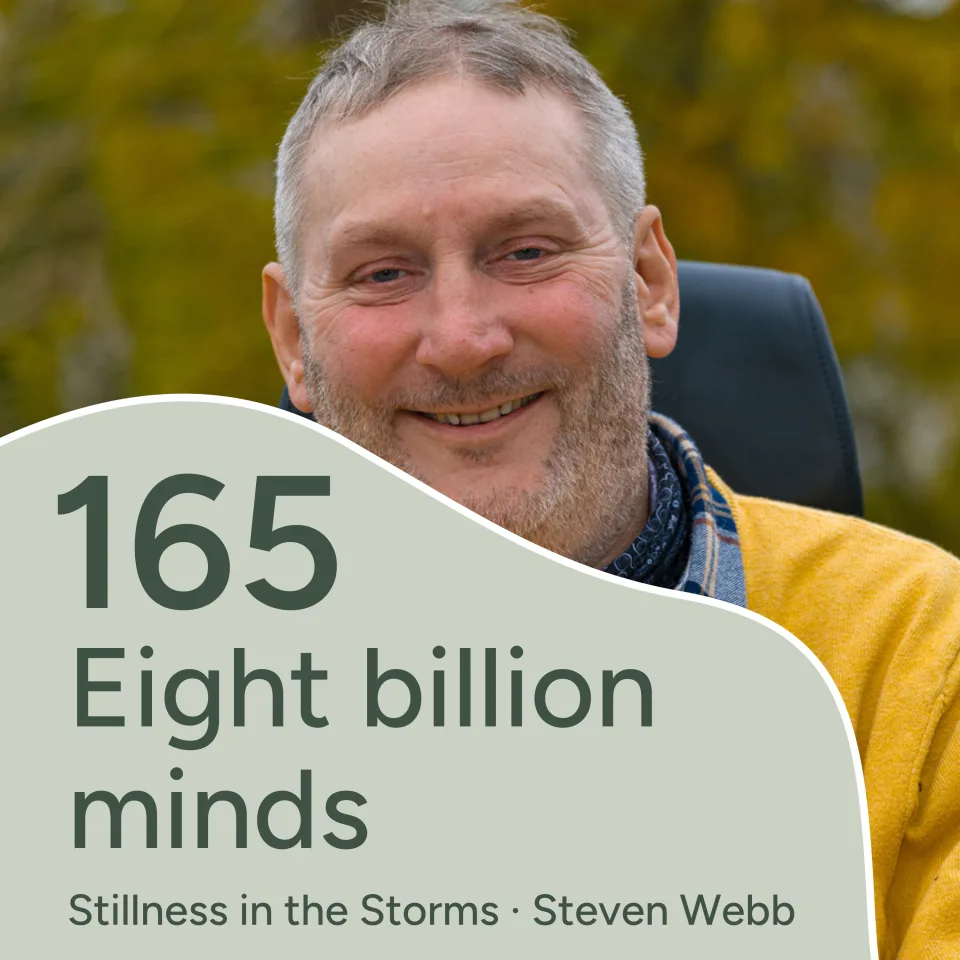
8 Billion Minds. Why Meditation Doesn't Work for Everyone (And What You Can Do About It)
Why does meditation work for some people and not others? Eight billion minds. You can only write the book from the altitude you are actually standing at.
Why does meditation work for some people and not others? Eight billion minds. You can only write the book from the altitude you are actually standing at.
My chair broke and I could not do anything. That is a lifeline gone, and a friend had to come and push me out to the van. In the weeks after I read a hundred and twenty year old book by James Allen saying you are not your thoughts. Sometimes I need to think something through and I will go into a story deliberately. Other times there are gaps between the words.
One thing to try: Stop asking whether you are doing it right. Ask what works at your altitude.
In this episode
(0:03) Eight billion minds, and why one method cannot fit them
(2:35) You can only write from the altitude you are at
(4:50) The chair breaking, and losing the lifeline
(7:10) Reading James Allen, and you are not your thoughts
(9:54) Going into a story deliberately, and the gaps between words
With gratitude to
Suzanne, Maria, Michael, Tiffany, Ellen, Kathleen, Edyll, Nicola, Jess, Lynette, Linda, Laura and Yavuz.
Why does meditation work brilliantly for some people and do nothing for you?
Somebody hands you the book that changed their whole life. You read it and get almost nothing from it. That is not you failing, and it is not them lying.
The heart of it
Every book and every teacher speaks from the altitude they are standing at. They can talk down the mountain. They can only guess upwards.
Your mind is wired the way it is wired. You can widen the road you are on. You cannot swap it for somebody else's.
It is easier to accept yourself than it is to change eight billion people. Trust me, I have tried.
I spent years trying to get the world to fit into my box, on the basis that once everybody was in it I would finally be comfortable. I did not manage it with one person.
You can only write a book from the altitude you are at.
I am doing exactly that here. This is the view from where I am standing. If somebody higher up points into the distance and tells me there is another mountain over there, I can nod, but I am not going to see it.
None of the obvious things put me on the floor. Not the broken neck, not the bankruptcy, not being cheated on. What did it was my chair breaking in town at forty. My chair is how I get out. Credit cards maxed, bankrupt already, so no way to fix it. A friend came and pushed me out to the van. Before that I sat in a busy doorway in Boots on a Saturday afternoon and bawled like a two year old, and a security guard came over, said nothing at all, and squeezed my shoulder. That still gets me.
For two weeks after, I felt nothing. I was not working anything out. I was just watching, like one long accidental meditation. When the thoughts came back they were unbearable, and I started drinking myself to sleep, and then reading instead. A hundred and twenty year old book by James Allen, one word at a time, rereading paragraphs over and over because I am dyslexic and had not read a book since school. And what it said was that you are not your thoughts.
If one book tells you to meditate, fine. When thirty of them do, you are the person in a windowless room with nine people saying it is raining outside.
I have ADHD, and telling my mind to be silent works about as well as telling children in the back of a car to stop laughing. So I found other ways in. Sometimes guided. Sometimes staring at a leaf. Sometimes going into a story deliberately.
One small thing to try
Stop asking whether you are doing it right, and ask what works at your altitude.
Then push the edge of it, gently. If a minute is your limit, go to two. Neuroplasticity is real. The people in the long studies who took up music at twenty grew the same bit of brain as the ones who started at five.
Questions people ask
If I cannot sit still, is meditation just not for me?
No, it means sitting still is not your way in. Guided, walking, one minute at a time, all count. The bringing back is the practice, not the posture.
Does this mean I will never be a good meditator?
You can get a great deal better. What you cannot do is become somebody with a different mind. Widen the road. Do not try to change roads.
Is it worth reading self help books at all?
Some. I have said before that you would do better sitting on the pile and spending five minutes a day working out how your own mind runs.
Read along
The transcript
It follows the audio. Press any line to jump there.
meditation-how-to · mindfulness · acceptance
Read the transcript
So, 8 Billion Minds. Why meditation doesn't work for everyone and what you can do about it on today's
podcast. Hello, I'm Steven Webb and welcome to Stillness in the Storms. The podcast that helps you to find peace
even in difficult times. No fluff, no quick fixes. Just honest and down-to-earth wisdom from someone who
lives it every day.
so last week we went back to basics. This week, I want to say something about what sits right
next to that because we are all different, I've grown up for so many years trying to
change the world into who I am without even realising it that I had the answers, I had the common
sense, meanwhile, I didn't, I knew I didn't have all the peace and quiet. I knew I did not have
everything sorted. But meanwhile. I was trying to convince 8 billion people to think and be like me and to
fit into my box because as soon as everybody fitted into my box, I would then feel comfortable and life
would be a damn sight better for me I laugh about it now, and it's, do you know what? It's
easier to accept yourself than it is to change 8 billion people. Trust me, I've tried. It's hard work and
I don't think I managed with even one person. So there you go. If you're still trying to change the
world, good luck. It's a long, hard slog. So
why does meditation work beautifully for some people and it doesn't work for other people? And
why does one teacher work for one person? Another teacher work for another, and someone will give you a link
or give you a self-help book and they'll go, it's brilliant. It's done everything. It's changed my whole life. And
then you read it and you go yeah no, didn't get much from it. And I always say the more
self-help books you read, you're better off just putting a pile of them sitting on them and work out how
your mind works. Because if you do that for five minutes a day, that'll be better than 10 000
self-help books. And there's a reason for that because every self-help book is wrote. And every teaching memoir is wrote
from the altitude that author is at that time. And they could be amazing psychologists, psychiatrists,
they could be the best doctors. They could well be way higher than you, way
lower at the altitude. But what is true for all of them is that you can only write a book
from the altitude you're at. You might be able to communicate with those below you. But you can only hazard
a guess at those above you, and that's just the reality of it. The same as this podcast, same as
me talking to you, I can only give you my reflection from where I am. I'm so far up the
mountain. My viewpoint is what I can see? If someone up the top of the mountain says, Steven, look over
there, look in the distance. There's a nice something, there's a different mountain. No matter how much I try, I'm
not going to see that mountain. I could visualize it. I might be able to have some kind of vague
idea, but I'm not going to see it. And the same as if you go down lower, you're going to
see even less. So I think this is really important. Going slightly off topic now from the meditation side.
So what got me into meditation? I've told the story a couple of times, but I think it's really important
because I think you'll relate to it.
So I did despite everything that gone through in my life, my broken neck and.
Being cheated on going bankrupt. I lost my friend in my 30s I don't tell you all them because
I don't think my life is much different than most people's, but none of that made me hit rock bottom,
even becoming paralysed. What
made me hit rock bottom was one day in town and my chair broke, and my chair's broke more times
than I can imagine It broke down today twice
and. But we did sort it and I've got to get hold of call more mobility tomorrow because my chair's
broke again. Anyway, off topic again. So I hit rock bottom at 40 and I
was in town. The chair broken down. I had no money. My credit cards were to the top. I was
bankrupt at the time and I had been bankrupt a number of years before, so I couldn't borrow. I couldn't
do anything. And my chair is my lifeline to get out. I managed to get hold of a friend and
they come down and they push me out to the van push me into it, and come home. Luckily, that
friend was a bit of an engineer and he could help a little bit,
and I remember sat in the busy doorway. I literally pulled my eyes out. Saturday afternoon,
I was in boots. It's a, like a well-being store, a really big superstore in the uk.
And there was a security guard stood on his little higher platform near the door and he walked over and
he grabbed on my shoulder and
he didn't say a word. I don't think he knew what to say. There was this 40-year-old in a wheelchair
just bawled out crying. Crying like a two-year-old like as if the world had absolutely ended.
And I managed to compose myself after what seemed like hours, probably only two minutes. But that security guard meant
the world. He just squeezed my shoulder and it's like I know you're there I've
got you. And that I even tear up now thinking about it, but that meant a lot to me. I
got home I didn't think for two weeks, almost day and night. I was just stuck observing life.
Didn't feel anything, want, angry want. I just did not have any emotion for like two weeks and
I wasn't even working stuff out. I was just literally observing like one long awesome, deep meditation. And
then when the thoughts and all started creeping back in, they were so painful, so horrible that I started reading
the self-help books or I started doing all these different things. Just to get some sleep. In actual fact, just
before that, I started drinking and asking the carers for a drink every night I ended up drinking three or
four seven comforts every night just to go to sleep Two hours later, I was awake and in the middle
of the night. I wasn't going to call a carer down to get another drink. After a while, I just
started reading As a Man think of to go to sleep and been dyslexic. I'd never read anything since school
and reading it word by word rereading paragraphs again and again and again. Eventually I had full
sleep I'd done that for several weeks, and in that book it's about 120 year old book by James Allen.
And he just basically said, you are not your thoughts. So
I started looking into meditation a bit more rather than when I tried it in my 20s to try to
do something popular. When
every single book tells you that, the answer is in meditation, when one book tells you, you go, yeah. Maybe
when two books tell you But when 20 or 30, when every single book turns the page and says, if
you want inner peace, if you want a quiet life, you want to reduce your suffering, meditate, at some point,
you cannot ignore it. It's like if you're sat in a room with no windows and doors and nine people
walk in independently and say it's raining and one person walks in and goes, ah, it's sunny. Why you're stupid
if you don't grab a coat? That's the reality. If enough people are telling you it's meditation,
but I've got, well, I now know I've got adhd or add according to another book I read
and with me, my mind's just utterly chaos and a mess and it's thinking everything,
it's doing more and more things by the day. And it comes up with ideas day and night, and
they're just random and they're ridiculous and they're, if you ever go walking with me anywhere, I literally do not
stop.
I will be talking about the butterfly on the leaf to a big challenge to Trump, to
everything, to how my, why my toe works the way it does to my eyes, and how they see.
To the universe and how Pluto is the planet right back to the butterfly sitting on the leaf and the
birds hearing. And I've learned to just allow it to be what it is and my mind.
But when I sat down to meditate it's like silence it and I just couldn't.
It's like telling kids in the back seat of a car to stop laughing. Not gonna work.
It's like the group of kids in school to sit down and stop fidgeting. Worst thing you do you
know, tell them to fidget for five minutes and then they get bored. And so
meditation, I thought was off the cards, but I sat down and I, I found my ways of meditating and
sometimes I need guided meditation Sometimes I need to just stare at a leaf. Sometimes I need to really
think of something I even go on a story deliberately to visualize something. Other
times I can have a lot those moments between my words and you'll recognise those moments
of just peace,
like if you listen to every single word I say now.
From this one
to this one. In between waiting for that word, you had a moment of just waiting awareness.
And the problem is with all of this is we do see the world through the image of who we
are.
So we think we'll look at productive people and go, how are you productive? We look at people that meditate
and go, how could you meditate? We don't know what's going through their mind while they're sitting there meditating. Most
of them are faking it. I bet most of them are just sitting there thinking,
I wonder if they've got their eyes open. I wonder what they're thinking about. I wonder if they're thinking about
to you as Same as me. I wonder if they got a bad back. I wonder if they, I'm sure
I seen them move a minute ago. And even when you go on retreat and you see 10 people, if
you look around long enough when you're supposed to be meditating, you'll see people just open their eyes slightly and
things like that I even think the teacher is sitting there thinking. All different things, but the point is, is
to bring it back, bringing it back, bringing it back, like I spoke about last week, so I'm not going
to go repeating. If you didn't listen to last week's and you struggle with meditation anyway, I really suggest you
listen to last week's podcast, but
it's eight billion people eight billion minds. They're all on a spectrum from one side to the other, whether it's
autism focus or anything. On one end of the spectrum, you've got somebody that was born with a mental illnesses
and all that where the chemicals just don't fire, right?
And they would find it very difficult to live in the world, and they may not get beyond the age
of one or two years old mentally. On the other end of the spectrum, you've got someone that we deem
as incredibly amazing with an IQ of 200 that can focus, that can read a book in like hours that
can remember the most amazing things. They may not be emotionally
as intelligent, but we deem them as brilliantly productive, amazing people we put them on a pedestal.
And everywhere between those two things is everybody else. There's the people that can focus at times. There's people that
could never focus. There's people that can get in the flow and get things achieved. But only in the right
circumstances. And the thing is, with the eight billion people, there's eight billion roads and
each one of us is on our own road. Then you can go from one side of the road to
the other. You can go towards, you can be pulled towards other people's roads, but you ultimately cannot change the
road you're on.
Your mind is wired the way it's wired. You can rewire parts of it. You can. Train it to become
more focused. You can train it to become more spontaneous and more bewildered and curious.
You can train a closed mindset to be more open, but you'll never be able to move
from one end to the other. You just cannot do it. It just doesn't work that way and.
I've spoke about when I think in about the 1950s or 60s they had every 10 years they have a
group of people they put together and they follow them every 10 years of their life and they ask them
questions. They do things well. In the 50s or 60s they had a group of people they scan the minds
of the first time, scan the sides of their brains, and when they got to the 90s they
scan them again. This other group. And the ones that played the piano and played music when they were really
young, they noticed they had an extra part of the brain somewhere near the bottom, and this brain was linking
the ears and the hands and the coordination.
And the people that didn't play music didn't have these despite the brain, so they thought, oh, it's a born
talent. But then they scanned them again, this same group of people. And because it is comparing and this group
of people that are all kinds all over the world from different things, there's hundreds of them and then they
scanned them again at 20 and 30 years old. Now the ones that did not have that a part of
the brain, but they had it at 30 because they started playing music at 20. So they learned for
the first time a thing called neuroplasticity. Your brain will change. If you meditate more, you'll have more
focus. If you read more, you'll become better at reading. When you left school, you could add 37 and 39
up quite easily. You asked me to do that. Now it takes me about 20 minutes
I haven't got enough fingers to do it,
but if you ask me to do maths on a daily basis, after a few months, I'll be able to
do that quite easily. So we can vary. We can move from side of the road to the other, but
you cannot get off your road and get someone someone that really finds life difficult because life was
set up for the, the middle of the focus side, if
you say on the right all the focus people on the left all the scattered people.
Society liked the people on the right because they could be controlled, they could be put into factories, they could
build things, they could be okay with working for 50 minutes, not working for 10 minutes. The bells worked with
them and they were deemed as the brilliant ones. Everybody else they're the problems and they're the ones that cause
trouble. The irony is now if you're the one that causes trouble and changes the world, you're a hero.
If your crazy idea hits a home run. Then you're a genius. If your crazy idea goes nowhere, you're a
lunatic.
The world's mental. The world is just so messed up. But it's not. It's brilliantly human. And that's the point.
And this is where you fit in. You don't fit into the world. The world is terrible adapting to who
you are and where you are.
Do you stay where you are? No. You change your mold It's not like star signs. You're born a Sagittarius.
And then from then on, luck is going to be behind a red door. I
do believe in the Enneagrams, the nine types, because you move in and out of them and they depend on
how you think in life, not where the planets were when you were born. I don't believe in Mercury retrograde,
I don't believe in all these things that planets are having an effect on you, that the moon has an
effect on you because it's pulling the water in your brain, one side or the other. Turn around. It pulls
it the other way. But on the other hand, why does crime go up on a full moon? I'm just
ranting now, but I'm gonna have my rant. Why does crime go up on a full moon? Because burglars like
to see what they're doing. Simple as that. If you turn the lights out in villages, they don't get burgled.
When the street lights are on late at night, they get purple It's that simple. Do you know what else
reduces crime in the winter or the summer? Rain. Yeah. There's a direct
correlation to how much crime there is and how much rain there is and how cold it is. Yeah. And
that has nothing to do with the planets.
So I'm going to wrap this up. We've done 20 minutes now, and I think you get my point. We
sometimes put labels on things just to help us fit in and I was really pleased when I was, I
was labeled dyslexic at school. Adhd or anything like that didn't come into play, but it has done now and
it's made me see my life so much clearer because I
tried to be that focused person that fits in because that's what society told me a good person is.
And now I realise there is no good or bad people in that respect. It's just that's the way we
work within our road. Then you can go back to that metaphor, you can widen your road. You can have
influence, you can
temporarily use other people's roads, but you cannot change fundamentally who you are.
So when it comes down to meditation, if guided meditation helps you let it be.
If meditation just one minute at a time, let it be. Do that. If meditation on 40 minutes, sit on
the cushion, do that. All I will say is whatever you do, keep pushing the boundaries. Don't settle for one
minute. If you can manage to do one minute work up to two, work up to three, five because you
will have bigger rewards, you will widen your road and eventually that road will move into
other roads. So you can widen your road. You really can. You can become a good meditator, a dyslexic person,
in my respect. If you're similar to my dyslexia they're remembering what you read, I read a page and
I can't remember the character. I get better at doing it partly by reading something I'm actually interested in.
Not, council work. Don't tell councillors that Don't tell any of My friends on the council that agendas are bloody
boring, I'll tell you that. But they're important. They're needed to be, and I'm glad, like on the audit committee,
we have people that are accountants and things like that because my god, if they're relying on me to scrutinize
it, no. But I'm there to get a bench where it's needed. I'm there to fix a fence. I'm there
to make a difference in people's lives. Right? I want to get back to something really important and I want
to thank those that bought this podcast free. These are the people. And I don't make any apologies for spending
time on this because it's really important. So thank you, Suzanne. Maria, Michael, Tiffany helen Kathleen
Adele, Nicola, Jess, Lynette, Linda, Laura your views and a few kind anonymous
souls. Thank you so much, and a special call out to Jane one year as a monthly supporter as of
15th of April. You guys are awesome and I've got people that have been subscribing for two or three years,
but when your anniversary comes up, I will call you out. You guys keep these. Inner peace meditations and
this stillness in the storms completely free of adverts. It's the only way I can do it. It's the only
way I can earn some money. So thank you so much. You are awesome. And if you can donate or
you can help leave a review, hit a star follow. StevenWebb.uk. The link is in the
show notes and I've got a couple of courses and you can, with the courses, you can pay what you
like from zero to, well wherever you want to pay I think the highest is a hundred dollars,
but you can pay what you like because that's what I believe. I believe none of my teaching is mine,
and I'm lucky. So thank you guys. Deeply grateful to you. I'm going to sign off now, and I just
want you to leave you with one thing. We're all different. We're all on our roads. The more you practice,
the more you do, the more you can widen your road but The world was not designed for you. It
wasn't designed for me, or eight billion others. It's that simple.
Don't feel that you need to fit in, do the meditations the way it does for you. Just keep pushing,
pushing yourself, and ultimately accept yourself. Take care and I love you.