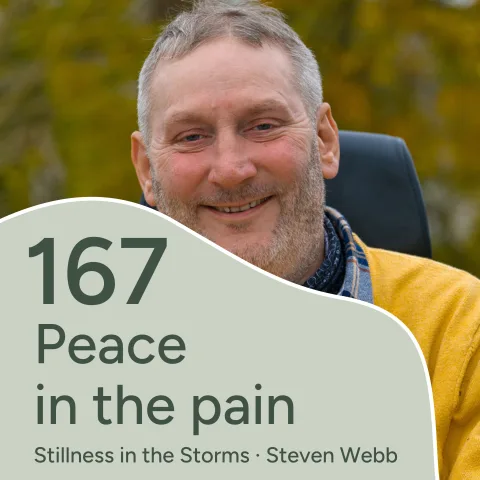
Why do feelings come in waves? Because that is what they are. And the serenity prayer is not really about the big things at all, it is about the next five minutes.
Why do feelings come in waves? Because that is what they are. And the serenity prayer is not really about the big things at all, it is about the next five minutes.
When you first sit down to meditate the waves feel enormous, because you have never watched them properly before. The bit we get wrong is thinking the serenity prayer applies to wars and world events. It applies to the phone going when you are facing the wall in your own room, and to whatever arrives in the next few minutes.
One thing to try: Take the next thing that annoys you and ask which of the two it is. Changeable, or not.
In this episode
(0:02) Changing the name, and why the podcast is not the wrong one
(2:22) Facing the wall, and the telephone going
(4:59) Feelings are waves. They are the ocean
(7:39) The serenity prayer is not only about the big things
(9:44) Where this is going, in ten to fifteen minute episodes
Support the podcast and join the Weekly Calm: stevenwebb.uk
Thank you for listening.
Steven
The story behind this one
I was sitting where I am now, facing the other wall, when the phone went.
Somebody I had never spoken to. Are you Steven? You do not know me, but are you Claire's friend from down in Cornwall?
Yes. Why?
She passed away last night.
I said thank you for letting me know, and I put the phone down, and I sat there in silence for what felt like an age and was probably ten seconds.
My partner asked who it was. I told her. Then she burst into tears, and her friend started crying, and I carried on with my work.
It was a good fifteen or twenty minutes before it occurred to me that I had just lost my best friend. Ten years of laughing, crying and being lonely together. Dating without the relationship. She had the most infectious laugh of anybody I have known.
That is what a knockout blow actually looks like from inside. Not the film version. Somebody carrying on typing.
What it taught me
The crying came later, and it came in waves, which is the thing I want to say about all of this.
Feelings are waves and you cannot calm the sea. When people first sit down to meditate they try to flatten it, and it will not flatten, and they conclude they are no good at it.
I grew up in Cornwall, surrounded by beaches, and I was a poor surfer. But I know what it is like to sit out beyond the break waiting. You do not get annoyed with the swell. You bob up and down and let it pass under you.
Then there is the serenity prayer, and I think we have it aimed at the wrong target.
Grant me the serenity to accept the things I cannot change, the courage to change the things I can, and the wisdom to know the difference.
We read that as being about wars and world events and the great arcs of a life. I think it is far smaller and far more immediate than that. It is about a single thought, and a single feeling, and the next five minutes.
You cannot change a feeling once it has arrived. Loneliness will not convert into gratitude by being told to. It is a tin of paint you have opened. You can keep putting the lid back on and moving it aside, and it is still that colour, and at some point you have to use it.
Questions people ask
Why did I not react?
Because that is what shock does, and it is far more common than the version in films. Not reacting is not the absence of feeling. It is the delay before it arrives, and mine took twenty minutes.
How long do the waves go on?
Longer than anybody wants and less constantly than it feels at first. What changes is not the size of them but whether you are fighting them, and fighting is what makes them bigger.
What do I actually do when one hits?
Name it. Grief. Loneliness. Sadness. Then let it lift you and set you back down. That is the whole technique and there is not a better one.
Read along
The transcript
It follows the audio. Press any line to jump there.
grief · resilience · suffering · personal-story
Read the transcript
Hey, welcome to Living Deeper Lives.
Yeah, you're not on the wrong podcast.
I'm changing the name.
I used to be called Stillness in the Storms, but from now on, it's
going to be Living Deeper Lives.
And over the next few weeks, you're going to see the rebranding
of that.
It opens the doors up to more of what I want to talk about, more
of the conversation, and where I want to move it to.
You see, Stillness in the Storms will still be a large part
of the podcast, but I want to have some guests, and I want to dive
deeper into what it means to be a full human, what it means to
be 100% human.
And I really want to tackle the topic of human emotions and how
we deal with the deeper human emotions.
And very often from a young age, we're told to suppress our emotions.
We're told to wipe them away.
And our parents do it to us because they don't want to see us
in pain.
So they try to prevent our pain when we're crying or upset or
angry.
They don't want to see that because that triggers a reaction
in them, and nobody likes to feel bad.
So I want to steer the show more in that direction, and I hope
you'll understand that it's where the conversation needs to go.
And on today's show, we're talking about how do you deal with
life when it suddenly gives you that curveball, when suddenly
somebody phones you up and says it's over, or you get a call
from the doctors and your blood tests are not what you expect
them to be?
You suddenly get a phone call from somebody that says, your friend's
passed away or something.
How do you deal with those times?
And also, how do you deal with when you're watching the news and
something triggers you and makes you really mad?
How do we stay in that moment and we're able to hold that emotion
without losing our senses and without reacting in a bad way that
makes things a whole lot worse.
I want to start with a story about when I was sat here.
Virtually where I'm to now is just facing the other wall.
And I've had my room redone since then.
I was facing the wall and with my monitor and all in front of me,
and the telephone went.
And my partner at the time was sat behind me on a sofa in the other
room, and the phone went.
I picked it up and, hello.
And someone who I had never spoke to before was on the end of
the line.
They said, hi, is that Stephen?
I said, yes.
You don't Know B.
But are you Claire's friend from down in Cornwall?
I said, yeah, I am.
Why?
And she said, well, Claire passed away last night.
And I said, okay, thank you for letting me know.
And I put down the phone and I just sat there in complete silence.
And after what seemed an age, it was probably only 10 seconds,
Emma looked up and said, who was that?
And I said, oh, it was Claire's friend.
Because Claire was away at the time.
She was training to be a nurse.
I said, it's Claire's friend.
And she went, okay, what does she want?
I said, claire passed away last night.
And I carried on with my work.
And Emma burst out in tears.
She had a friend here at the time, and her friend started crying,
and I just carried on my work.
And it wasn't for a good 15, 20 minutes that it suddenly occurred
to me that I just lost my best friend.
I lost somebody that I'd spent a good part of the last 10 years
at that point with in regards to.
We laughed together, we cried together, we were miserable and lonely
together.
It was like dating without the relationship.
She had the most infectious laugh.
And what do you do with that?
How do you cope with that?
Because here's me not being able to deal with it, not being able
to cope in any way, just carrying on my work.
My partner's crying, and we all react differently.
We all react.
Respond differently whenever we hear news like this.
And as time went on over the few days and I started crying more
and more, and it started to really come over me like waves.
And this is what I wanted to talk about, is these waves.
You know, feelings are like waves.
They're like the ocean.
And when we first sit in meditation, we almost want to calm
this ocean.
We want to make everything smooth, and we want to get rid of
all the ruts.
But that's not how it works.
You cannot get rid of all the ruts.
You cannot get rid of all the bends in the road.
But you get the point.
You cannot calm that sea.
No matter how much you try, the waves are going to continue.
So what do we do?
We learn to ride the waves.
We learn to allow that wave to come up, and we learn to just bob
up and down with the wave.
I come from Cornwall, and I'm still in Cornwall.
I was born here.
And we're surrounded by beaches.
So before breaking my neck, I knew what it was like to sit on,
like, a surfboard out on the sea.
And while you're waiting for the big break or the big wave to
come, I wasn't because I wasn't a very good surfer at all.
So I wasn't really waiting for the big wave, but I was out there
beyond the break.
And you didn't get annoyed by the waves.
You just allowed them to come and go and you'd bob up and down.
And that's what we got to do with emotions, is don't get annoyed
by them.
Allow them to come and go and identify them.
Just, you know, that's grief, that's sadness, that's loneliness.
And the more we do that, the more we experience being a full human
and the less we avoid it.
We really spend so much time trying to avoid these emotions that
we don't like the emotions that we're trying to push away.
And the answer is not to avoid them.
You remember the Serenity prayer, and this is what reminds
me of the waves and acceptance.
God, grant me the serenity to accept the things I cannot change,
the courage to change the things I can, and the wisdom to know
the difference.
And I was talking to somebody today, and this is what made me think
about doing this podcast.
And that is, we often think of that serenity prayer as something
big, except the big things that happen in the world, the big
things that happen to us, and the courage to change the big things
within us and try to change the big things in the world.
But I think that serenity prayer is much more subtle than that.
I think it goes down to a single thought or a single emotion.
You imagine if you had the wisdom to feel the emotion arise
and choose what to do with it, whether you choose to just allow
it to flow through and then disappear, or do you fight it and
end up annoyed by it, and then the wave gets bigger.
So I think we should look at this serenity prayer different.
You know, encourage, just change the things I can.
You can't change a thought once it's here.
Once an emotion has grown within you, it's there.
You know, if an emotion of loneliness is present, but you can't
change that loneliness into a party animal.
You can't change that loneliness into gratitude.
That feeling is what it is.
It's like trying to change pots of paint.
You open it up and you go, I don't like that one.
Try to put the lid on it and put it to the side.
Well, it's still there.
It's still that color.
No matter how many times you put the lid back on it and put it
to the side, at some point you gotta open that lid and you gotta
paint yourself in that paint.
And when we do we accept it for what it is and then it moves
on.
And I think that's a good message to start the new branding
of the podcast on, because that's what the podcast can be about.
It's going to be about 10, 15 minute episodes.
It's going to be about living deeper lives.
And how do we do that?
How do we, you know, we've got all the span in the world.
We've got more friends than we ever have.
We've got more people in our span than in the whole of human history.
We used to have just a few people we knew in the village, maybe
a few more in the school, and maybe you've been on holiday a couple
of times or you went to stay with a friend in a nearby village.
But now you got the whole world.
And not only you got the whole world, you got the whole of your
lifespan so far to collect these friends.
But are you living a deeper life?
Are you living a life with meaning and worthwhile and purpose?
That's what this podcast is going to be about.
So appreciate you being here, appreciate you listening.
If you could leave a review on itunes, that would be amazing.
Or wherever you listen to it to, if it's on Spotify, put a heart
or subscribe, whatever you do on Spotify.
But until next week, live a deeper life.
Take control of those feelings.
Have the courage to change the things you can and the wisdom to
know the difference.
Take care.
Thank you.
Head over to my website, StephenWeb.com if you want to treat
me to a coffee or download meditation that would help you through