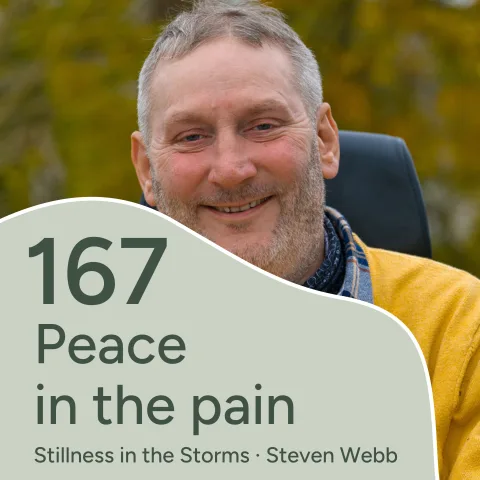
What do you do when you cannot pay the bills and you have stopped eating? I know, because I did it. The answer was the thing I was most avoiding.
Richard and I opened a computer shop called Bees Knees. I could not wait for the weekend, because the banks shut and that meant two days of quiet. I lost a lot of weight. I was not eating. When I finally took responsibility and asked for help, I could actually do something. The antidepressants let me eat again. That hole feels permanent while you are in it. It is not.
One thing to try: Whatever you are carrying on your own, tell one person before you have to.
In this episode
(0:03) Twenty eight years on, and the part of my life you will recognise
(2:57) Meeting Richard and opening Bees Knees Computers
(4:26) Setting it up properly, then waiting for the trade
(6:08) Waiting for the weekend, because the banks were shut
(7:22) Having to come home and tell my parents
(8:56) Taking responsibility was the thing that freed me
(9:59) What the antidepressants actually did
(15:49) Is there a gift in it? And what that looks like from the hole
Support the podcast and join the Weekly Calm: stevenwebb.uk
Thank you for listening.
Steven
The story behind this one
Richard and I opened a computer shop called Bees Knees. He was the hands and I dealt with the customers and the orders, and to this day I have never plugged in a USB cable. I can talk somebody through building a whole machine. I have never touched one.
It went well for a couple of years. Then a few things caught up with us. I undercharged constantly, five pounds here, a tenner there, when the shop down the road charged thirty an hour and was right to. There was never any margin in hardware. And then PC World opened, which was not their fault but was the point at which I decided we were finished.
By the end I was ringing the bank at three o'clock every afternoon to explain that day's position. Had we sold anything. Could we cover anything. I could not wait for the weekend, because the banks shut and that meant two days of quiet.
I dreaded the phone. I dreaded customers coming in, because I would have to tell them their parts were on the way when I was waiting for the next cash sale to order them.
And I stopped eating. I am six foot and I went down to about seven and a half stone. You could see every rib and every bone in my hands.
I told my parents I had eaten at home. I told my carers my parents had fed me. My golden retriever Ben put on weight, because he got my dinners.
What it taught me
It ended when the Inland Revenue rang and told me I could not keep trading, and I had to go home and tell my parents.
Bankruptcy followed, and paying people back, and none of it weighed anything next to what I had been carrying. I was free the moment I stopped pretending.
Because here is what I had actually been doing. I thought I was being strong. Soldier on, come back tomorrow, be a warrior about it. I had become a victim of my own courage.
Sometimes the strong move is knowing when to stop and change direction.
I went to the doctor and took antidepressants for about eighteen months, and one of the things they did was give me an appetite back, which meant I could rebuild a body.
Five things I would tell anybody in that hole.
Avoiding it makes it grow. Push against a wall and the wall pushes back, and feelings work the same way.
There is always something to be grateful for, and if all you have is a breath, start there.
It is not personal. The universe is not keeping score and does not know your name.
There is a gift in it, and you will not see it while you are in there. Mine took years and it was learning to take responsibility.
And it is not permanent. It feels like your life. It is a moment.
Questions people ask
Why did I not ask for help sooner?
Because I had confused stubbornness with strength. And because asking meant saying out loud that it had gone wrong, which felt worse than the situation itself right up until the moment I did it.
Are antidepressants a failure?
No. Mine let me eat. They are not the whole answer and they are not a defeat, and they should be started and stopped with a doctor.
What actually changed things?
Taking responsibility. Not solving it, not fixing it. Simply stopping the pretending, at which point there were options I had not been able to see for months.
Read along
The transcript
It follows the audio. Press any line to jump there.
resilience · suffering · personal-story · healing
Read the transcript
Welcome to Stillness in the Storms of Life. I'm Steven Webb, your host, and this is the podcast that helps
you to have a little inner stillness and peace when you have it least and you need it most. And
on today's show, I'm talking about when we're struggling, when things seem to get on top of us and things
are relentless and it's one thing after another.
I'm going to share a story about when I lost my computer shop and went bankrupt and what I learned
from that. And we'll end the show with the five things to remember when you want to give up. But
before that, if you support what I do, you can head over to my Patreon and for just four dollars
a month, you can really help me to produce more content, more podcasts like this. And you can ask your
questions directly to me and I will answer them in the way of a video or it directly in a
podcast. So yeah, head over to StevenWebb.com. And there's a link at the top to my Patreon site. That'd be
awesome. And if you want to shout out on the show, yeah, I'll shout your name out on the show.
Not literally shout you know what I mean. Yes, struggles. We all have them, right? And the regular
listeners would know that I'm paralysed just below my neck. I've got limited arm movement. And I broke my neck
when I was 18 years old now. It's coming up now. Coming
up, what? Nearly 30 years. 28 years it'll be first of September this year.
So, but I've picked a particular time in my life where I think you'll be able to relate it was
a time when I started to get my life back together and the one thing that was really important to
me and what I enjoyed doing was working with computers. Shortly after I came out of hospital, I was given
a computer. And it was the first time that I really was into computers. I was more interested in women
and partying and everything else before I broke my neck. So, hey, I'm just being honest um But after I
broke my neck, it was more um I got into computers because it helped me a lot more. A computer
opened a whole new world to me. And then as time went on, I wanted to upgrade the computer and
I taught myself about it. So I become like an engineer of computers, but I never really ever plugged one
in. Still to this day, I've never plugged in a Usb cable. Yeah, I know I can instruct people to
build a whole computer, to upgrade it and do the different things with it. And the computer I've got now
is completely built by one of my carers that knows nothing about computers at all. Literally, I
tell her where to put the screws in, where to put the cables in and how to do it. So
yeah, I'm a computer engineer but never actually done it. After a few years I met another gentleman called Richard
and we started up a computer shop together. He was going to be the hands, I was going to be
the person that dealt with all the other stuff, the orders and the computers and things like that. I would
deal with the customers coming in. And it worked really well for a couple of years. And then it was
at a time when the internet was just taking off. I think Google was about a year old um eBay
didn't exist yet. Facebook wasn't going to exist for another five years. And it was in that twilight zone of
when everybody was buying dot-coms. And I'll be honest, I didn't think much of the internet at that point. It
was more so download drivers and... To go onto these forums, but I couldn't really see the point
in it. It was much like the radios were years ago on the Cb where you had the fanatics that
loved it, but most people didn't really get that involved. Well, we set up this computer shop and my stepdad
and Richard went out there. They put in all the sideboards. We got already Me and Richard went to the
bank and we alone And we got a couple of cards that we had some money on and we started
the shop. We sat back and we waited for the customers. I think we put a couple of adverts in
the newspapers and it was called Bees Knees Computers. As
in, you know we know what they mean by the Bees Knees. It's called Bees Knees Computers and it was
limited. So we all set it up properly with help from accountants and... And we sat there and we waited
for the trade. And yeah, it did all right well we slowly built up. We built up a a good
number of customers and visitors used to pop in for coffee. One of the things I cannot answer really for
Richard, but for me, I was far too lenient. I would repair people's computers and go, oh, just five pound
just ten pound here and And really, the computer shop down the road that was doing well would charge like
30 pound per hour, which was probably about right but there But I thought, well, I've just sat here and
it's taken me about an hour. Just fiverr tenner So over time this had a knock-on effect because the
hardware never really made you any money. You know, all the giants could sell it a fraction of the cost
that we would incur. So there was just no profit in that. So we tried to go down the end
of route of selling computers. And we did all right We sold quite a few computers. But there was never
any real profit in that. And then PC World opened up. And that really, it wasn't PC World's fault, clearly.
But my mindset was that we were going to struggle. And we did. And then eventually, about eight, nine months
later, becoming clear to me that I was relying on the next customer to come in just to pay the
day's bills. And I was having to phone the bank at three o'clock every day just to... Explain to the
business manager at the bank exactly the situation that day. Did we have some money to pay in? Did we
sell a computer? Did we have to pay any bills? It took its toll on me. I couldn't wait until
the weekend when the banks were closed. It meant I had two days of relative peace um
and then the the accounts were building up and everything was just building up and we were trying to... I
can say We were trying to, we were always in reactive mode. We were trying to just get through the
next day. It got to the stage where I I wasn't eating. I dreaded going into
work. I dreaded the phone going. I dreaded the customers coming in because I did not have their parts and
I did not know what to tell them anymore like they're on the way when really I was waiting for
the next customer to pay cash for something. In order to order the previous customer's parts. And
it's a pretty dire situation and I thought I could handle it. I thought I could sort it out. I
saw almost thought that something would come along
until the day I got a phone call from Inland Revenue and they said, you know, you cannot keep trading.
You're a limited company and you have a responsibility to your creditors to stop trading. I
had to come home and tell my parents. By this time, I'd lost quite a lot of weight. I wasn't
eating. I was I was lying to my parents and my carers. I would say to my parents that I
had just eaten. I would say to my carers that my parents have fed me that evening and But
I wasn't. I couldn't eat. My dog was putting on weight. I had a golden retriever at the time called
Ben. He was a dogs for a disabled, awesome dog. And he was putting on weight because I was feeding
him my food.
Just couldn't face it. I was six foot tall and I went down to, I believe, about a seven and
a half stone. You could see every rib on my body. Being paralysed as well, I was so, you
could see all the bones in my hands and my arms and
my legs. It wasn't pretty. I closed the shop and I confessed to my parents. Yeah,
that was that. It was like a huge weight lift off my shoulder. Albeit I had I had to go
bankrupt and I had to pay back my parents and I had to do all these different things. But the
burden of that was nothing compared to the burden of saying to customers, I haven't got their parts when I
know they've already paid. Worrying about them coming in and worrying about the phone calls.
When I eventually took responsibility, I was able to do something. You know, there is lifelines out there
and But I got so blinkered that I thought no matter what, I will soldier through. I
didn't realise I was becoming a victim of my own courage ego. You could do this. You could you could
really really stay strong in the face of this you know Come back the next day and have sheer
willpower. Be a warrior. You
know, sometimes you gotta know when to give up and change direction. And that was one of those times. And
of course, in doing that and making that decision taking responsibility, it wasn't the end of my struggle. I had
to fight back. I had to bring courage and strength and growth to my time. After that, I went to
the doctors and I was put on antidepressants, but I didn't want to stay on them, you know I was
I was on them for about 18 months. And I think they play a good role when we need them.
The antidepressants were able to suppress some of my fears and they enabled me to eat.
And they say very often when people go on antidepressants, they put on weight. Well, it's because the antidepressants almost
give you an an appetite And that appetite meant that I could rebuild myself and my body a little bit.
So that was a good thing, because I couldn't stand the drinks that they gave me. These build-up drinks, they
were disgusting. You know, the strawberry wasn't one wasn't too bad, but the banana one was just disgusting the
Bananas didn't even come close to it, you know. It was about this time also that I met my then
long-term partner. Emma and I met her daughter, which is still my daughter now. She's my stepdaughter She moved in
when she was four. We stayed together for 11 years. So when I took responsibility, when I started like
um building back my life, that's when we got together and we sorted our relationship out and So everything
went on a plus. But it did feel for a long time that no matter what, everything was against me.
No matter what I tried, you know, the universe had the An answer for me, but it wasn't the answer
I wanted. But it was the answer that I focused on. I was always like focused on more debt, more
troubles, more hassle. So I said at the beginning I was going to share five things to remember when you
want to give up. And I wrote these things down the other day thinking about my time at that point.
And the first one is by avoiding it, it grows. And this is whether it's an emotion, whether
it's a problem or anything. The more we try to push away something, the more it pushes back. It's almost
like the the rule of opposites what What is that physics rule you know
Equal and opposite reaction. The more you push against the wall, the more the wall pushes back at you. And
this goes the same with emotions like The more you try to suppress them, the bigger they grow until one
day they
totally swamp you. It's much like building a dam on the little river beside the beach. We
build the dam trying to hold back the water and at some point the water will always break through. And
that's what it does when we try to push these problems away, like as if they're like as if they
will go away by themselves. They won't. They will get bigger and bigger and bigger until at some point you
have to deal with them or you cannot deal with them.
Please don't leave it until you cannot deal with them
that's the You're stronger and you've got more courage and taking the responsibility will really
free you from this bind of whatever problems you're having.
Another one is, there is always something to be grateful for. And even during the darkest of times you
still got a breath. Start there
you know in In the most dire of circumstances,
even when Nelson Mandela was in prison for 25 years. He
still had his breath. And while he has his breath, there's still hope. And then when there's hope, you have
life and you have thought and you have all the other things that can come from that. You know, you've
got the ingredients to grow the seed of a better life. There's always something to be grateful for. And very
often we've got things that somebody else is praying for. I always like that quote. I don't know where I
come from, but it's true.
If you're listening to this podcast. You're doing okay. You really are. Number three,
it's not personal. We
often think that these things keep hitting us again and again and again because it's something about us it's the
sun The universe has got it in for us. Like the universe has got so much to dish out and
it's dishing out all of it towards us because we even see these quotes like, well, we only get given
the stuff that we have the strength to endure. I don't subscribe to that. I really don't. I don't think
the universe is up there keeping score, seeing how strong you are. I just think life's happening
and I think we need to deal with it. We need to enjoy the things we enjoy and we need
to embrace the things that we don't enjoy so much because you cannot have one without the other. And the
universe really doesn't know your name. It's not keeping score. You're really not that important for
everybody to conspire to damage you or to keep picking
on you. It really is not that that kind of universe. It doesn't work that way. And this next one's
a little bit harder because this is this is a motto, I believe. And there is a gift in everything
and you just need to find it. What's the gift when your times are really, really difficult? You know, what
was the gift when I was facing bankruptcy, when I was feeling sick at the thought of going into work,
when the phone would go, I would look around the shop to see who was there because I did not
know how to have the conversation with the bank and such like. But yeah, I do believe there's a gift
in everything. And what is the gift when... You know, you're an antidepressant You're so fed up with life you
You don't have any money. You can't pay your bills. You think the world's judging you. And you really just
wake up every morning and the problems start the moment you open your eyes. Where's the gift? Well, the gift
I couldn't see at that time. But I see the gift now. And the gift was... It grew me. It
taught me stuff it I had to take responsibility for my life. And because of that, many things have happened
since. That that responsibility that I learned at that point has really helped me to not go back to
that point today. It's taught me many, many things. And there's always a lesson in something. So even if the
gift is only a lesson, it's still a gift. And
finally, finally, the
moment is not permanent you
know when we When we have real problems or when we're really suffering, we tend to think that's our life
you know We might be suffering from depression or a bad case of anxiety. And when
we're in that hole, when we're in that situation, we think that's permanent. We think that's our life. We
think that is who we are. It's not. It really is nothing more than a temporary moment,
temporary glitch, and it will move on and pass. Things will work out.
Okay, so let's bring this podcast to a close. Are you going to be my first supporter over on Patreon?
That would be awesome. Support what I do. Enable me to create more content, create more podcast
And yeah, help more people. Help more of you have a little more inner peace and stillness when you need
it most. Head over to StevenWebb.com. The links are below this podcast. Thank you. Share. And I don't
know if you can hear my little westy in the background doing some coughing, I think. Take care, guys. Have
a good day. And don't forget to subscribe and review my podcast if you can. Thank you. Bye.