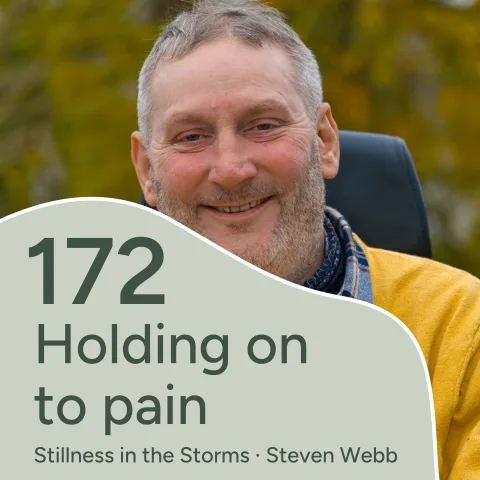
Episode 167 · 17 May 2026 · 16:19

Waking Up to Body Betrayal: How to Find Peace in the Pain

Is your body letting you down, or have you been sold that story? Mine is not the enemy. It has always told me exactly what it needed, and I did not always listen.

Subject: Hard Times & Resilience

Apple Podcasts Spotify

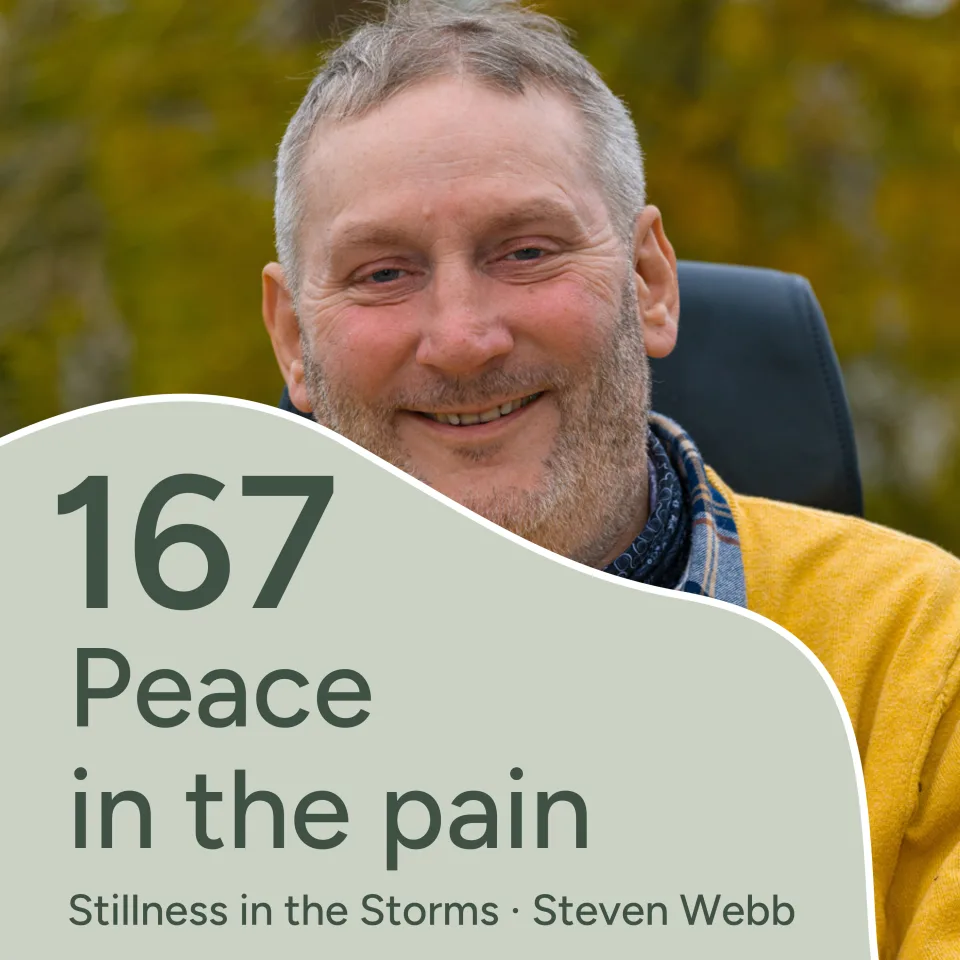
Stillness in the Storms · Episode 167

Is your body letting you down, or have you been sold that story? Mine is not the enemy. It has always told me exactly what it needed, and I did not always listen.

Every morning is like this for me at the moment, so I do feel it. But we have been handed a story where the body is the opposition. It is not. It is the mind, the body, the toes, the fingers, the knees, all in it together. We ignore the soldiers doing the work, then get angry the moment anything goes wrong. Thank you for being my companion.

One thing to try: Say thank you to one part of your body that has been doing its job unnoticed.

In this episode

  • (0:01) No fluff, no quick fixes, just this
  • (2:42) That is me every morning, especially at the moment
  • (5:21) The story that our body is the enemy
  • (7:44) The mind, the body, the toes, the fingers. All of it together
  • (10:04) Whatever your illness is, the story is still a story
  • (12:41) Ignoring the soldiers, then getting angry when it fails
  • (15:15) Thank you for being my companion

With gratitude to

Sin, Ellen, Dominique, Adam, Annie, Joe, Sujata, Senga, Jack, Glenn, Denise, Laurie and Rosie.

Support the podcast and join the Weekly Calm: stevenwebb.uk

Thank you for listening.

Steven

The question this answers

Is your body letting you down, or have you been handed that story?

I wake up and I do not want to move my arms, because I know the elbow is going to hurt and the shoulder is going to hurt, and on a cold morning it is worse. Five minutes after I do move, they give in and get on with the day. That is every morning for me at the moment, so I am not talking about this from a distance.

The heart of it

  • Your body is not the opposition. The mind, the body, the shoulders, the knees, it is all one side.
  • Pain is what it is. The story you build on top of it in the first minute is where the suffering starts.

I have a picture I keep coming back to. You are born with a certain number of soldiers, and their whole job is repairing you overnight. When you are young there are loads of them and they are fit and they get it all done. Through your teens you hand them the drinking, the smoking, the rubbish you ate at midnight, and every night they look at each other and say, right then, what has he got us into this time.

As the years go on there are fewer of them and they are tired, and by morning they simply have not got round to every joint. When I gave up smoking I made it easier for them. When I stopped drinking, easier again. Then the coffee. I am still working on the food.

We let our bodies down more than the body lets us down.

We were sold a story where the body is the enemy, and the mind stands over it complaining. Why can you not run faster. Why do you get a hangover now when you never used to. And later, how dare you. I have said more than once that I do not know whether I need a body transplant or a head transplant, and with my luck I would wake up in something worse.

Accepting the body is not giving in to it. It is not saying you can stop me doing everything I wanted to do. It is closer to being in it together.

Here is where the suffering sneaks in. My shoulder hurts, and I can meet that with, this is going to be a terrible day, I am falling apart, I should stay in bed, I will never feel right again. None of that is the pain. All of it is a story about a day that has not happened.

I think an older body is like an old violin. You look after the wood, you check the strings, you handle it with more care than you did when it was new. And it plays a different tune, not a worse one.

One small thing to try

Say thank you to one part of your body that has been doing its job and getting no credit for it.

Thank you for carrying me. Thank you for getting me this far. Thank you for being my companion.

Then ask it something. What do you need today? It has always told you. The listening is the part most of us skip.

Questions people ask

My condition is not going to improve. Does this still apply?

Mine is not going to improve either. I have been paralysed since I was eighteen. This is not about the body getting better, it is about the second layer we add on top of a bad morning.

Is this saying I should just accept the pain?

Take the painkillers. Move about, do the exercise, do what helps. Acceptance is about the arguing, not the treatment.

What are the soldiers, exactly?

My own way of picturing whatever is repairing you while you sleep. It is not science, it is a way of remembering that somebody is doing the work and could do with less of a mess to clear up.

Listen together

The companion meditation

A guided meditation recorded to go with this episode, on Inner Peace Meditations.

Read along

The transcript

It follows the audio. Press any line to jump there.

pain · disability · acceptance · healing

Read the transcript

I'm Stephen Webb and welcome to Stillness in the Storms.

This is the podcast that helps you find peace in difficult times.

Yet, no fluff, no quick fixes, just honest down to earth wisdom

from me, someone who lives it every single day.

So this week, do you ever wake up in the morning and your arms are

just.

And your shoulders, And I say my arms and shoulders because I cannot

feel anything below my chest.

My arms and shoulders, I just don't want to move them because I

know they're going to hurt, especially on the colder mornings.

I know the minute I bend my arm, my elbow is going to hurt, my

shoulder is going to hurt.

But I also know that in about five minutes after I move and stretch

just a little bit, they'll start giving in and they go, okay,

we're ready for the day.

Now, this podcast is for you.

If you think your body is letting you down, betraying you,

or you're struggling middle age or whatever age, and your body

ain't what it used to be.

So before we dive in deeper, I just want to give a shout out to

everybody that's treated me to a coffee, signed up to the monthly

whatever you want to donate per month and supported me in the

past.

Well, it's almost three weeks now because I didn't get to do a

podcast last week and the one before I recorded a bit earlier.

So there's a few names, but bear with me because it's important

and I'm thanking them as much as from me and from every single

listener and every single meditator that listens to inner peace

meditations and this podcast and it keeps it advert free.

Thank you Sin new monthly subscriber, but thank you.

Ellen, Dominique, Adam, Annie, Jo, Sajetta, Senga, Jack, Glenn,

Denise, Lori, Audra, Rosie, another Laura and Cassia and a few

others from PayPal, Emmanuel, Rita, Julie, Danielle and Maria and

Katazuna and Tracy, Anna, Jill, you guys are absolutely amazing.

If I've missed anybody, I will get to you next week.

Thank you for keeping this podcast free.

Let's get on with today's show and if you would like to support

in any way or contact me or got any ideas for a meditation, just

head over to stephenweb.uk so do you ever wake up in the morning

and you're lying underneath your quilt and you just know the

minute you move it's going to hurt?

Yeah, I feel you because that's me every morning, especially

at the moment.

But that's our body, you know, Is it failing us?

Is it letting us down?

Well, I did a podcast.

There's two podcasts and then one about listening to the body quite

a while ago, maybe even two, three years ago.

And what about soldiers?

And I think that was one of my first 20 podcasts or something.

And just to recap over the soldiers, because I do love this

concept, I think about it quite often, and it helps me to just

make some healthier choices.

And that is.

We've got so many soldiers.

We're born with a certain amount of soldiers.

And those soldiers job have one job, to repair our body and keep

us healthy and get us ready every night for the next day.

So you go to bed at night, and when you're young, baby, they're

all raring to go.

They're fit and they're healthy, and you've got loads of

them.

And they can recruit and they can use other soldiers and other

people that's got different jobs in your body, whether they're

little proteins or whatever we want to call them.

I like soldiers.

And every night they do all the repairing.

After all the mistakes we made during the day and in our teenage

years, when we drink and we smoke and we do all the bad choices,

the things we need to do as teenagers, and sometimes we need

to do them as adults as well.

And those donuts and things like that, all with the processed

food we eat at night, they've got to do all the repairing.

And I can just imagine my soldiers, when it comes to every

night, especially when I was a teenager, it's like, oh, seriously,

Stevie, what have you got me into tonight?

What have you got us?

Okay, boys, let's get to it.

And they got to repair my blood from the poison of the alcohol,

and they got to repair my lungs from the smoke and all that.

And it's easy for them when they're young and fit and they got

loads of them.

As time goes on, they get tired, they get more fed up, and

it's like, seriously, Stephen, we got enough to do without you making

it harder for us.

So when I gave up smoking, I made it easier for them.

Then when I stopped drinking, I made it easier.

When I stopped drinking too much coffee, I made it easier.

And I'm working on the food.

Come on.

Rome wasn't built a day.

And my soldiers are like, oh, okay, we'll forgive this.

But every night they go to work, and I just think they're tired

as well.

So by morning they.

They've done enough, and they just cannot get to every joint, every

single thing that needs repairing.

So I feel for them that's it.

That is, they're there to help, but they can't do everything.

And I cannot help to think that we're sold a kind of story that

our body is the enemy.

It's the body that is letting us down.

How dare you?

And our mind is not a friend to the body.

The mind is like, oh, come on, why can't you run faster?

Why can't you do this?

Why can't you, you know, as a teenager?

Why can't you just drink more and more?

Why do you have to have a hangover in your late 20s?

Can you not just go on there?

I want to do more fun things.

And the body's just not up to it.

And then as you get older, it feels like it's more letting us down.

And as I get older, I feel like my whole body's betraying me.

It's like, how dare you?

Come on.

I was like, can I have a body transplant?

I've often said that I don't know if I need a body transplant

or a head transplant.

I don't know which.

Now, my luck, I'd wake up with a body that's probably worse than

mine.

So I'll probably wake up with a sumo wrestler body and then go,

oh, what have I done with this?

And then six months later, I'm like, no, this is awesome.

I love this.

Like, sumo wrestling.

I don't know, I.

Anyway, I digress now.

I don't know where that come from.

Anyway, let's get back to it.

But what do we do with this body?

What do we do?

A body that feels like it's letting us down and feels like it's

betraying us.

And I think, again, I talk about this, but it's about acceptance.

You know, we are this body, although spiritually, we're not this

body.

We're more than this body.

We're just awareness and all those other things.

I know.

That's the only body we got.

We need this body for you to be able to sit here and function,

have a conversation, to be able to see the world, to really

experience the world in the way we do.

It's the one body you got.

Yeah.

You can change your little bit on it.

You can spruce it up here and there.

You can put on some lipstick, you bought some nice clothes.

You could do some exercise.

You could do it.

But fundamentally, you cannot change your body fundamentally.

Just accepting the body the way it is isn't giving up.

You're not saying that's it.

I'm just gonna let you go.

I'M gonna just.

You're gonna stop me doing everything I'm gonna do, want to

do, and I'll just give in to you.

It's not like that.

It's about, okay, we're in this together.

The mind, the body, the soul, the spirit, the toes, the fingers,

the hands, the bum, the knees.

We're all in this together.

And I can't go anywhere without you all, and I couldn't function

without you all.

So I need you all kind of here.

And I think we know essentially we are in this body,

but essentially we don't feel totally connected with this body.

We feel like the body is in some way us, but we're separated

to it.

Does that make some sense?

Does that make any sense at all?

It does for me.

And I think someone gave me an example one day.

If someone coming out a tennis ball next to your hip, how close

would that be?

They go, oh, that's pretty close.

If they held a tennis ball next to your shoulders, would you

say that's closer or further away you go, I think that's closer.

If they held it right next to your eyes, right next to your temple

of your head, you go, okay, that's really close now.

And it's strange the way we think we're in our head, but are

we?

Is that just because the way we see, is that a function of that?

That's a really interesting way of the relationship with the

body and what we need in our eyes.

And what's funny is blind people since birth often feel that

if something's touching next to their eyes, they feel closer to

it as well.

It doesn't make any sense, really, if they're blind since birth.

So it's not to do with the eyes.

There's some kind of location sensor in our head somewhere that

gives us a sense of where we're to.

But I think we gotta really look at the body differently.

We've got to somehow step back and accept our body in some other

way.

And we often see pain as a failure, like our body is letting

us down.

You know, when my shoulders hurt or when I have an autonomic

dysreflexia attack, it's like, how dare you?

When I'm having a really terrible day with bad spasms and

my body is sweating, when I'm already freezing cold and things

are really hurting, I get pressure sores and things like that.

And for you, whatever illnesses you have, it'll be what

it is.

But we do feel like it's letting us down.

But it's a story so when I wake up in the morning, my shoulder's

in pain.

I can be, oh, my shoulder's hurting, and this is going to be

a terrible day, and I'm falling apart and I need to stay

in bed, and I'll never feel okay again.

Well, that's suffering.

That's the story.

I added layers of story that I'm making up about what's going

to happen in a day.

I don't have no idea what's going to happen today.

You know, I can kind of guess at it.

I can guess with the kind of weather it's going to be, whether

or not it's going to be easier or not.

I don't know the kind of experience I'm going to have today.

And the joys and the highs and the lows I'm going to have today.

So we add this layer of story, and it's very often the story of

our bodies and what it's going to be.

That's the suffering, of course.

Pain and hurt you cannot get over.

You could take some painkillers, you can move around,

you can do some exercise.

But the suffering is optional.

And there is a difference.

There's a big difference between pain and hurt and the suffering.

As I get older now, I realize that my body isn't the temple it

used to be, if it was ever a temple.

I'm more looking like the Buddha by the day.

And I think if we looked at it as an old violin, as you get older,

it just plays a different tune.

You have to look after it a little bit more.

You have to look after the wood.

You have to check the strings a little more.

I know nothing about violence, but I'm guessing you.

You treat it with an element of delicacy that you wouldn't have

done when you first had it.

And it almost feels like it plays a better tune.

It almost feels like you have a different experience with it.

You have a different relationship, you have a respect

for it.

And I think that's where we got to go with our bodies.

We gotta step back and have a element of respect with it.

It's not letting us down.

We could say that we let our bodies down more than the body's

letting us down.

If we.

To be honest, and if the body's giving you pain and giving

you suffering, how many times has the body said to you, look, I

could do with some more exercise, I could do with better

eating, I could do with less pressure on my soldiers?

And how many times we don't take any notice of the soldiers and

yet when the body does start letting us down, we get angry, we

get teasy.

It's a two way, it's a relationship, it's never too late

to do the best in that relationship.

And I'm totally projecting now and I'm thinking about what I can

do better today, even what better things I can eat for tea.

So I want to close with, let's treat our bodies as an ancient violin

that we can respect and we can nurture and enjoy the tune it plays.

It may not be the perfect tune it was ever set out to do.

It may feel like it's letting us down.

Sometimes it may even feel like it betrays us.

But I think we got to remember the bit that we've played and we

have played a major role in where our body is today.

And I think if we have a better relationship, if we just nurture

it that little bit more and listen to it step back and understand

and go high pain.

How can I help you?

Hi feet, how are you doing today?

Hi shoulders, how are you doing today?

I think I might record a meditation because I used to do a

meditation just on those lines about the morning, the waking up

in the body we wake up in.

And when we wake up, we don't know what body we're going to wake

up in.

And what I mean by that is I'm always waking up in this Steven's

body that's paralyzed, but I don't know what that body is going

to be that day.

I don't know how bad the spasms are going to be.

I don't know how bad the pain is going to be.

I don't know how much it's going to feel like it let me down

or do really well today.

It is what it is.

But I can nudge the needle to help the body give me the best possible

day.

And I think that's what we can do just the same with the violin.

We can, I don't know, do oil strings.

Do you, whatever you do, tune it, do oil the wood, whatever you

do, you know, please somebody email me to say what you would do

with a violin if it gets older, but it becomes priceless,

it becomes something valuable.

And I think our body has to do that.

Now.

My shoulders will hurt again tomorrow, so are yours.

So will another part of your body.

But move it, shake it out and go.

Thank you.

Thank you for carrying me.

Thank you for getting me this far.

Thank you for being my companion.

I've not always done the perfect thing for you.

I've not always done the right thing.

But you've always told me what you needed and I'm going to start

listening.

Maybe not today.

Always an excuse.

Always an excuse.

I just want to say thank you.

And thank you for bearing with me, as always.

I'd take a week or so off.

Doing too much again, as usual.

Just.

Yeah.

Check out Inner Peace Meditations.

Check out my website, stephenweb.uk see where I can help.

You can always message me and sign up to my weekly Calm newsletter.

So take care of yourself.

Take care of your body.

You are in a partnership and I love you.

Weekly Calm

One calm email.
Every Sunday.

A little space to pause, a practical thought to take into the week, and a reminder that you’re not doing this alone.

Join and I will send you my book, 5 Simple Practices for Inner Peace. Free, and yours to keep.