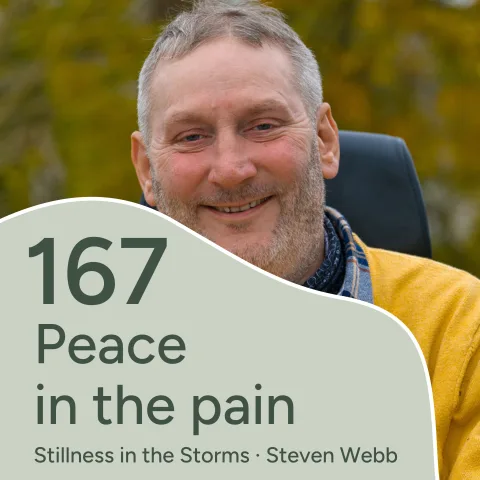
Would the other version of your life really have been better? I spent three months not getting out of bed at all, and I worked out how to eat with a fork through my hand.
Would the other version of your life really have been better? I spent three months not getting out of bed at all, and I worked out how to eat with a fork through my hand.
The staff were stacked out, which meant nobody rushed me chewing my food. I still eat the same way today. It took me years to accept an electric wheelchair, and it turned out to be independence rather than defeat. If you had stayed with them, or stayed in that job, you might well have ended up more miserable. We should not be frightened of the side swipes. We should be ready for them.
One thing to try: Next time you catch yourself imagining the better version, ask honestly whether you know that it was better.
In this episode
(0:03) Inner peace when you have it least and need it most
(2:23) Three months without getting out of bed at all
(4:34) Nobody rushing me, because the staff were stacked out
(6:44) The food was good, because we were in there permanently
(8:42) Working out how to get a fork through my hand
(10:51) Giving in, and going for the electric wheelchair
(13:04) If you had stayed, you might have been more miserable
(15:14) Would I even have been ready, the other way round?
With gratitude to
Clint, Cheryl, Maureen and Yvonne, the first four patrons.
Support the podcast and join the Weekly Calm: stevenwebb.uk
Thank you for listening.
Steven
The story behind this one
The chip is what I remember.
Three months flat in bed, then a little while sitting up each day. Staff so stretched that feeding me happened two mouthfuls at a time, and then they would be called away and come back. Nothing against them at all. It also meant nobody ever stood over me while I hurried my food.
The occupational therapist was going to fit me with a device next week. A strap and a tool, which is what tetraplegics are given, because my fingers and thumbs are paralysed and my level is C5.
There was a plate in front of me. Two sausages and chips. And all I had to do was get one chip up to my mouth.
I picked one up with both hands and leaned forward as far as the collar would let me. It felt like it took two minutes. And there was this delicate balance the whole way up, this chip and me, and when it went in there was a cheer from the nurses' station, because they had stopped what they were doing and watched me try it four times.
I still tear up a bit telling that.
A day or two later I asked whether I could just push a fork through my fingers. That is not how it is done, they said. There is a tool for it on Monday. I said, what if I am out somewhere and I want chips.
I worked it out within a few days, and I have eaten that way ever since.
What it taught me
That stubbornness cuts both ways, and I should be honest about the other half.
It took me about eighteen months at home to accept an electric wheelchair. Everybody told me it would give me my independence back and I refused, because I was not that disabled. Nobody would say it to me straight. So I sat in the front room in a manual chair I could not push over a door threshold.
I gave in eventually and that was that. Everything since, the council, the podcast, going out on my own, comes from the day I stopped defending my pride.
Four things I would offer anybody in the middle of a change they did not choose.
The alternative is not automatically better. I was an idiot in a car and I might have killed somebody.
Focus on what you do still have. I had my eyes. I could still enjoy things.
You could not have done differently. You did the best you knew how with what you had that day, even when it was a mistake.
And take some time out. Be angry, be upset, grieve. Put a rough limit on it, tell people, and then do not stay there.
We should not be frightened of the side swipes. We should be ready for them.
Questions people ask
Was twelve months in hospital a waste?
It was the most useful thing that could have happened. If they had patched me up and put me in a chair inside a week I would not have been ready for any of it, physically or otherwise.
What is the difference between tetraplegic and quadriplegic?
Nothing. One is the English word and one is the American, and I use both. Both mean all four limbs are affected, as against paraplegic, which is waist down.
Is being stubborn a good thing?
It got the chip to my mouth and it cost me eighteen months in the wrong chair. Same trait, two very different bills.
Read along
The transcript
It follows the audio. Press any line to jump there.
change · resilience · acceptance · personal-story
Read the transcript
Welcome to Stillness in the Storms, the podcast that helps you
through the most difficult times in life to give you a little
inner peace when you have it least and you need it most.
I'm Stephen Webb, your host, and this podcast is all about dealing
with change.
When things go terribly wrong, when things happen unexpectedly,
like when someone dumps you, or when you lose your job, or perhaps
you break your neck like I did and end up severely paralyzed.
I remember when I was 18, when I broke my neck and I was having
a good summer.
The year did not start off that brilliant for me, but by the
end of the summer, things started working out and I was starting
to have a bit of fun, starting to enjoy my life again.
And I went swimming one evening and climbed up on the wall,
walked along the top of the wall, and I dived in.
And in that moment, my life had completely changed.
I broke my neck and ended up paralyzed from just below the shoulders
with limited arm movement.
And my fingers and my thumbs are completely paralyzed, and I cannot
feel them either.
So that was a huge change in my life.
And I often say it was the gift of no choice.
Because if someone had come and said to me, well, look, we'll
give you a more deep, meaningful life.
We'll make you more grateful for what you got in life, but we
have to paralyze you and put you in an electric wheelchair to
do it, I would have gone, no, you go away.
That's not very nice.
It's not very nice.
I. I think I would have been a little less politer than that, but
I would not have taken that choice.
Under no circumstances will I have taken that choice, but yet life
threw it at me.
And once it was there, where's the gift?
What can I do with it?
And I think I had a wonderful gift of 12 months in a rehab center,
in a hospital, and I had to really think about what my life meant,
especially in the first three, four, five months lying in bed in
hospital.
The first three months, I never got out of bed at all.
And after that, it was only up for a little bit each day.
It really does give you the time to reflect on life a lot.
It's that time in the cave, and we only had four channels at
the time.
And, you know, at the time I remember.
Who is it?
Went to number one.
Brian Adams.
Everything I do, I do it for you.
It was number one for, like, the first four months of me breaking
my neck.
That was harsh.
Every Top of the Pops, every radio was playing the same tune.
That was harsh.
Thanks, Brian, for That one.
And then shortly after that, Freddie Mercury died.
So that was tough as well, because everything was Queen and
I didn't mind Queen.
But by the time I come out of hospital, I could not hear another
Bryan Adams song or another Queen.
So, again, we did not have the variety.
I had like five CDs that I could play on my CD player.
I had the main channels.
So I become a big neighbors fan and Home and away fan.
But essentially, I spent a lot of time, I guess, really in solitude
of my own mind, of my own life.
And I didn't spend an awful lot of time focusing on what I'd
lost.
I focused a lot of time on how I can solve the problem.
And it wasn't about solving the problem of how do I fix my neck.
It was how do I live in this way and still do the things I like
to do?
And I was somebody that was very much.
I was stubborn.
Stubborn and persistent.
I don't like to be told what to do or I don't like to conform
to the normal.
And I remember one day when I was out of bed, and at this time
they were still feeding me, so they would bring around the plate
of food, I would sit there and they'd put in a couple of mouthfuls
and they would get called away and they would come back and give
another couple of mouthfuls.
Nothing against the staff, they were so busy and stacked.
And that was fine.
I was okay with that because it also meant I did not have to rush
chewing my food.
There's nothing worse than sitting there and having to chew
your chip really, really quickly.
Well, there is worse things.
There's way worse things like Marmite and stuff like that.
But it's not nice having to rush your food when you've got someone
you know, has a lot of other things to do and they're waiting
there with the next mouthful on their fork.
And the occupational therapist wanted to, the next week, give me,
like, a tool device that went into my hand that would enable me
to eat.
And this is what tetraplegics had.
Tetraplegic is like the English word for quadriplegic, which
basically means our arms and legs are affected, all four limbs
are affected.
So that's the only difference.
A paraplegic is just waist down.
Really.
It's a lot more technical than that.
You've got complete, incomplete and all the other things.
But essentially I'm a tetraplegic quadriplegic.
So use those words interchangeably.
They both mean exactly the same thing.
So the OT would be used to working with tetraplegics of a C5
complete, which was my level, which basically means from the fifth
cervical bone down, all the nerves that come out of the spinal
cord at that point has no contact with the rest of the body.
So if my brain sends a signal down to my thumb to bend, my thumb
just does not get the signal because the nerve that goes to my
thumb would be low where I broke.
So the OTs would know that, right?
They got a paralyzed hand.
This is what we normally do.
So they would put like some kind of device in a strap and you
would be able to eat.
Well, A I did not want to wait till next week because I was sitting
there looking at a plate of chips and I was thinking, all I have
to do is get those chips to my mouth.
You know, I think it was like two sausages and chips on the plate
and there was a bit of sauce.
You know, this was a hospital.
There was no beans now.
And I will say the food was good because we were in there permanent.
We could always, if we didn't like any of the menu, we could say,
ah, can we have scrambled egg on toast?
Can we have chips and beans?
And we always got what we wanted.
May not always be ex.
It may not always resemble what we ordered, but it kind of looked
like what we wanted, you know, but that's a whole different story.
That's just, you know, mass catering in it.
But I just had to get these chips to my mind and to my mind to
my mouth.
And I picked up one with both hands and I lent forward and I stretched
my neck forward as much as I could because I was wearing this
big thick collar on my neck so I couldn't move much.
And it was like this delicate balance between this chip and I'm
tearing up a bit now.
It's like quite emotional when I did it.
And this chip was getting closer to my mouth and I put it in
my mouth and just as I got in my mouth, it felt like it took about
two minutes to do it.
And there was a big cheer at the nursing station.
All that because they were doing other things, but they stopped
and watched me attempt this about four times.
Well, as soon as I got it in my mouth once, that was it.
I was away.
The rest of the chips and sausage was at that way the next
day or the next day after that, I said to one of the nurses,
I said, well, what if I just shove the fork through my fingers?
Yeah, but that's not how they do it.
They'll give You a tool to do it on Monday.
I said, yeah, but what if I'm out and I suddenly want some chips?
I want to be able to use a normal fork.
So let's work out how I can use a normal fork in my hand to eat.
No, that's not the way we do things.
That's not the way tetraplegics eat.
I was like, yeah, but that's the way I want to eat.
Okay.
So at some point over the next few hours or days, I worked out how
to put the fork in through my hand and I could eat.
I still eat to this to same way to this day now.
I don't like having the need to rely on tools and implements and
all these things I. I do at home, of course.
And this is why I love Alexa.
And hopefully she won't talk back.
Moment of silence.
No, she hasn't.
She doesn't listen to me very often anymore.
I think I've upset her or something.
It's like for a long time she used to listen, even if I just thought
it.
Now she doesn't anymore.
I think, yeah, perhaps I'm upset.
Perhaps we're in a relationship now that that's what
it's come to.
You know, the relationship degraded to the point that she no
longer listens most of the day anyway.
I digress.
Let's get back.
Where was I?
But we're talking about change and how do we adapt to change?
Well, I adapt because I'm.
I'm partly stubborn.
And that is not always a good thing, because when it meant moving
from my manual wheelchair to my electric wheelchair, which happened
about 18 months after I come home, I refused it and refused it.
Wasn't interested.
The OTS and my friends and all that would say, yeah, but it was
so much easier and all that you'd have your independence on.
Yeah, but I'm not that disabled.
Well, you kind of are, but no one would actually say that to me.
No one would be honest with me and say, stevie, you know, swallow
your pride.
You know, I know loads of people in wheelchairs, electric wheelchairs,
the same level as you, and they're off doing loads of things
in life.
Yeah.
And so I would sit in the front room for weeks, just in my
manual chair and not pushing around the house because any kind
of anything that was in the way, just like, I don't know, just
the grip between the doors, the thresholds that stopped me, you
know, that's.
That's why I didn't conquer the world.
Threshold, door thresholds.
But I digress let's go back.
So I eventually given in and I eventually said, yeah, okay, let's
do it, let's go for an electric wheelchair.
I tried a few and then that was it, I was gone.
And to this day I'm on the council.
I go to and fro things, I used to go to and fro town.
I do other things.
I do so much independently of my carers.
I have 24 hour care because of the life threatening condition I
have.
I don't have 24 hour care because I need someone holding my
hand 24 hours a day.
And plus if they're around me all the time, it would do my head
in.
It's like my own shadow does my head in and that tends to stay
with me.
So how do we deal with change when it happens?
Well, I put together a few things that I think we should deal
with change.
And the first thing is, and this is the most important one of
all, you know, remember, the alternative is not always better.
Remember, the alternative is not always better.
We tend to see the alternative through rose tinted glasses, like
as if, if this hadn't happened, this would have been so
much better.
My life would have been better.
People say to me, well, if you weren't, if you hadn't broke your
neck, you'd have been really successful.
I'm like, how do you know?
I was a real jerk before I broke my neck and I was still a jerk.
Well, I still am.
Okay, let's rewind a little bit.
I might have like killed myself in a car because I was driving
like an idiot.
I thought I was the world's best driver, yet I'd only been driving
a few months, you know, I might have ended up killing somebody
else in the car.
We don't know the alternative.
And this is really important, so stop looking at the alternative
that if you got there on time or you weren't stuck in a traffic
jam, or we hadn't been poorly or we hadn't, or we hadn't lost our
jobs or things like that.
The alternative, you know, you might have lost a job, you might
have lost your partner, you might have ended up single.
All of those things might have happened, but you don't know.
If you stayed with them, you might have been ended up a lot more
miserable, or if you stayed in that job, you might have ended up
a lot more miserable or something worse happened.
You don't actually know.
So that's the first one.
Remember, the alternative is not always better.
And the second one is focus on what you do have.
You still have something.
When I was lying in bed, I still have my eyes.
I still was able to eat, I was still able to enjoy life.
There was much I could enjoy.
I could either focus on what I couldn't do or focus on what I could
do.
And that was really, really huge to me to focus on what I could
do.
Focus on what you do still have.
That's gratitude.
Living with gratitude.
And I talk about that a lot on my podcast and on my YouTube videos.
Recognize that you could not have done anything different.
And this is important as well.
We often go, well, if I'd only done this or if I'd only done that,
what if I didn't go to that swimming pool that night?
Or you can change it for one.
There's no, nobody's got a time machine.
Nobody can go back and change these things.
And we always do the best we can with the knowledge and experience
we have at the time.
Yes, it may have been a mistake, yes we may have done something
stupid.
But at the time it was still your best with what you had at the
time.
Maybe you were tired, maybe you knew you shouldn't have stayed
up late and you shouldn't have made that mistake.
Maybe you shouldn't have said that to your boss, maybe you shouldn't
have had the argument and thrown back at your partner.
A few choice words.
But you still did the best you knew how at the time.
You can't change it, you cannot change it.
So recognize that you could not have done anything different.
Take a little timeout.
And I mean this really, this is really quite important.
I had the gift of lying in bed.
That was my timeout.
Now then if I broke my neck and they wired me up and they got
me back and I was in a wheelchair within two days, do you
think I'd have been ready?
Do you think I would have been mentally ready?
Physically?
My body would have had all the muscles of an able bodied person,
yet I stuck in a wheelchair.
I would have had a lot of fading away today.
I can't think of the other word, muscle fatigue.
And I would have had so many other problems my body would have
had to go through and not climatize to the new, the new life
I was going to live.
So that time out, that recouping that, that time for my
mental ability in my heart and my life to, for me to take evaluation
of my life.
So you may not need 12 months in bed.
So I'm not saying lie in bed for the next 12 months and I'm saying
take some, take a little time out and be angry, be mad, grief,
be upset, whatever you want to do, but give it some time.
So say if you lose someone, say, look, I'm going to grieve and
I'm going to grieve for two weeks and say to your friends, look,
I'm going to grieve for two weeks.
Let me grieve.
And then after that I will sort my life out.
But put a time frame on it.
You might need two days, you might need two weeks, be angry for
two weeks, whatever.
Honestly, put a little time on it.
You know, there's nothing wrong with anger, grief, shame, all
those other things that come with massive change in life.
But it's really important that we don't stay there.
And that's what the main thing is.
Don't stay there, be those things, take time out, but don't
stay there.
And that's my Just to recap, don't look at the alternative of
something that's better.
Focus on what you do have.
Recognize that you could not do any different and take a little
time out to be angry or grief, you know, and then your cope would
change.
And if you recognize these as tools in your box, you won't fear
change, you won't fear something that's going to sideswipe
you.
4pm on Tuesday, because, look, it will.
Things will go wrong in your life.
They've gone wrong many times in the past and you dealt with them.
We shouldn't be frightened of change.
We shouldn't be frightened of those side types.
We should be ready and able to deal with them.
So that's my podcast for this week.
Thank you for joining me and hopefully I help you, to prepare
you and to help you through any difficulties that you might be
going through at the moment.
I'm Stephen Webb and clearly I'm your host of Stillness in the
Storms podcast.
I'm here and thank you for spending this time with me.
If you can review this podcast or if you can support me in what
I do or become a patron, that'd be amazing.
If you become a patron.
I want to say thank you to Clint, Cheryl, Maureen and Yvonne
for being my first four patrons.
You can head over to my website, StephenWeb.com at the top
you got a donate or a patron, if you can help in any way.