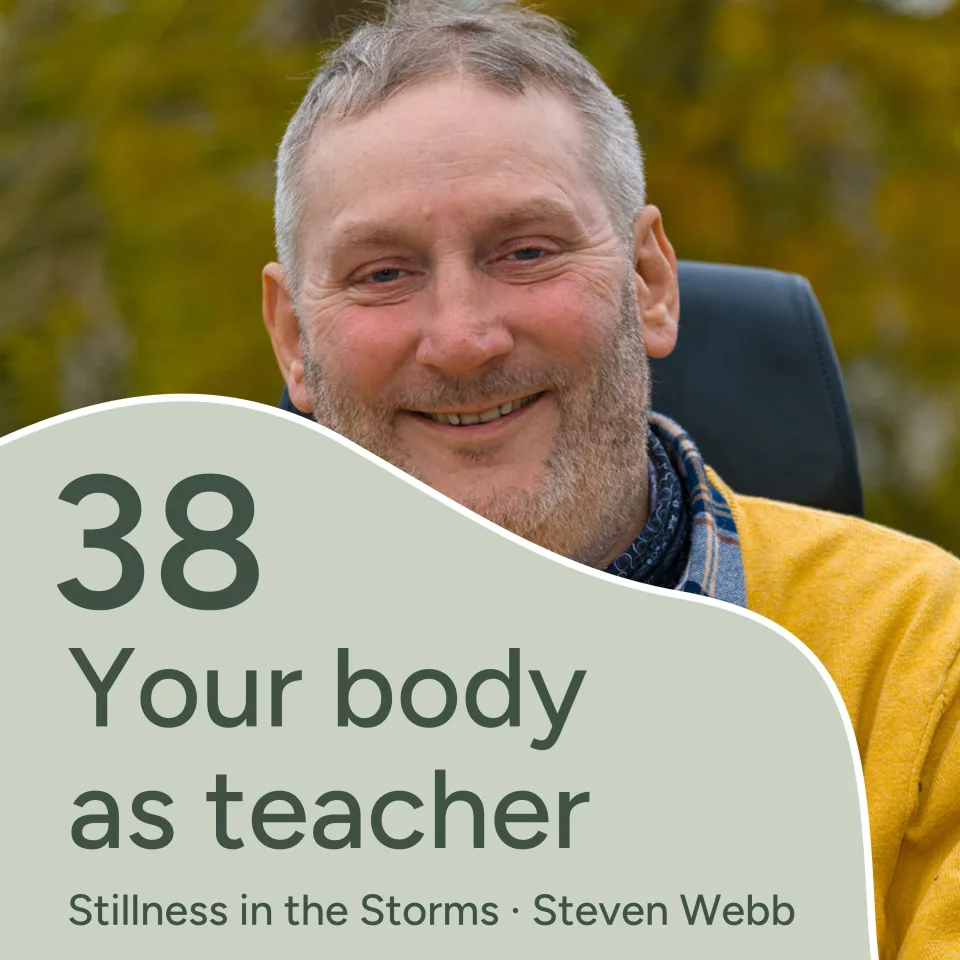
What is your body trying to tell you, and why can you not read it? Mine speaks a language I had to learn from scratch.
I am paralysed just below the neck, so my body cannot point at the problem. It shouts instead. Blood pressure through the roof, blue lips, a headache that takes the day off me, and the cause turns out to be a sock with a crease in it or a shoe done up too tight. Yours is subtler and you still are not reading it. Cheese late in the evening and my sleep is gone. Eat wrong and by four in the afternoon I am asleep. That is not a mystery. That is a message.
One thing to try: Sit with one recurring pain for three minutes, twice today, and ask what it keeps trying to say.
In this episode
(1:15) Paralysed just below the neck, and what I do feel
(2:35) My body tells me, but never subtly
(3:46) Cheese late at night and the sleep is gone
(5:25) Blue lips, a headache and no location
(6:20) A crease in a sock can do it
(7:35) Study your body like a mechanic studies an engine
(10:10) What you eat is fuel and repair
(11:22) I am not a doctor. See one. Then still sit with it
(15:43) Three or four minutes, two or three times a day
What is your body trying to tell you, and why can you not read it?
Mine speaks a language I had to learn from nothing, because it lost the ordinary words thirty years ago. Yours is far subtler and you are probably not reading it either.
The heart of it
Pain is information rather than an enemy. Most of us try to push it away before we have listened to it.
Your body is the only thing keeping you alive and the one thing you have never studied.
We tell other people to look after their bodies far more than we look after our own.
Here is what it is like without the normal signal. If my jeans have a crease in them under me, you would shift in your seat without noticing you had done it. I get nothing. So I sit on it all day and end up with a pressure sore.
What I get instead is a shout. My blood pressure climbs, my cheeks tingle, my lips go a bit blue, and I get a headache that takes the day off me. It tells me something is wrong and refuses to say what. A sock with a crease in it. A shoe done up too tight. Sometimes it is trapped wind. When it is serious it is a medical emergency inside fifteen minutes.
So I have had to learn to lean one way, wait, and read something almost invisible.
Yours is doing exactly the same thing more quietly. Cheese late in the evening and my sleep goes. A big lunch and by four in the afternoon I am useless. Cannot concentrate, and the honest answer is usually water, sleep or what you ate.
A day before a colonoscopy, emptied out and not allowed food, I could not stop shivering. Nobody explained why. It was obvious afterwards. There was no fuel in me to keep me warm.
If a mechanic told you a fuel would stop your car running and stop it repairing itself, you would not buy it again. And your body coughs and splutters at you constantly.
And we all do the other thing too. The headache fades, you forget it, and then you go looking for it to check whether it is still there. Yes, there it is.
One small thing to try
Sit for three minutes, two or three times a day, and ask what your body is saying.
Slow the flywheel down. Running, to walking, to sitting. Then notice. What was that noise? Why is that aching now? What did I eat?
You are not hunting for pain. You are reading what is already being sent.
Then treat it the way you would treat a child who came to you hurt. Where is it? When did it start? What were you doing? We interrogate everybody else properly and give ourselves one lazy answer about always having had it.
Questions people ask
Are you saying I should never have a takeaway?
Not at all, and I have plenty. Have it knowing you may feel rough for a few hours, and decide whether that trade is worth it. Usually it is. What does no good is doing it and being baffled by the consequence.
Is this medical advice?
No, and I say so in the episode. Persistent pain goes to a doctor. This is about the daily signals that never reach a doctor because we have decided they are just how we are.
What if my body is not telling me anything?
It is. You have stopped listening, which is normal, and three quiet minutes is usually enough to hear it start up again.
Read along
The transcript
It follows the audio. Press any line to jump there.
pain · disability · mindfulness
Read the transcript
Okay. So you hear it around everywhere about Your pain is your teacher and your perceived enemy is
your teacher and all those things. In this podcast, I want to particularly talk about our bodies and your body.
And I want you to look at your body and wonder why that is the teacher and why it is
your body gives you all the information you need for you to be free of pain.
It doesn't really make sense, but bear with me on this podcast.
I'm Steven Webb, and this is Stillness in the Storms. And I talk about things that are going to give
you a little more inner peace when the world around us is going crazy, when we don't have it and
we need it most. So follow this Podcast Leave a Review if you can
click the follow and click there whatever it is on whatever platform you're on, it it'll be really super awesome.
If you do subscribe to this podcast, that would be amazing and that would leave me with a really good
feeling like you know We all like to show up and help others. And if
someone clicks on the following or it doesn't make me feel like I'm helping, I'm making a difference.
So let's talk about the body pain. You know, I'm. I'm paralysed just below the neck. Here's the thing. I
don't feel my body. So I don't feel when my body is in pain. I don't feel when in
the same sense that you might. I'll give you an example. If I'm sat down on in my wheelchair and
my carers haven't put my clothes straight, my jeans straight, and I'm sat on a seat, it's going to cause
me pain. Now then what you would do is you would get the information and you would just move a
little. You would just adjust yourself a little. But because I cannot feel it, I wouldn't know that was giving
me pain. So I wouldn't adjust. I wouldn't know where the pain was coming from. So by the end of
the day, I would go to bed and I would end up with a pressure sore. And this pressure sore
from a seam could end up bleeding or could end up being really, really bad. And it has done at
times. But
the thing is, as I get older, the more I slow down, the more I take notice of my body.
My body does tell me where and what the pain is, but it doesn't do it in a subtle way.
And it's the same with your body. It's like it's like a whole different language. And it's a
language that we need to learn. It's it's like as if you come across someone that
maybe is deaf and they've got to do sign language for you, you'd have to learn the sign language to
understand what they're saying. You might get the odd bits and the odd glimpse, especially when they're really mad, you
know, if they're really cross and they're angry, you might get the gist of it then. But in the normal
conversation, you would not understand. And this is the problem with the body. In the normal body feedback loop, we
don't really understand. We're not listening. You know, when I was overweight and when I was smoking, my body was
subtly telling me in little ways that, you know, this smoking is hurting me. When I was overweight and
eating the wrong things, in subtle ways, my body was telling me in my energy levels, that was information. If
I ate a really large lunch, I would be feeling really sluggish. By three four o'clock I'd be falling asleep.
And if I ate really late in the evening, I probably wouldn't go to sleep or at the wrong things.
My sleep pattern would be terrible. You know, I now know if I eat cheese shortly before bed, I tend
to. It's not just a myth. I do tend to have nightmares or it's because it's something heavy the body
needs to digest, so I don't go into a deep sleep. So that's why you end up with nightmares. Well
that that's my theory. That's based in no evidence whatsoever, just on my evidence, so. And the ability to repair
the body. So if the next day you're still in pain you're still struggling and still you're not eating the
right foods, your body's telling you this, you know, if your concentration focuses out, your body's telling
you, you know, in. In a subtle way, if you cannot concentrate on things, you're not drinking enough water or
you're not eating the right things or you're not doing the right things, you're staying up late and doing all
those other things. We complain we cannot focus or we cannot stay awake or we cannot do those things and
yet we don't look at the reasons why. But my body has this system now, then it's
a broken system because if I get any kind of pain or like I said earlier, sat on a crease,
my blood pressure starts to go up slowly and it makes me feel uncomfortable. I get tingly cheeks in my
face. I
always have to say in my face. Because if I say I get tingly cheeks, it's like, which ones? No,
in my Face, let's keep it. Keep it above a certain level. And my lips go a little bit blue
and they tingle a little bit as well. You know, I get a headache and I start to feel quite
awful. But it doesn't tell me where the pain is or what it is. It just tells me I'm uncomfortable.
And then I would wiggle my body a little bit because I cannot really move. So I'd lean to one
side or lean to the other. And I have to wait there just a second just to see whether it
eases or whether it gets worse.
So I'm looking for these really subtle little signs that tell me where the pain might be
what where the original place of the pain might be.
I don't always get it. I sometimes get it wrong. I sometimes say to the carer, well, I need to
go back on the bed because of this. I need this and get back on the bed, I'm totally wrong.
And it might be the shoe done up too tight. It might be the sock with the crease all kinds
of things. Even wind at times creates this autonomic dyslexia but A lot of the time, it's very mild. If
I have a lot of pain, the autonomic dyslexia causes high blood pressure really, really quick, and it becomes a
medical emergency and in which the blood pressure is that high. It's not just high blood pressure, it's extremely high
blood pressure that after 10, 15 minutes can lead to a stroke or even worse, it can be fatal. So
in that instance, we need to do something about it. My carers are very much trained. I I know a
lot about it. So we would go back on the bed and we would start looking immediate But normally that's
quite obvious. It's normally, I need the toilet or something like that um But the milder dysreflexia, the
milder discomfort is not always easy to read. And, you know, I'm talking about me, my position,
but I want. I want you to look at the pains in your body, the discomforts and
really just look at them as information. Look
at them as, what's my body doing? What's my body telling me?
And start to study your body. You know, if you're gonna be in charge of
uh I don't know if you if you. To become a mechanic and be in charge of diagnosing cars and
all that. You're going to learn about the cars and how they work. And each one of you, you learn
about the things you drive and the things you do and the things you are in control of well you're
in control of this awesome body and it's the, it's the most important thing to you, you know, nothing else
on earth is keeping you alive apart from your body. But we don't sit down and study it. We don't
stop and take notice of what's going on. Then I have my tummy rumbles and all
that and I think, oh, I used to think advert on telly, I must be hungry. That's not the case
at all when it when your stomach's making those gurgitating noises
burrogamy apparently it's called. It happens about three times a day and it's your intestines moving, your fuel,
your food on. Sit
down and study it, feel it, what's it like, what's it doing? Why is it doing you
know is this uncomfortable? What have I eaten to create this uncomfortable I went in for a colonoscopy and
the day before they give you these juices and I'm not going to go into detail, but they empty you.
They seriously empty you um I mean This is the most interesting day. And I went to bed, I
wasn't allowed to eat for 24 hours and they emptied my intestine and
I woke up the next day and I went to hospital to have the procedure and I was freezing, I
was shivering
and I said to them, I said, I am freezing, I can hardly function. And they said, yeah, this sometimes
happens. But they didn't explain to me, they didn't say why or what or And I thought about it over
the next couple of days and I realised whenever this similar kind of thing happens, where I upset stomach or
something like that, and I become quite empty, I got no fuel, I
lost all the fuel to keep me warm, what my body was using to keep me warm and to repair
me and all this other thing So
my body did not have what it needed to function properly. And I realised how important it is what we
eat, you
know, on a daily basis how important it is what we eat. What we're eating is fuel. It's
also the repairing. Now then, if you were told by your local mechanic, don't put that fuel in your car,
your car won't go very well and it won't be able to repair because imagine for a minute that your
car needs the fuel to repair as well, not just the function. The mechanic told you, don't put in that
maker fuel you wouldn't do it, would you?
Yet the doctor and all the dieticians and all that, you know, they don't always get it right and they
haven't mastered the art of it, but they're telling you what to put in and what not to put in.
Yet we're not taking any notice. If
your body was coughing and spluttering as it was walking down the road, you wouldn't put in that fuel again.
So
when you have pain in your body, when you have these niggling sensations, when you have muscles that cannot repair
themselves and all that, the back and all hurting, I'm not. I'm not a doctor, so please don't take this
as advice like if you if you've got pain that's really bothering and you go to the doctor. But if
it's ongoing, again and again, sit with that pain. What is it teaching you? What is it showing you?
What information is it giving? So imagine it as literally information
so So instead of sitting there going, I
don't like this pain, and trying to push it away,
trying to. Because sometimes we cling to pain because it's a comfort. How many times have you done this
when you've got a headache and the headache and suddenly you forget about the headache and you go, have I
still got a headache? And you bring on the headache to check whether you've still got a headache. And then
you go, yes, I've got a headache. Or the shoulder pain would go. And then you go, no, shoulder pain.
And you move your shoulder around to see if you've got the pain.
Do it all the time. Be honest. You know, I do it, I still do it now.
But imagine if we just looked at it as information. So
for the next few days, just
look at your body, feel your body. What is it telling you? What is the information telling you
know this because if a child comes up to you, you ask, what's wrong? Well, where is it hurting? How
did it happen you've tried to diagnose it, but we don't diagnose
very much about ourselves but If we do, we do it on a very superficial way. Oh, I've already had
that pain. It's always been there. I don't know where I come from.
Oh, yeah, I always get it when I'm stressed.
Really sit with it. Imagine what it's like. Imagine it fading away and coming back. Why is it
there? And really just start to listen to your body. Your
body is telling you everything you need to know to live an awesome, healthy, sleeping, well,
concentrated, focused, mindful life. But
we don't listen. And
this is what we should do more often. It's just listen to our bodies. When you listen to your body,
when you really take notice of what happens when I eat this food? What happens when I do that? I'm
not saying don't ever have a takeaway. I'm saying have a takeaway, but know that you're gonna suffer for a
few hours maybe, you know, fine. Is that. Is that pleasure worth suffering for two hours Brilliant. Knock
yourself out. Do it. I do it. You know, I'm not against takeaways. Totally. I'm not against.
I'm not against the odd cigarette or the odd drink. I'm just against it if it's totally destroying your body
again and again and again, and we're ignoring the signs
um you know, just to be able to feel exactly where the pain is would be a superpower for me.
I've got to really slow down and listen to my body, listen to the subtleties
And Okay, let's let's end this podcast with how do we do it
now? Take a couple of deep breaths.
And when we just slow right down,
just when that fly wheel of the mind starts to slow and
we go from that running of the mind and the running of the body to a walking and then to
a sitting.
While sitting,
really just
take notice. What was that noise in my body? Why is that leg aching
now and You're not trying to create pain. You're just inquiring what's coming up.
Very often, the information is there. Just listen, listen, take notice.
That's
all we have to do. Do that three or four minutes, two or three times a day, and you'll be
surprised how much information the body's giving you.
You know, it's the only thing you got it's keeping you alive. It's the most important thing to you. We
tend to tell other people to look after their bodies more than we look after our own. Think about that
for a minute. Really consider that for a moment.
You know, your body's the most important thing to you.
Listen to it. Your body is your teacher. Your pain is your teacher.
I'm Steven Webb, and this is Stillness in the Storms podcast. Leave a review, hit a follow. You know, if
you enjoy my podcast, please, just let us know. And if it's something you'd like to know on the podcast
or if it's something you don't like about the podcast, let me know in the reviews. You know, take
care, guys. Thank you. And this is Stillness in the Storms podcast.