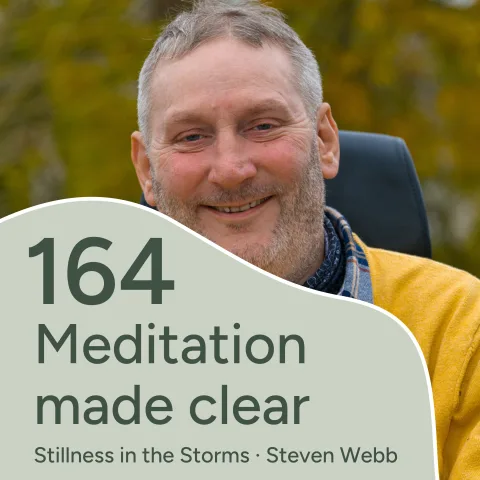
Can five minutes of meditation really touch depression? It will not fix it and I would not pretend otherwise. But it changes what you do with the thought.
Can five minutes of meditation really touch depression? It will not fix it and I would not pretend otherwise. But it changes what you do with the thought.
A friend on the spinal unit broke his neck shortly after I did. He was the positive one, but he talked about the past constantly, about the way things used to be. A couple of years after I came home I heard he had taken his life. I am not against medication. Sometimes the water is too muddy to see through at all. What meditation adds is the chance to ask whether the thought is even true.
One thing to try: Take one thought that has sat heavy today and ask a single question of it. Is that actually true?
In this episode
(0:00) Five minutes, and what it can and cannot do
(1:31) My friend on the other ward of the spinal unit
(2:56) Always positive, and always talking about the past
(4:23) Hearing, a couple of years later, that he had gone
(5:48) No, of course I do not enjoy any of this
(7:23) Why there is a place for medication too
(8:41) Living in the future or the past, never here
(11:50) Questioning the thought, and choosing which ones to take
Support the podcast and join the Weekly Calm: stevenwebb.uk
Thank you for listening.
Steven
The question this answers
Can five minutes of meditation really touch depression?
One thing first, and I say it at the start of the episode. If you have been diagnosed with clinical depression and you are under a doctor, this is not aimed at you and it is not a substitute for that. I am talking about the flatter, heavier version of being properly fed up.
The picture I use is standing in the road, getting run over, standing up, dusting yourself off and getting run over again.
The heart of it
Meditation does not remove the thought. It gives you a moment to ask whether it is even true.
Depression very often lives in the past or the future rather than in the room.
Medication has a place. Sometimes the water is too muddy to see through at all.
There was a lad on the spinal unit who broke his neck shortly after I did. Same age, similar injury, slightly more arm movement than me. He was the cheerful one. Always laughing, always joking, at the gym every day, and I am not sure I ever saw him without a smile.
He also talked about the past constantly. What he used to do. What his mates used to do. How it was never the same now.
A couple of years after I came home, I heard he had taken his life.
I cannot speak for him and I will not pretend to. What I noticed at the time was that every conversation pointed backwards, and that his life was measured against a version that was not coming back.
I have been in the hole myself. When the computer shop went under I stopped eating. I am six foot and I went under eight stone, and you could count every rib. I told people at lunchtime that I had eaten in the morning and told them in the evening that I had eaten at lunch, and I fed my dinner to the dog.
I took antidepressants for a while, prescribed properly, and they helped. I am not against them.
One small thing to try
Five minutes, twice a day, and be open minded about it for a fortnight.
First minute, just notice you are breathing in and breathing out. After that, watch. Anything that turns up is allowed to turn up and allowed to leave.
When you find you have climbed onto a thought, get off it and wait for the next one. Do not be cross with yourself about it. Being cross is another thought.
Then, out in the day, when the heavy one arrives, you get a moment to ask the useful question. Is that actually true? Do I have all the facts, or is that my version?
Over months your mind starts offering you different material, because you have quietly stopped rewarding the old kind.
Questions people ask
What if my mind races the moment I sit down?
Everybody's does, and it feels worse at first because you have never watched it before. That is not evidence you cannot meditate. It is the first thing you were meant to notice.
Is medication a failure?
No. Sometimes the glass is so full of mud that you cannot see anything at all, and lifting you out of the lowest part is what makes climbing possible. Prescribed properly, taken properly, stopped properly, with a doctor.
Why does looking backwards hurt so much?
Because you are measuring today against something that cannot be reached, and you will lose that comparison every single time. The past is not competing fairly.
Read along
The transcript
It follows the audio. Press any line to jump there.
meditation-how-to · healing · personal-story
Read the transcript
Welcome to a new episode of Stillness in the Storms. The podcast that helps you to find that inner peace
when you need it most and you have it least. I'm Steven Webb, your host. And today I'm talking about
those feelings of depression and what we can do with them. How we can turn them around. And how just
five minute meditation twice a day can have a real profound effect on your life. And it doesn't have to
be complicated. It really can be quite simple. And at the end of this podcast I will share with you...
A five minute meditation that I have recorded especially for this task. So you'll get to download that at the
end of this podcast. And just before I start talking about it, I want to just point out that what
I'm talking about when I say depression, clinical depression. And if you've been diagnosed with clinical depression and you've seen
the doctor about it and and I don't mean diagnosed yourself, I mean you've gone and got help and they've
said you have clinical depression and you're under professional help for that, this may not be for you. I'm
talking about more that when we're feeling fed up, when we have times in our life where things just aren't
going to plan. I always feel depression is more like you're standing in the road and you get run over.
And you stand up, you dust yourself off and you get run over again. And you don't know where to
turn, you don't know what to do, and you don't know how to get out this hole that you're in.
That's what I'm talking about. A feeling of really fed up.
I want to start the story about a friend of mine on the spinal unit. He broke his neck shortly
after I did, and he was on the other ward. The ward was split up into two wards. There was
the Avon Ward and the Tamar Ward. I was on the Avon Ward with several other patients, and he was
on the other one. And I got to know him a little bit. He was about the same age as
me. He was a real happy-go-lucky person.
And he gave me my first taste of... Getting really high. I remember we went down to the greenhouse one
day and I don't know if you've ever heard of it. It's like some bottle and it's called a bong
or something like that. I wasn't really into that kind of thing, but we did it in the greenhouse house
on In the hospital. And I can remember for the next few hours all of my life was just in
a weird time loop. I remember going into the lift and then coming out of the lift and I thought
I'd been in the lift about four hours. Meanwhile, I thought I was only in there like just a few
seconds. So yeah, that was all weird. He came in that weird experience in life. I'm glad he did it
was It was an eye-opener. And it probably stopped me doing a lot more of that later on because it
freaked me out to be quite honest. But the funny thing is he was always quite happy. He was always
quite positive and... Enjoyed life. But he used to talk about the past a lot. He used to talk about
the way things used to be, meaning in his life. He broke his neck the same as me he was
His arms were paralysed. He could have slightly more movement in his arms, which meant he could push his chair
easier than what I could. And he used to be able to push it around the spine unit a lot
quicker than me. But he did not have his hands and he found life very difficult just like I do.
But he would talk about constantly about what he used to do with his mates you know before breaking his
neck. And his mates used to come around. They used to take him out and all that. But it was
never the same, he would say. And he would talk about all the things he couldn't do. And that was
his main focus on he just wasn't happy with the way things were. And, you know, that's
understandable. You're able-bodied and suddenly you break your neck or you break your back. And you're paralysed. You can't do
anything. Your life is totally changed. Not only that, you're in the prime of your, I was gonna say
mating season, I guess, really. You're in the prime of your um courting and getting on with life
and leaving college and getting drunk and doing all those things. And then you're struck down with breaking your neck
and you're in hospital for 12 months. Shortly after I came home, after a couple of years, I heard that
he took his life. He went out with his friends one night and they gave him a huge cocktail of
drugs and they took him home and they put him to bed.
Now then, I don't have first-hand experience with the story but that sounds about right and I have no reason
to question it. And I guess really on the outside he was really happy. Go lucky. He seemed to have
it all together. He was at the gym every day on the spine unit Everything looked like on the outside
that he was ready for life. Always had a joke. He always had a smile and laugh on his face.
I don't think I ever seen him without it. But the conversation was always in the past and he was
joking about the past and joking about what he couldn't do. But I guess there was something deep down that
he couldn't deal with. And he wasn't accepting. He wasn't letting things be what they were.
And I cannot speak for him, but as a guest, he found it very hard to deal with. Very
hard to cope with.
And come to that decision. On the flip side, there's me
um Did I talk about the past quite a bit? I don't know. But
I was looking forward to the future I I wanted to get out of the hospital. I wanted to see
what I could do with my life. Did I want a life paralysed? No, of course I didn't. Do I
enjoy dropping things and not being able to pick them up? No. Do I enjoy carers not being able to
make me toast properly? Hell no. Drives me insane
you know how many different ways of making toast there is? Yeah. There's more ways of making toast than there
is atoms in the universe. Really, believe me, trust me on that one. But I don't focus on
the bad things. I don't focus on what's wrong in life. But sometimes I do go there. And when I
lost my business and I lost the computer shop, I did get really depressed. I stopped eating. I went down
to
very, you know, I was under eight stone. I'm six foot tall, under eight stone. You could see every rib
on me. I was telling people in the evening that I ate lunch. I was telling people at lunchtime that
they ate in the morning in the evening. So nobody knew I wasn't eating. And when I was given a
plate of food, I would feed it to my golden retriever dog. Just couldn't face food. I couldn't face... I
didn't want to face life. But
I was that down and fed up that I didn't have the will to go and do anything about it
either. And
that lasted for about seven or eight months. And during that time... I did take antidepressants prescribed by the doctor
and I do think they help as long as they're subscribed properly and we take the right dose and we
continue them until we're ready to come off them. I believe there is a place for that kind of help
just to just to take the edge of it so we can think a little more clearly. You know, sometimes
we get our glasses so full of the muddy water that we're not able to think clearly. And
sometimes just lifting us out of that lowest level of feeling gives us the ability to carry on climbing. So
they have their part when we're feeling really fed up.
But the depression that I'm talking about is more so that
we don't like life the way it is.
We're fed up with things that are happening in the world. It might be in politics. It might be in
the social side of things it could be what we might be fed up with facebook or fed up with
Social media. Whatever we're fed up with, we might have a family that is just are full of narcissists that
just don't listen to us and their opinion is best and we don't feel like we belong most of the
time. Whatever the thing is, it's about life right in this present moment is not what we want it to
be. And we often talk about I think about the past and the future. We go to this Place in
the future that we want it to be. Or we go to this place in the past of where we
want to be. You know, I just want it to be like it used to be. I just want to
find a person like my first love. Or I want to go out on a night out like I did
when I was 20. You know, we're wishing for those times now. I wish I was back at school. Not
sure I do. I spent most of the time skiving in the toilet, I think. But that's that's a whole
different story. Sorry, teachers, if you're listening my podcast but That's the reality. Nothing about your lessons.
Just the toilet was more fun um
Why am I even telling you? It's what it is. Let it go, people. Let it be
and then And then the next time in my life that I really got depressed was when I ended up
single. And it wasn't nothing to do with a breakup. It was because I had my whole life mapped out
in front of me in my mind. And then I thought, well that's it. My life's over now. None of
that's going to happen and I And then after that I set goals and I watched all these videos online
and listened to podcasts and they all said, I'll set goals, set a date and you'll hit them. Well four
years later and I've missed all my goals nearly one after the other. But
I learned to accept things. It is what they are. You know? I don't try to change this present moment
but How do we do that? How do we not change this present moment? Or, more importantly, how
do we learn to accept the present moment without trying to drag the past to it or without wishing it
was different? Well, meditation. Meditation and mindfulness. Hear me out on this. You
may not meditate you You may think that you think too much. Therefore, you cannot meditate. And when you sit
down to meditate, your thoughts come racing more than before. So it actually has the opposite effect. Although it feels
like that, it is kind of like that, but this is exactly why we need to meditate.
So how can meditation help you with depression? Or help you with the feelings of being fed up and depressed?
Well, it gives you the ability to become aware of your thoughts. And when you become aware of your thoughts,
you can do something with them or not.
Now then you can have a thought that you're fed up and you're going to go and have a Chinese
because it will pick you up.
Well, normally you would just go and do it. Well, meditation will give you the ability to go, well, wait
a minute. Is that really going to help me? And
the other thing is when we have a thought, perhaps we're going through a breakup or perhaps we've got a
boss that's on our back. We have a thought that the boss is deliberately picking on us or our partner
know cheating or something like that. Meditation gives us the ability to question it and go but is it really
true? Is
it my opinion do I Do I have all the facts? And then when we start questioning our thoughts,
we can then choose which ones to put weight on or not. It's much like I said in the last
podcast about our subconscious mind is like training a puppy. We need to focus on what we want it to
think. And your subconscious mind thinks that you just want to keep thinking what you normally think. So it keeps
hitting you with that. But what if you can tell it, give it a score. Give
it a score, say one to ten So every thought you have, give it a ten if you like that
thought and give it a one if you don't like that thought. But also add an emotion to it. So
if it's a ten feel really good with the thought. If it's a one don't feel anything. Not feel
negative because the body stores negative thoughts as important. And rightly so you know you If
something hurts you often enough, you need to remember that.
But when meditation comes in, it gives you that ability to be aware of your thoughts and feelings. And
we do it by, when we sit down to meditate, because I'm
aware that some of you may meditate a lot, and I'm sure you know exactly what I'm talking about when,
you know, you have the subject and the object. The subject is you. The object is your thoughts and feelings.
But if you don't meditate and you think you cannot meditate, I want you to just try this. And I
want you to be open-minded for just a few weeks. And just do this twice a day for five minutes.
Just sit down. Take a few deep breaths. Become aware. For the first minute, just breathe in and breathe out.
Become aware that you're breathing in and breathing out. Then after a minute, just go into observation mode. You're
just observing. Any thoughts that come up, allow them to come up and go.
Any feelings that come up, allow it to come and go. And if you find yourself going with the cloud
or with the thought,
just bring yourself back and say I'm on my breath and I'm going to wait for the next one.
So if you find yourself getting on the thought, get off the thought and then wait for the next one.
Don't get annoyed. Don't don't get like passive aggressive with it oh Yeah I wish these thoughts wouldn't come along
or anything like that. Don't get anything like that. Just be with the thought. Be with whatever arises. And it
builds up a neuro network, a neuro path in your mind that brings you back to the present moment. And
the way it helps with you in your everyday life when you're not meditative is you
have a feeling of being fed up or you're depressed or you have a thought that something's going on or
your boss really is picking on you and singling you out. You can go, ah, there's a thought. And you
can just allow that thought to go. And after over a long time, your subconscious mind will build up a
bank of the kind of thoughts that you want and the kind thoughts you don't want. Over time, you'll stop
having the feeling of depression quite so much. You'll go to more where you want to feel. And it stops
you having this anger with the way things are at the moment, the way life is at the moment.
I've recorded a five minute guided meditation to help you with this. And I put it on my Patreon page
for my patron there's only four dollars a month to be a patron and you get extra guided meditations and
you get extra things that I record and do to help you find a little inner peace um And I
appreciate the patrons out there. And I answer your questions directly in the secret podcast. So you don't want to
miss out. You don't want to miss out on the secret podcast that is all starting next month. So, until
then, take care guys. Head over to my website and there's a link at the top to my Patreon site