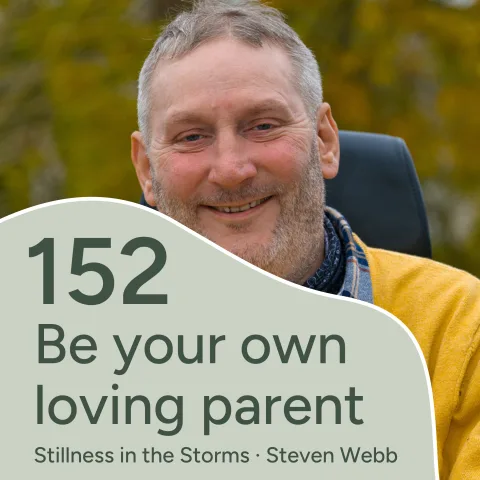
0:00 Hello, I'm Stephen Webb and this is Stillness in the Storms,
0:04 the podcast that helps you to find inner peace in the midst of
0:07 life's chaos.
0:10 On today's show, I'm going to be talking about my story of shame
0:14 and then I will share how you can identify whether shame is holding
0:18 you back.
0:19 And considering I did not see how it was holding me back for 30
0:24 years, it's not easy to see.
0:27 It really did transform my whole life complet the moment I realized
0:33 this and it was really just a moment.
0:36 You know, you need to hear this story.
0:37 If you're just if you feel like there's a lot more you can do
0:43 and you just on the edge of it and you want to be there and you
0:46 want to do more, but you're a bit fearful of doing it.
0:50 This show is for you.
0:52 But just before we start on today's show, I want to say thank
0:55 you to a few of you this week.
0:57 And it's so appreciative and thank you.
0:59 Who bought me a coffee?
1:00 I Audra Bianca, someone Anonymous and Kelly and Lydia.
1:05 You guys are awesome and thank you.
1:07 It makes such a huge difference.
1:09 And if you want to treat me to a coffee, just say thank you for
1:13 the show.
1:13 Just say if I help you in any way, it makes a huge difference.
1:17 I'm currently saving up to buy a new seat for my wheelchair and
1:22 that's where all this money is going to right now.
1:25 I'm trying to buy and you see it's currently on ebay and I'm hoping
1:29 they don't sell it.
1:30 It's in Germany and they're, they've redone it.
1:34 So that's what I'm currently trying to save up for right now.
1:37 Anyway, I've made it really easy for you.
1:40 Just head over to thankousteven.com and you can donate.
1:44 You can buy me a coffee or you can download the five simple practices
1:49 for Inner peace and join my newsletter.
1:52 Thank you, steven.com.
1:55 you are awesome.
1:56 Right?
1:56 Today's show, I'm talking about shame.
2:00 I don't know if you ever seen any of the books by Brenny Brown
2:03 when she talks about shame.
2:04 She's done a brilliant TED talk a few years ago, probably 10
2:09 years ago now.
2:11 And I remember watching it and I remember about eight or nine years
2:15 ago watching it and thinking, well, that's other people.
2:19 You know, I know stuff from Shane, but I never realized it really
2:22 affected me and I could see it in other people.
2:25 And I was happy.
2:27 I was, you know, I got on my life I enjoyed my life.
2:31 Shame doesn't bother me, but boy did it.
2:34 It so affected me in so many subtle ways.
2:38 And I had no idea, I had no idea the decisions I was making was
2:43 because of my shame.
2:45 I thought I was just being nice and polite.
2:48 I thought I was being kind to people and all that.
2:51 And it wasn't.
2:52 I was really deep, like neck deep in my shame.
2:57 So just a very little bit of background to anybody that's new
3:01 to my podcast.
3:02 I'm paralyzed from just below the neck.
3:05 I broke my neck when I was 18 years old.
3:08 I was in 1991, so over 30 years ago now, September 1st, it
3:14 was 10:30 in the evening and I dived into a swimming pool and I
3:17 broke my neck C5, the fifth bone down and instantly paralyzed.
3:23 I cannot move my hands, fingers, I cannot feel anything from
3:27 my nipples down.
3:29 And I use an electric wheelchair permanently.
3:31 And yeah, I've been like it, you know, 30 years.
3:36 And anybody who knows me, I'm happy, I get on with life, I'm very
3:40 positive and things like that.
3:42 I just find there's as much effort in being negative as there
3:45 is in positive.
3:47 But it's not that easy.
3:48 You know, if you listen to my podcast regularly, you'll know that
3:52 even being positive there's, it takes work, you know, it's not
3:57 just a moment decision.
4:00 But I digress for a moment.
4:02 I want to, I want to stick on the story of shame, but I had to
4:06 give you a bit of background, otherwise you may not understand
4:10 the reason behind it.
4:12 So my story of shame, really.
4:16 Well, a, I didn't know I suffered from it and this is really
4:18 important, but very much after I broke my neck, I spent 12 months
4:23 in hospital and the very first time I can remember coming out of
4:28 hospital for a proper day and I went to Farnborough Air day.
4:34 And at the time I was in a manual wheelchair.
4:38 It took me a few years to succumb to the fact that I might
4:41 need an electric wheelchair to be more independent.
4:44 That was like giving into my disability.
4:46 I'm not that disabled.
4:47 I don't need an electric wheelchair.
4:49 Boy, the minute I got an electric wheelchair, it's like giving
4:53 me my freedom.
4:54 But you know, I wasn't that disabled, didn't need that.
4:58 So I was being pushed around Farnborough Air day.
5:02 It was massively hot, they were running low on water and it
5:06 was the first time I was out and about and being going from an
5:12 able bodied person at the age of 18.
5:13 I was now 19 because I spent a year in hospital Being pushed about.
5:18 Other people in wheelchairs waved to me.
5:20 And just like.
5:22 I don't know if you.
5:23 If you're in the uk, you got the VW club.
5:26 Oh, you have the VWS or otherwise.
5:28 But they tend to wave at each other as they drive past in the road.
5:32 The vw, the Volkswagens.
5:34 And it's like this communist niche community.
5:38 Like, you feel part of it.
5:40 You wave at people even if you're not.
5:42 You don't know them.
5:43 And suddenly I was.
5:45 These people in wheelchairs were like, all right, all right.
5:48 I was like, yeah, do I know you?
5:51 I found it a little bit strange and odd.
5:54 I remember there was a little small queue, about five or six people
5:58 queuing up to sit in the cockpit of a Spitfire.
6:02 I think it was.
6:04 It was a fighter plane anyway.
6:05 And you had the steps going up and the steps going down the other
6:08 way.
6:09 And a couple of the guys came over to me and said, do you want
6:13 to sit in the cockpit?
6:15 No, no, not at all.
6:17 I said, no, sure, it won't be a problem.
6:19 We got enough guys.
6:20 We can lift you in.
6:21 I was like, no, no, no, it's okay.
6:24 And of course I wanted to.
6:26 I was dancing.
6:28 How cool would that be?
6:30 I still want to do it.
6:31 You know, if anybody's got a fighter plane out there, especially
6:34 one that flies in the air, you know, if you want to put me in the
6:37 back of me, I'd love to do that.
6:38 How awesome would that be?
6:40 But I didn't want to do it because I didn't want to put them
6:44 out.
6:44 I didn't want to be a burden.
6:47 Now then that seemed normal to me.
6:49 That was okay.
6:50 I just didn't want to be a burden on people.
6:52 I didn't want them to have to put themselves out for me.
6:57 And I didn't know quite why I felt like that.
7:00 It took me 30 years to realize why I felt like that.
7:04 I could guess.
7:05 I would always say, well, I just don't want to be a pain.
7:07 I don't want to be a burden on people.
7:10 You know, they're busy and all that.
7:12 I used to justify in so many ways, but what was the reason behind
7:16 it?
7:16 What was the deeper reason behind it?
7:20 And it was my shame, but I couldn't see it.
7:23 And I would be in a shop or something like that, and I'd be looking
7:27 at stuff on the shelf.
7:30 I'm looking at magazines, and I always remember, I'm going to tell
7:33 you this story, actually.
7:34 I remember being in a shop called Tremlets in the uk and I don't
7:40 know if they're countrywide or just local to Truro, but a shop called
7:44 Tremlitz.
7:44 And in the uk, the adult magazines were always on the top
7:49 shelf.
7:50 And I can remember being in the tremulous.
7:53 I was looking at all the magazines, I was looking around and
7:57 this lady, she's probably 10, 15 years older than me there she
8:02 was, she was quite a bit older than me actually.
8:03 I was in my early 20s and she must have been 40, 50.
8:08 And she said, do you want to have a look at the magazines or anything?
8:11 Do you want me to help you look through them?
8:14 And I was like, no, no, no.
8:16 She goes, no, honestly, honestly, I don't mind.
8:20 I was like, no, honestly, I'm okay.
8:23 She said, look, I can reach any of them from the top shelf or
8:26 anything and I don't mind showing you the pictures or anything.
8:29 I just wanted to die.
8:32 But I just, I don't know why I shared that story.
8:35 It's got nothing to do with my shame or anything like that.
8:37 But I just wanted to die.
8:39 But.
8:39 But I get that a lot.
8:40 So when I'm in supermarkets or when I'm in town or when I'm over
8:43 places, if I stop to have a look around, someone to go, do you
8:46 want a hand?
8:47 And my go to answer was always, no, I'm okay, thank you.
8:53 Even if I want a hand, even if I'm desperate to have a look at something
8:58 to smell the candle or I'm just trying to think of something
9:02 else that I might pick up to smell.
9:04 But if I wanted to look at something more detail, may have wanted
9:10 to see the ingredients on some in food, I would just look up and
9:13 go, no, I'm okay, thank you.
9:14 And I would disappear quickly.
9:17 And that was my go to answer for anybody offering help.
9:22 And it was very much right throughout life.
9:25 So I'm going to Skip now like 30 years.
9:31 And it was after I hit my rock bottom and after I started like doing
9:38 some work on myself and through meditation and through other
9:42 things and through meditation and all that.
9:44 And I don't mean deep work to be happy and positive and like be
9:49 enlightened and all that.
9:51 My meditation work was just sit down, shut up and observe.
9:55 You know, if you want to paint an amazing picture of the scenery
10:00 outside, really slow down and have a look at the scenery, look
10:06 at the different color leaves and how the light shines on the leaves
10:10 and how they're different textures and all.
10:12 So in order to do something well, you have to sit and observe.
10:17 So that's What I did, my meditation practice was sit and observe.
10:21 So I would observe the way I thought, the way I feel, the way
10:25 I'm seeing the situation.
10:26 And I'd be entertained by it sometimes, annoyed by it sometimes.
10:30 And in general, I would just sit down and shut up and watch it.
10:36 And over the course of a couple of years, I learned that when
10:40 I was annoyed about things, they were onto something.
10:45 So if somebody annoyed me, then there was something there that
10:51 I had to deal with.
10:52 There was some shadow, there was something from my past or some
10:56 thoughts I had, some jealousy or, I don't know, some shame or something.
11:01 There was something there that.
11:03 And Jun Ho, one of my teachers, sadly passed away.
11:06 Now, his phrase was, your angst is your liberation.
11:11 So if there's some angst there, go there, find out what it
11:15 is, don't dismiss it.
11:17 So if it annoys you, it's something to go and have a look.
11:21 I remember sitting down in the dining room.
11:23 My ex girlfriend came over and this was about two years after we
11:28 finished, probably three years.
11:30 So I was able to sit in the dining room.
11:31 I was able to not feel anything.
11:33 She was a friend by that time, and I was able to sit there.
11:38 And she said, you know what the problem with you is?
11:42 You have like this chip on your shoulder.
11:45 I was like, oh, so right.
11:50 Like a red rag to a bull.
11:51 It's like, really?
11:54 I didn't say anything.
11:55 I sat there and I felt my anger boiling.
11:59 I was like, oh, then years ago, I'd have been, how ridiculous.
12:03 W stupid.
12:04 How dare you say that?
12:06 How can you?
12:06 But I knew that she said something that triggered something
12:11 in me, so there was something there.
12:15 You got a chip on your shoulder.
12:16 And I said, explain what you mean by that, because that's really
12:21 bothered me, you saying that.
12:22 So explain what you mean.
12:23 She said, the problem is, over the course of the conversation, I
12:29 realized it was some kind of shame.
12:33 And I remember saying to her that I would work on it, not any
12:37 reason for her or anything like that.
12:39 I said I would look at it, I'd try to see what that is.
12:43 And over the course of a few weeks, I was looking at the decisions
12:47 I was making.
12:48 And these decisions I was making was very much like when someone
12:55 offered to help me, I would refuse.
12:57 I'd go, oh, I wonder if that's to do with it.
13:00 And then at the time, I was having a conversation with one of
13:04 my fellow councillors, Councillor Stokes, and we were trying
13:07 to work out a way in which I could fund a new wheelchair.
13:13 My wheelchair was dying it was on its last legs.
13:16 The steering was broke, the batteries were gone.
13:18 It was 15 years old.
13:20 And we were working out all these ways of.
13:22 I could do a tour around Cornwall, I could get sponsors from
13:26 companies.
13:26 I could do all these things.
13:28 And then she suddenly said to me one day, why don't you just ask?
13:34 Why didn't you just put up a GoFundMe page and ask?
13:37 So I can do that?
13:39 I gotta give something back.
13:40 Why would they give it to me?
13:43 And in that conversation, I've realized, oh, my God, there's my
13:47 shame.
13:49 I cannot ask people why.
13:53 And of course, the why is the angst, the liberation.
13:56 You find out the why and you'll know where you've got to go.
14:00 You know where the work is.
14:02 Why can I not just ask?
14:06 And I said, because I'm not deserving of it.
14:10 So what do you mean you're not deserving of it?
14:13 You do loads of things for people.
14:14 You help people all the time.
14:16 Why are you not deserving of it?
14:18 And over the course of a couple of three weeks, I thought,
14:21 why am I?
14:22 Why don't I think I'm deserving of it?
14:25 And it led me to one realization, that when people say
14:28 I'm an inspiration, and I still get this now, people say, oh,
14:31 you're such an inspiration.
14:33 I used to hate it.
14:35 Why am I an inspiration?
14:38 I get out of bed the same as anybody else I go in my life, I'm
14:41 positive and happy.
14:42 Just because I'm paralyzed, it doesn't mean to say you can't get
14:45 on with your life.
14:48 But I realized that I had a deep shame about my disability, and
14:52 I was embarrassed about my disability.
14:54 And I'll tell you why.
14:56 Because I was the dumbass that broke my neck.
15:00 I was the dumbass that dived into that pool and did it.
15:04 I was the bloody idiot.
15:06 So everything that stemmed from me being paralyzed, I felt I
15:10 wasn't deserving of it.
15:12 To the point of, I had a deep shame about my disability, and I
15:16 didn't even think I deserved to be in disabled groups that advocate
15:23 and help disabled people.
15:26 How crazy is that?
15:28 They're not me.
15:29 They're people that are doing amazing things, but I don't belong
15:33 to that group because they're born with it or they had an accident
15:38 or they've done all these things.
15:40 They're genuinely disabled.
15:42 And I'm not.
15:42 I'm an idiot.
15:45 And I had a huge shame about my disability.
15:48 And don't get me wrong, I was an idiot for diving into the pool,
15:53 but it was A mistake.
15:55 It was a one off.
15:57 Yet that one mistake held me in such a deep, invisible subconscious
16:04 shame for 30 years.
16:06 And it stopped me asking for help, it stopped me growing, it stopped
16:10 my confidence, it stopped me advocating and helping other disabled
16:15 people.
16:16 I was trying to live an able bodied person's life while having
16:20 my bum wiped, while having to.
16:24 And some days, if I get through the day without bloody soil
16:27 in my pants, it's a damn good day.
16:31 I'm the mayor of Truro at the moment and it's the most awesome
16:35 experience I've ever had.
16:36 So I go to meetings, I do all these amazing crazy things and yet
16:41 going through a day just not soiling myself is like a bloody success.
16:45 And I didn't realize how severely disabled I was because I
16:49 was denying my disability, because I was embarrassed about it.
16:55 How crazy?
16:58 How crazy is that?
16:59 And that shame, just me away and it had me away because I wasn't
17:05 living my full potential, because I was holding myself back,
17:10 because I feared people would see that I'm not really disabled,
17:14 yet here I am, paralyzed.
17:18 How crazy.
17:19 It's just mental.
17:21 How something can have such a massive impact on your life, yet
17:27 you cannot see it.
17:31 Boy, that was the realization of that.
17:34 And then subsequently I said to Kylie in Councilor Stokes, I said,
17:39 okay, let's do it.
17:41 I set up a GoFundMe and I said, I need £10,000 for a new electric
17:45 wheelchair.
17:47 £1,000 came in.
17:50 I was like, what?
17:54 1200 pound, 1400, 1600.
17:57 I feel like sitting there crying now, thinking how and just
18:03 telling the story.
18:05 Boy, I got tears in my eyes now.
18:07 Just telling you the story is like, what a freedom.
18:12 Wow.
18:14 And I realized when I spoke to people, I said, why?
18:16 Why are you doing this?
18:17 I wanted to give them the money back.
18:19 I wanted to phone them and say, look, that's great, but you
18:22 know, you can have this money pack.
18:25 Didn't feel deserving of it.
18:27 And, and of course they wanted to give the money.
18:29 That in the art of giving was enough for them.
18:33 They didn't.
18:33 They just wanted to give me my freedom, they wanted to give me my
18:36 chair and it was a gift from them.
18:38 They didn't want the money back.
18:39 They would have been offended if I had given the money back.
18:44 So over the course of like three weeks I had 10,000 pound come
18:50 in and I bought a new wheelchair.
18:54 And in the first two years I'd done 1800 miles in this wheelchair.
18:58 It was mental.
18:59 I love my wheelchair.
19:00 I'm back in it again today because we've done some Work on it.
19:03 Recently, we've done some repairs on it.
19:06 And the freedom that gave me.
19:09 But the chair wasn't the freedom.
19:10 The chair was the physical freedom, but the freedom of realizing
19:15 that shame and suddenly going, do you know what?
19:17 I am deserving of it?
19:18 I'm deserving of it because I'm getting on with my life.
19:21 So the accident.
19:22 And this is why I know now you want to give me a.
19:25 Call me, an inspiration.
19:27 Go ahead.
19:28 In part, I still want to run, but in part, I love it.
19:31 And I love it because it's not what you do in life, it's what you
19:35 do with it.
19:37 You know, I was a dumbass.
19:38 I paralyzed myself.
19:39 I dived into the pool, but what did I do with it?
19:44 And I often say, if someone was to give me the best piece of
19:47 advice when I was lying in bed with metal braces attached to the
19:52 top of my head, with 15 pounds of weight hanging off the top, with
19:57 a tracheotomy in my throat, that I couldn't speak, losing several
20:01 pounds per week until the point where I was six foot and you
20:06 could see every rib, I was down to about seven and a half stone.
20:09 Hospital.
20:11 If someone could give me the best bit of advice, then would have
20:14 been, do you know what, Stephen?
20:17 Great, you're paralyzed, but what are you going to do with it?
20:23 Great, you're paralyzed.
20:24 What are you going to do with it?
20:26 And that is the key.
20:27 You have this life.
20:29 What are you going to do with it?
20:31 You have this gift.
20:32 Now, this gift could be.
20:34 You know, the gift was my accident.
20:38 The gift was what happened to me.
20:41 The gift was that I was a dumbass that dived into the pool.
20:46 You know, I believe there's a gift in everything.
20:48 You just got to sometimes dig a little deeper to find it.
20:54 You know, I'm paralyzed.
20:56 Whether I use it as a gift or not, I'm still paralyzed.
21:00 You know, it's like saying, you know, I'd love to be an animal,
21:06 a rabbit or something, and live in some lovely meadow.
21:11 Well, you can.
21:11 You can want that all you like, all you like.
21:14 You're still going to be human.
21:16 The end of the day, you know, all our angst comes from when we
21:21 want something to be different than what it is.
21:25 And there's my shame.
21:26 And since then, I've been able to talk to more people.
21:29 I wouldn't be sitting in here as mayor of Truro if I didn't have
21:35 that realization of how the shame was holding me back.
21:38 And does it still hold me back?
21:39 Does it still keep me Humble.
21:41 Oh boy, yes.
21:42 And I'm glad of that.
21:44 When someone comes up and offers me help, my initial reaction
21:49 of that habitable so long in my life and I still think now that
21:54 seven year old self doesn't, isn't deserving of something.
21:58 And I don't know why I'm still working on that one.
22:02 You know, have balance with the work as well.
22:04 Don't work too hard, you know, have balance because you can dig
22:09 all you like and you'll always find something.
22:12 The wisdom is knowing when to stop digging and when to get on with
22:16 life.
22:16 From the depth you are or the height you are, whichever way.
22:22 But going back to my shame and my liberation from it, just that
22:28 realization just brought it in.
22:30 From a shadow to the visible self, I shone the light on why I
22:35 say no.
22:37 And now when someone offers me, my initial reaction is no.
22:41 But then I go, I pause right to the point.
22:45 Now I can say, look, if you want to offer me a coffee, if you
22:50 want to donate a coffee to me, it's alien to me to say to you, donate
22:56 something.
22:57 If I help you, go to thankousteven.com that feels odd
23:00 to me.
23:02 So when one of you do it, like Audrey and Bianca that have done
23:05 this week, when one of you do that, I find that strange.
23:11 But on the flip side, I'm starting to get used to it and I'm
23:15 starting to think, well, if I help, why not?
23:18 So, yeah, that's my story of shame and the way I found freedom
23:24 from it.
23:26 But I had to go there.
23:28 I had to go where it was uncomfortable.
23:33 How do you identify yours?
23:36 I don't know.
23:37 I don't know.
23:39 See what annoys you?
23:42 You know, the difference is made in my life and it's a healthy
23:47 confidence.
23:49 I'm still not that confident now.
23:51 I still say to everyone, was that okay?
23:53 But that's all right, that's fine.
23:56 I can always remember Oprah Winfrey telling a story about Obama.
24:00 Obama, probably one of the best speakers on earth.
24:04 He was on Oprah Winfrey after he was president, after he become
24:10 effectively leader of the free world.
24:12 You cannot get no higher promotion than that.
24:16 And he leaned into Oprah at the end, Oprah said, I said, did
24:20 I do all right?
24:20 Was that okay?
24:23 I don't mind that humbleness.
24:25 You know, I'm always second guessing, am I doing okay?
24:28 Was that speech okay?
24:29 Was that all right?
24:30 That's fine, you know, don't have that.
24:33 There's a fine balance in confidence.
24:36 You know, I don't release the podcast as often as I should, because
24:41 I don't feel like I've got something to share that's worthy.
24:46 Yeah, I know, it's crazy.
24:49 Even though I get these emails, I get these things of how
24:51 much I help people, I still want to step back.
24:54 And I think that Marianne Williamson quote is absolutely brilliant,
24:57 where it says, it's not the darkness that we're frightened of,
25:01 it's our light that we're frightened of.
25:03 What if the world shines a torch on us and says, show up?
25:07 Oh, boy, that's frightening.
25:10 And that in that fright.
25:13 And that's why we're more frightened of going on stage talking
25:17 in front of 10, 15,000 people than we are of death.
25:23 I think 80% answer the question.
25:25 Of course, this isn't actually true because they probably aren't
25:30 faced with death imminently, but 80% of people said they would
25:34 rather die than go on stage talking in front of people.
25:38 I'm sure they wouldn't, given the two options, but that's how frightening
25:43 it is when the world's spotlight is on you.
25:47 Terrifying.
25:50 But I promised at the beginning of this podcast that I
25:53 would share with you a few ways in which you can see your shame.
25:57 And if shame is affecting you, you know, self doubt, and that's
26:05 me, you know, if you frequently doubt your abilities,
26:09 you question your decisions or feel unworthy, then maybe it's shame.
26:15 Maybe it's shame playing the role.
26:17 If you're a perfectionist and you think everything has to be perfect,
26:23 I would say that's shame holding you back.
26:26 You're frightened of the world seeing you expose your flaws.
26:32 We're all deeply flawed, trust me.
26:34 And what's really interesting is we done a little march through
26:38 town.
26:38 I was in my robes and on Monday morning and I was talking
26:41 to the clergy there, I was talking to the canon and other people.
26:48 And it's really funny because I said one thing I've learned since
26:51 I've been married.
26:52 Everything looks really polished, but everything's going
26:56 wrong on the inside.
26:57 But no one knows.
27:00 Everybody's winging it.
27:01 Really.
27:02 Believe me, everybody's winging it.
27:04 When you see that perfect speech, you don't know how many words
27:08 they go wrong.
27:10 You don't.
27:12 Another way is avoidance.
27:13 Are you avoiding situations?
27:17 Do you have negative self talk?
27:20 Oh, boy, I do sometimes.
27:22 I don't suffer that so much as I do, but I have a lot of conversations
27:26 in my head.
27:27 Years ago, as growing up, we always said that would be.
27:30 You think you got a mental illness if you've got conversations
27:33 in your head.
27:34 If I don't have a conversation in my head.
27:35 I think.
27:36 I think something's wrong nowadays.
27:39 If you if you like isolation, you know, if you tend to withdraw
27:44 from social situations, avoid making new friends, or struggle to
27:48 connect with others on a deep level, shame may be contributing
27:53 to your feelings of isolation.
27:56 You know, if you recognize these signs in yourself, it may be
28:00 helpful to explore your feelings of shame and how they're
28:05 impacting your life.
28:07 Seeking support from a trusted friend Just say to them, you know,
28:13 how does shame affect you?
28:16 And I highly recommend Brandi Brown's book Power of Vulnerability.
28:22 I do them on Audible because they're easier.
28:25 Shove them in my ears and press play.
28:28 Sorry to say it Brenny, but I do fall asleep a lot to Audible books
28:32 and I have to re listen to them.
28:34 But that's okay.
28:35 Sleep's good either.
28:37 Dalai Lama said the best meditation is sometimes sleep thank
28:45 you guys for listening to my podcast.
28:47 My podcast going from Strength to Strength.
28:50 If you can leave reviews, that would be amazing.
28:52 If you can support in some way.
28:54 Like I said, I'm trying to save up for a new seat at the moment
28:58 to go on that new awesome wheelchair that I bought a couple
29:01 of years ago.
29:03 I did buy a seat at the time, but it's not comfortable.
29:07 It's giving me pressure.
29:08 So I've got to go back to the original seat I had back the new
29:13 version of it.
29:15 Anyway, I'm complicating things.
29:17 If you can help, it'd be awesome.
29:19 Thank you steven.com but you can download the 5 Simple Practices
29:23 for Inner Peace.
29:24 You are awesome.
29:26 Have a look at your shame.
29:27 If it's bothering you, there's something there to work on.
29:31 Take care guys.
29:32 I love you Sa.