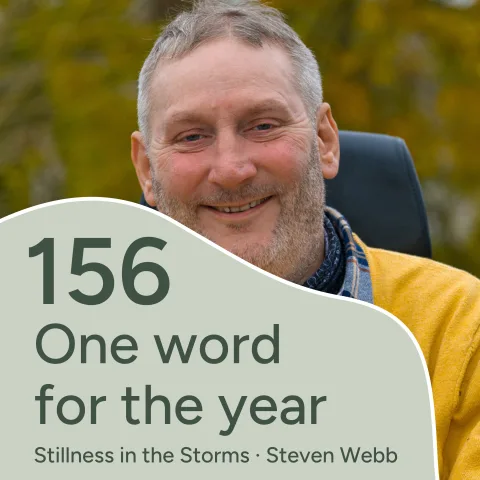
What would your kettle say about you if it had feelings? That is not a joke. That is where deep gratitude starts.
I did not want to record this one. You get up, you put the kettle on, it clicks, it boils, you pour the coffee and you sit down, and not one part of that got a moment's notice. Go deeper. The person who made it. The people who mined the metal. Do the same with the shirt you have on, the cotton, the field, the till it was sold at. That is when it stops being a gratitude list and starts being genuinely overwhelming. And the Buddha put gratitude on the path itself, not beside it.
One thing to try: Pick one ordinary object today and follow it all the way back. Stop when you feel it.
In this episode
(2:45) What the Buddha said about gratitude
(3:51) Desire, attachment and where the suffering comes in
(6:19) If you take one thing away, take this
(7:56) A fire alarm needs action. A feeling does not
(9:15) I would not be who I am if it had not happened
(15:05) The bedroom upstairs I have not seen since I was eighteen
(18:48) The kettle clicks and nobody notices
(20:01) It will overwhelm you at first
(22:48) The shirt, the cotton, the field, the till
With gratitude to
Laura
Support the podcast and join the Weekly Calm: stevenwebb.uk
Thank you for listening.
Steven
The question this answers
What would your kettle say about you, if it had feelings?
That is not a joke. That is where deep gratitude starts, and it is the single thing that makes me happier than anything else I do.
I did not want to record this one. It had been a rough morning, back on the bed several times, two carers sorting me out. I said so at the start rather than pretend otherwise, and by the end of it I felt better, which is rather the argument.
The heart of it
Gratitude turns what you have into enough. That is the whole mechanism.
Being grateful for the good bits is a list. Going deep on one ordinary thing is a different experience altogether.
You do not have to do anything with a thought. Not one thing.
The Buddha put gratitude on the path itself rather than beside it. Grateful for what you have rather than resentful for what you do not, and that word resentful is doing more work than it looks. Wanting something you do not have, and needing it to be all right, are the same activity.
Gratitude turns what you have into enough.
Now the practice. You get up, put the kettle on, it clicks, it boils, you pour, you sit down. Not one part of that got a second's notice.
So go deeper. Somebody made the kettle. Somebody mined the metal. Somebody got out of bed at five to run the power station. Somebody farmed the cow and somebody drove the milk. Tens of thousands of people, most of them long dead, had to line up for you to have that ten seconds.
Do the same with your pillow. The cotton, the field, the factory, the shop, the person on the till who sold it to you. That is when it stops being a list and starts to be genuinely overwhelming.
And then look at how we behave when one of them fails. It has boiled seven hundred mornings without missing once and the day it does not, we cannot believe it. Always happens to me. Bloody kettle.
The harder version is being grateful for the bad days, and I do not manage it on the day. Looking back, I know I would not be who I am without them. You would not wish a hard childhood on anybody, and the people doing the most for others have usually been through the most.
One small thing to try
Pick one ordinary object tomorrow morning and follow it all the way back.
Not five things. One. Keep going past the obvious answer, into the people you will never meet, and stop when you feel it in your body rather than when you run out of facts.
Questions people ask
Is this just counting your blessings?
That is the shallow end, and there is nothing wrong with it. This goes further. One object, followed back through everybody who touched it, does something a list of five things never quite manages.
How can I be grateful for a bad day?
Usually not while it is happening, and I would not pretend otherwise. What I can do afterwards is look at what it built. You are also assuming the alternative was better, and you have no way of knowing that.
What is the second practice in this episode?
That you do not have to do anything with a thought. Notice it like a leaf going past on the water. You do not have to fish it out, dry it off, or even decide it is a leaf.
Read along
The transcript
It follows the audio. Press any line to jump there.
In this episode
gratitude · happiness · buddhism
Read the transcript
I really don't want to do today's show. I don't want to be here recording a podcast. I don't feel
like it. But let's get on with today's show.
I'm Steven Webb and this is Stillness in the Storms. And hopefully the show will give you a different perspective
on life, to give you a little more inner peace. Today I'm talking about gratitude. The one thing I think
that makes me happier than anything else.
I often get asked the question, why are you so positive? Why are you always seem to be so happy?
And I first of all say, no, I'm not. I'm not always positive. That's certainly for sure. I'm not always
happy. What's going on the outside is not always what's going on the inside.
But I think what's really important is why what I do, what my practices are, that does make me
feel a little happier. And I wouldn't say they're actually practices. I would say they're what I do with my
mind when things start creeping up like today and This morning was a pretty rough morning. Had to go back
on the bed several times. The poor carers had to do all kinds of things
to sort me out and everything like that. It's just lucky there was two of them this morning. And yeah,
it was rough for them, but I was really grateful for them, what they were doing and what they were
helping me with. And I was really appreciating that they didn't want to be there and they didn't want to
be doing that either. And I'm sure they appreciate the fact that it's their job and things like that, but
that's not the point, you know what I mean? You know what I'm saying? What did the Buddha say about
gratitude? I always like to look up what the Buddha said, you know the one of the really wise people.
And when I say the Buddha, we're all Buddhas, we all have Buddha mind. What I'm talking about is the
sixth buddha siddhartha kutama the one that went around teaching the world, the one that found the four Noble Truths,
the one that seemed to leave some wisdom behind that we're still trying to get to grips with nowadays. You
know, you should be by a time we're reasonable age, we should all be living these things anyway. But yeah,
we're still. I have to think if he come back now and he would look around and go, really? I
left you those simple to-do list like a to-do list of like five or ten things or the Eightfold path,
like three thousand years ago, and you still haven't got a grip to it yet. It's like, yeah, well, you
haven't seen my to-do list and still isn't done from last week, last month, last year. But anyway, what did
the Buddha say about gratitude? The Buddha said gratitude is the key ingredient in the path of enlightenment.
He said that in order to achieve true happiness, we must learn to be grateful for what we have
rather than resentful for what we don't have. The Buddha believed that gratitude can bring us closer to contentment
and the peace that comes with it. I think there's a couple of really key ingredients there. He says about
being grateful for what we have. We all understand that concept. You know, if you're grateful for what you have,
you don't want things, you don't desire things, you're a lot happier. You're not resentful that other people have got
something that you don't have.
And he also mentions that rather than be resentful for what we don't have. So when you're desiring something and
wanting something, that's actually been resentful.
Unless you can desire in a way that you can desire it, but you don't need it.
You know, desire and need are two different things. You know, I have lots of desires. It doesn't mean I'm
going to act upon them. It doesn't mean I need them in order to be happy.
So. And desire leads to pain, leads to attachment. It leads to more suffering.
And the Buddha believed that gratitude brings us closer to contentment. We often look at happiness as a place to
get to,
whereas contentment is, I'm content. You know, if I look at something around me, I got a
cup on the side,
and that cup's just sat there being the cup
that cup is currently content.
Doesn't want for anything there's a need for anything. It doesn't want to be something different. It's just a cup.
Then if you sit there and just be a cup or be a human, just sit there and have desires,
have thoughts, have feelings, have emotions, but
don't do anything with them because you're just human. And that's what it means to be human. And in this
moment, you can just be content. Just
try it for a moment. What does contentment feel like?
What does contentment feel like to you?
Just close your eyes for a moment. Unless you're driving, don't close your eyes. If you're driving um
I think that's really a warning. But if you're able to close your eyes for a moment, or if you're
able to, even if you're driving out, just what does contentment feel like to you? What does that word mean
to you? You have everything you need right now. You have air, you have your health,
relatively, in this moment. You
have everything you need right now in this moment. Because if you're missing some of those vital things, you probably
shouldn't be listening into a podcast. So in this moment moment I'm going to presume that you have everything you
need in this moment to be content.
And whatever comes up at this moment, you don't have to do anything with.
What a concept that is. Wow. It's like what I can have a thought and I don't have to do
anything with it. Yeah, try it. That's like. That's like mind-blowing how much that simple
concept can change your life. And I say this on every podcast, I probably say at least once, if you
take one concept away with you, take this one away. If you have a thought or a feeling, remember, you
don't have to do anything with it.
Yeah.
You don't have to even acknowledge it. Just like a leaf floating down in the river, you could just notice
the leaf. You don't have to take it out, you don't have to dry it off, you don't have to
do anything with it. You don't have to take a picture of it. You don't even have to acknowledge it's
a leaf. You can just see it and watch it.
How much happier does that make you feel? Just been content that you don't have to do anything with it?
The problem is we're living in such a society now that anything comes up, we think we have to do
something with it.
We think we have to do something with everything. Now, I know that because whenever I go across town in
my role at the moment as mayor, someone will stop me and someone will go, do you know what? There's
something needs sorting out and I've got a bone to pig with someone. I've got this, that, and the other.
Very often a lot of people just want to have a moan when I say, well, look, can I take
a number Can I do something about it? They go nah I'm not that worried. I just wanted to tell
someone. And there instantly, that feeling of it's sorted is done. I
was still trying to work out with the people that or the things I need to do something with or
not need to do something with. If your fire alarm goes, that's something you need to do something. With work
out the difference, but yet we give our thoughts importance. We give our feelings importance. You know, you don't have
to do something with it. But going back to gratitude, you know, I don't know who said this, but gratitude
turns what you have into enough.
You've got enough in this moment.
Nothing more needed in this moment. Gratitude
means thankfulness, counting your blessings, noticing simple pleasures, and acknowledging everything that you receive
opal Winfrey Boy, that last sentence. And acknowledging everything that you receive and I cannot
speak for opal Winfrey but she had a pretty terrible, damning childhood. She didn't have an easy adulthood.
And if anybody's ever read Oprah's story it's it's pretty horrendous. But
you know what? She appreciates it. And she has a deep gratitude for the life she's had. And it's the
same as me I I I've got to the point where not always I've got to sit down and meditate
on it. Sometimes I gotta take a step back and look at it. But a lot of the time when
I have a really bad time, when I look back on my life and think, that was terrible what happened
to me.
And I take a deep breath and I think, do you know what? I wouldn't be who I am today
if it wasn't for that.
You know, when you look at the scars on your body, when you look at the scars on your soul
and your shadows and everything that gets triggered when things go wrong,
would you be who you are today without all those things?
You wouldn't choose them. You wouldn't want them. Don't get me wrong. You wouldn't wish for a tough childhood on
anybody. But you know what? The people that are doing really well as humans, as adults are the ones about
the toughest childhood. Not always. There's always the exception But in general, we're not talking about things like this. I'm
talking about the general going. When you line up 100 people and you look at the ones that are really.
I'm not saying they're successful with the most money, or the most stairs they've climbed anything like that, but I'm
talking about the ones that have done the most work, whether it's in the gym to run 100 meters quicker
or whether it's the most toughest times to be able to help the most people, they've normally been through the
most. Sometimes it's a choice, sometimes it's not. So if we learn to. Whatever comes up, love that, whatever
comes up, appreciate that. And I think that's what Oprah Winfrey's saying there is acknowledging everything that you receive.
How do you know? And I ask people this often when they say, you know, I'm after a really bad
day. And I said well how do you know the universe isn't giving you this day to teach you something
that you need later on? Now, I don't believe in fate. I don't believe in the universe there's any kind
of karma calculating. I don't believe there's some room somewhere in the universe with 10 million
animals or bugs or humans or something like that typing into
typewriters, all the scores of everybody keeping their karmic score on everybody. And well they've got high karma, they've got
low karma I don't believe any of that for a minute.
However, this way above my book I don't know what the universe is up to.
Who knows, Maybe I had to have this life. Maybe from the Buddha sense where we're reincarnated, maybe this is
the one life I needed before. Maybe this was the life I chose.
There's a really good question that says, you know, you're just about to be born, you're put down on this
earth again for another time you've got three choices. I'm going to butcher this one, but I think you have
three choices. You can have a really easy life and you'll just sail for it but you won't learn nothing.
You have a really, really tough, horrible life, but you'll learn loads. But it won't be easy.
Or you have a relatively normal life, but you won't really learn much, you won't really experience as much?
Which one would you choose?
It's interesting. Perhaps you've had the other two and they didn't work.
Because I know people that have had. And this is all relative. Let me point this out.
Everybody has a relatively tough life compared to the muscle they have built. And I'm talking about muscle, not just
physical muscle. I'm talking about mental and emotional strength and things like that.
Everybody that I know has
a relative life to what they've built up.
So before I say this, bear that in mind. But I do know people that have had a lesser, less
of a tougher life than others.
And when something goes wrong, boy, does it spin them out.
And other people look at them and go, they're losing the plot. They've totally spun them out
because that they've got a relatively comfortable, stable life. Now, it may not be relatively
comfortable and stable to them, but to others it may look like that. And to others, literally the world can
handle hand them the worst possible of Days again and again. And it can literally slam them down. And they're
like. A good analogy is they're on a three dual car, three road motorway and they're on the
middle one. They stand up and the car runs them down. They stand up, the car runs them down, they
stand up and they onto another lane and Laurie runs a nut And the analogy is, do you know what
I Keep knocking me down because I'm ready and I can handle it. And there's nothing you can do to
me because do you know what? I've been knocked down that many times. You cannot do any more to me.
So. And there's other people that literally, they just get knocked slightly off their feet and say, that's it, I'm
done. I cannot do life anymore.
And, you know, I'm not saying anyone's any better than the other. It's relative to them. Let's be straight on
that one. But it's really interesting. It's really interesting. So appreciate what comes up. I think that's where gratitude comes
from. Be you know be thankful for the things you like. Thank you for the present, thank you for the
next day Thank you for the. But gratitude has been grateful for everything. From a deeper sense. It's a practice.
And
be grateful for everything around you, your friends and everybody that's there for you and be And this is where
gratitude and depth comes in. You know, when I come down in the morning, I don't come down, okay, I
sleep downstairs. I, you know I'm paralysed I haven't been upstairs I live in the same house I lived in
when I was moved in here when I was 12 years old and I got my old bedroom upstairs. I
was there till I was about 18 and I broke my neck and they built an extension on the back.
But I haven't been in my bedroom upstairs since I was like, I don't know, 17, 18. And I remember
the very last Sunday I done a podcast on this um no Ordinary Day. It's called. And
if you look back through my podcast, it was 20, 30 podcasts ago, no Ordinary Day. And I talked you
through the last day I had that I got out of bed in that bedroom upstairs. I just went through
an ordinary day and ended up paralysed to the end of the day. I had no idea it was going
to happen. It was a podcast that was played on the Bbc radio. It went down that well. So
anyway, I I digress But even that day I'm grateful for now. I don't know if the
alternative was better you
know We don't like to be grateful for bad times. Because we think the alternative is better. If I wasn't
having this bad time, I'd be having a better time. No, not necessarily. You could be having a terrible time.
You know, if it wasn't raining and you're sodding through and it's freezing cold, you could be having a
lot worse time than that. Trust me. It may not be. The alternative is sunny. You
know, that's the reality of things
um I'm slightly going off the topic of. Well, no, I am on the topic of gratitude, because this is
all about gratitude.
You want to be happier, you want more peace, and like the Buddha say, contentment.
Be grateful for everything that's currently coming up. Everything. Even
the bad days. Love that as well,
because you don't know the difference. Otherwise, I'm going to give you a perfect example. How do you know
that stuff tastes nice if you haven't never tried stuff that tasted horrible? How
do we know that the sun is nice and we enjoy the summer without the winter if If every single
day was the same weather and it never changed and that just happened to work, we didn't have seasons and
we didn't have all those things, we would literally just. We would never talk about it. We'd never go on
nice weather. That conversation would never even happen because you'd never talk about it.
You know, you very rarely talk about um I don't know I'm trying to think of an example now that
doesn't change. Yeah,
I cannot think of one the thing If you think of one message me of an example of something that
doesn't change. I had a piece of white paper in my mind. You never go, oh, that's an extremely white
piece of paper. But
anyway, let's get back to gratitude. I
said I wasn't in the white frame of mind for a podcast today. I cannot even focus on one thing
and that doesn't matter. You're here. Oh, I totally forgot to say thank you to Laura for buying me a
coffee
20 minutes into the podcast. I haven't said thank you. Thank you, Laura for a coffee this week. And if
anybody wants to treat me to a coffee or you want to download the Five Simple Practices for in a
piece head over to StevenWebb.uk that's spelled with a V
s-t-e-v-e-n-w-e-b-b.uk
the link is under the podcast. Anyway, we're going back to gratitude. So you get out of
bed, you come downstairs and you put on the kettle and it clicks and it boils the water and we
pour our coffee in, we pour our milk in and we go and sit down, we have that lovely cup
of coffee in the morning. Do you ever sit there and go, do you know what? If it wasn't for
the farmer and the cow, if it wasn't for the guys getting out of bed this morning and going and
working at the power plants, if it wasn't for the, I don't know, tens of thousands of people that invented
the electric, invented the farming process, invented the cattle and everything like that that you wouldn't have had your coffee
so easily. We
take it for granted, don't we?
You look at how many things had to align to get you your coffee in the morning. Now, if you
do this one practice for the you've got two of them from this podcast. If you do this one thing
every morning with gratitude, this is a good gratitude exercise. Pick one thing when you get out of bed tomorrow
morning and think of everything that come into play in order to have that comfort, have
that coffee or have that car start. And
when you start to look into it, you'll
really see how deep gratitude does. And you'll probably feel quite overwhelmed to begin with. It'll really start overwhelming
you and your body and everything like that. Because when you start to realise how much stuff has to align
just to give you your coffee, just to start that engine in the morning, just to get you to work.
Problem
is, when it goes wrong, we complained. When the train doesn't turn up, we complain Don't get me wrong, you
probably should. That's a bad subject in the Uk at the moment. But when the kettle doesn't work or when
the car doesn't start, we can't believe this. It always happens to me. Bloody kettle. Wait a minute. It's worked
for two years there's 700 days or so on the regular mass, and it never missed a beat and you're
complaining? Imagine how that kettle feels. If kettles could have feelings, that should
be the That should be the title of this podcast. If Kettles could have Feelings. That's what it's going to
be,
deep gratitude. If kettles could have feelings. Yes, I like that. Give me a. Give me a high five.
Anyway, get back to see I'm feeling better. I'm just been grateful for my life. I'm being grateful
for thinking about everything that comes into play to give me my life right now. And I'm just feeling better
just to record this podcast. I've got a microphone, I got a computer, I got all these things. It all
lines up, all these people that invented all this stuff for me to be able to record something, to send
it over to you. So you can go to a website and you can download my five simple practices for
inner peace. You know, gratitude.
And when someone treats me to a coffee, I feel deeply grateful because it feels like I'm making a difference
and helping. And it helps me to do the editing so I don't have to do it all by myself.
It means I can. If five of you donate, it means that month I call that podcast, I can outsource
my editing, which saves me a lot of time. It saves me a lot of time. So
gratefulness has got a depth. And I'm going to leave it there for today. I've done over 25 minutes. I'm
going to totally leave it there. Gratefulness has a depth. And when you sit down and that practice in the
morning, just look at the depth of something. Take your pillow. The depth of that pillow is way deeper than
you think.
How did that pillow get there? Who invented the pillow? What is in the pillow? What is it made of?
The cotton in the fields that grew it. All those things. The. The place you bought it from, the person
not turn that for work to sell it to you on the till. Just go crazy of how deep these
things are. And you know what? You'll feel better. Your
whole life will change. Just simply remembering two things hey you don't have to do anything with a thought unless
you choose to. So choose to get on the positive, nice ones. Choose to do nothing with the ones you
don't want, and
you'll retrain your by retrain your mind, and
then choose to have depth of gratitude. And if you practice it on just one item every morning, sooner or
later you'll. Sooner or later someone will come up to you and go, oh, I can't believe what happened to
me it's like All the traffic lights are red. And you'll go, yeah, perhaps that saved your life. Who do
you know? How do you know that if the traffic light wasn't red, you might have had an accident 100
yards on?
So you'll become that person that turns all these negative feelings into a
positive, and you'll be like, oh, my God, I practiced deep gratitude and my life so much better. Let
me know how this goes um I love you guys. Thank you. And thank you for your emails. I've got
two or three emails I have to respond to um where you shared your story with me and you shared
what a difference these podcasts make and makes a huge difference in me.
I'm deeply grateful for you reaching out to me. You can do that via my website. I don't know if
I mentioned it yet, but it's StevenWebb.uk take care. Have an amazing week.