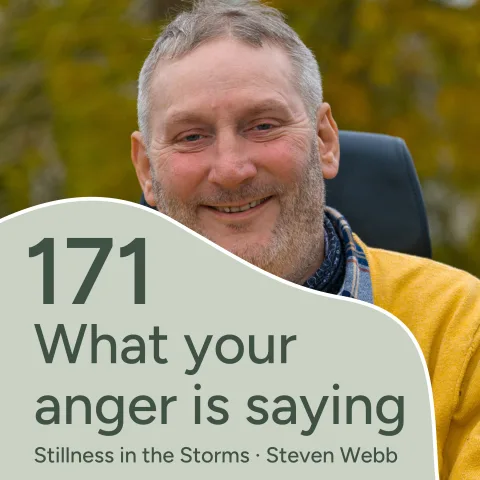
Why does a raised voice make you feel sick? Your nervous system is not overreacting. It learned that anger meant danger, and it is still doing its job.
Why does a raised voice make you feel sick? Your nervous system is not overreacting. It learned that anger meant danger, and it is still doing its job.
I was shouted at as a child, so some of it is that. Some of it is the person triggering something older. I get triggered by my daughter more than almost anybody, because I care and because I expected more. Nobody owns the road, and yet everybody wants to park in front of their own house. Anger is a hammer. It can smash a thing up or build something.
One thing to try: When it lands, ask one question. Did I expect more from them than I would from a stranger?
In this episode
(0:02) The sharp email, the raised voice, and your stomach turning
(2:48) Your nervous system is doing what it learned to do
(5:10) Being shouted at as a child, and what it left
(7:19) Nobody owns the road, and everybody wants to park on it
(9:25) Triggered by my daughter more than most, because I care
(11:57) You are not stuck in the past. Anger is a hammer
Support the podcast and join the Weekly Calm: stevenwebb.uk
Thank you for listening.
Steven
The question this answers
Why does a raised voice make you feel physically sick?
Somebody shouts, or a sharp email lands, and your stomach turns and your heart goes and you feel like you are four years old and in trouble for something you did not do.
Your nervous system is not overreacting. It learned that anger meant danger, and it is still doing its job.
The heart of it
For nearly all of human history you only dealt with your own tribe, maybe thirty people. Strangers shouting at you is brand new in evolutionary terms.
Anger is a hammer. It can smash a thing up or build something.
I hate conflict. Shouting makes me feel ill, and fighting back makes me feel worse, because it is not who I am. I have done it maybe three times as an adult and I cannot remember what any of them were about.
I was shouted at as a child, so some of this is that. The rest is the person hitting something older.
Here is the test I use. One person can go at me about something and I feel nothing. Another can say almost the same and I am off. Why? Usually because I expected more from them. I am triggered by my daughter more than almost anybody, because I care and because the bar is higher.
Twenty years ago, before I meditated at all, I had a kitchen full of plumbers and decorators and a man came down and knocked, wanting the van moved. Nobody owns the road and everybody wants to park outside their own house. He shouted for about five minutes. I said I could see it mattered to him, and if he gave me a good reason I would happily help. I was not reactive, because none of it landed on anything of mine.
I have never met an angry person who did not care.
Jun Po Denis Kelly
And I will give you the other kind. My daughter said something once and I let rip, in front of a friend, and I do not even remember what about. I can barely shout, since I only breathe with my diaphragm, and I managed it. She stood there and took it, and at the end she looked up and said, well, that was very Zen of you, wasn't it.
Do not try to be the tough one. Tough people are brittle. That is usually why they are shouting.
One small thing to try
When it lands, ask one question. Did I expect more from them than I would from a stranger?
And there is a thirty second version for the moment itself. Feel your feet. Then your breath. Then find the tension, in the jaw or the chest or the belly. Then say it inwardly: I am safe and I can choose. This is old wiring. I am not in danger.
Stillness here does not mean silence. It means staying rooted while the wind is up, and it applies to your own four year old too. Thank you, but it is alright.
Questions people ask
What if they are genuinely in the wrong?
They often are. You can say so, and you will say it better from a body that is not in fight or flight. Notice which one is talking before you answer.
Am I weak for reacting this way?
No. It is a survival response that kept your ancestors alive, and it is firing in a world it was not built for. That is not a character flaw.
Is there something to do in the moment itself?
The feet, breath, tension sequence takes about thirty seconds and works standing up in a corridor. It buys you the gap, and the gap is all you need.
Read along
The transcript
It follows the audio. Press any line to jump there.
anger · stress · boundaries
Read the transcript
You know that moment when someone raises their voice, shouts
at us, a sharp email hits your inbox, your stomach turns, heart
races, you feel sick, off balance, like you're in trouble.
And even when you know you're not.
That's what this episode's about.
Those moments when conflict doesn't just feel uncomfortable,
it feels unsafe.
Because you're not weak, you're not broken.
The body's just doing what it was built to do.
And that's why you're here for some stillness in the storms.
This is how to stay calm when people push your buttons.
So this episode was inspired by a brilliant question.
In our private stillness in the storms group, Toby Ross asked,
how do you deal with conflict when it feels unbearable?
When even a sharp word sends the body into panic or the mind into
self blame?
Thank you, Toby, great question and it still happens to
me today.
And thank you for letting me share the question and thank you
to you as a donator, because that's what keeps this podcast advert
free.
Every episode is free to listen to.
And it's not only possible and it's made possible by people like
you.
So deeply grateful to all of you that treat me to a coffee, that
donate and help this episode.
No four minute ad breaks, just us and just presents.
So thank you.
So I don't like conflict either.
I hate shouting.
I hate tension.
It makes me feel like I'm 4 years old and about to be punished,
like I've done something wrong.
Even when I know I haven't.
The response is real and it's ancient.
And especially when adults shout.
I say that because I'm an adult now, but yeah, somebody that's
anybody older than me, which means anybody older than 30, although
I'm 52, if that makes any sense.
You see, for most of human history, we only had to deal with
our tribe, our clan, maybe 30 people.
That's it.
We didn't deal with strangers yelling at us, or bosses sending
these Hyrule emails, or strangers on the Internet lashing
out, troll posting or anything like that.
In evolutionary terms, conflict outside of the tribe is
brand new.
So your nervous system is not overreacting.
It's just doing what it learned to do to stay alive.
If someone was angry at you in the past, it meant danger or exile.
So your reaction, heart pounding, nausea, panic, it's a survival
instinct.
It's not a weakness.
It's your body reacting the way it probably should do.
So that's the first thing, and that's one of the most important
things.
So in Zen, we often Say that the world is a mirror.
When someone is angry, they're holding up a mirror, not just to
us, but mostly to themselves.
Anger is often pain with nowhere to go, A desperate grab for
control, a cry that says, this matters to me.
You don't have to like it, but if you can see it, you don't have
to become it.
Stillness isn't about being passive.
It's about choosing your response and not being dragged into
theirs.
And my whole teaching with Junpo would always say I've never
met an angry person that doesn't care.
And that really.
That really hit me.
Because they may not care what I care about, but we can relate to
the fact that they care.
I've never been angry in my life, in any situation.
That it wasn't because I cared deeply about it, whether it was an
injustice, whether it was my daughter, you know, playing up, or
something like that.
It doesn't matter what it is, because I care.
There was something going on, and it was normally within myself,
whenever I was angry.
So it's.
It's one of those things that I always try to remember if.
If I'm.
If I'm reacting in a way that makes my heart pound and I feel sick
and feel really ill, there's still something in me that's unresolved
or something in me that's reacting.
It could be because I wish I did that as a child, which I was.
It could be because this person is triggering something deeper
in me.
So I try to recognize that, and that doesn't overly make it a
lot easier.
But what then I try to do is recognize that they care.
And I'll give you one thing.
We had a lot of renovation going on in our house about 20 years
ago.
And this was before I was doing any meditation, before I was
doing anything.
I've always been a reasonable person that doesn't like conflict.
I think I'm a reasonable person.
I.
The jury's out on that.
I don't know.
But I don't like conflict.
It frightens me.
It makes me feel ill.
But for me to fight back, for me to argue back, makes me feel even
worse.
Because that's not who I am.
I've done it maybe three times in my life that I remember as an
adult.
And I don't remember what they were about now.
I just remember doing it.
I remember asking my partner about 15 years ago to open the door
because I'm paralyzed.
I couldn't open the door over the damn door.
And she said, no.
I said, open the damn door.
Otherwise, I'll go through it.
I think she realized what I mean, and she opened the door, let
me out, and I turned around and said, and now slam it.
And I want you to slam it really hard, like as if I'm really
mad.
And I drove off about three hours, and I come back and I was
quite calm, but I don't really remember what it was all about, but
it was because I cared about something.
And very often it's something deeper, something further away, and
it might not even be what the other person is bringing to.
It might be something triggered.
So it's recognizing that they care about something.
So if you have to address their caring about something.
So we had a group of people, they were renovating the house, and
a guy come down the road.
He was always quite angry.
Our road is always, everybody likes to park in front of their house,
although nobody owns the road.
And if some people park 2 or 3 foot out of the way, other people
get really angry about it.
So a guy come down the road, knocked on the door, and I had a
kitchen full of people doing plumbing and decorating and all that
because I rent my house of local authority.
And they were sorting something out, and he stood there
and he said, can you move the van?
I said, look, the road's really busy.
Why do you want me to move the van?
Just move the van.
I said, look, give me a good reason and I'll move the van.
And he screamed and he shouted for about five minutes.
And all I said is, look, I know it's really important to you.
We've got no ass for the van for the moment.
If you can give me a good reason, I'm more than happy to help.
I didn't get reactive then because I knew I did nothing wrong.
So that's one type of conflict.
Just if you've done nothing wrong and you're not the one that
they're shouting at, just allow them to shout and say, do you
know what?
I realize you care.
But if we really react in a way that we don't like the situation,
it's normally because they've hit up on a nerve or they triggered
something in us.
Well, that's on us then, at that point.
And that's a difficult one.
That's a hard one to swallow sometimes.
And I'm still working on that one.
But very often when I sit back and think about it a few hours, do
you know what?
They really bother me.
And when you dig deeper, it nearly always is something with the
trigger is within us.
It's very often not them.
Because one person can never go at me about something and I'm
not triggered.
Another person can have a go at me about something similar and
I'm triggered.
Why is that?
Is it because the way they said it, Is it because who they are?
Did I expect more from them?
I'm triggered by my daughter more than most people and my family
because I've got emotional ties with them and because I care
deeply.
And I suppose I expect more if a stranger shouts at me about something,
I'm like, yeah.
Do you know what?
Your opinion means nothing to me.
But if Canberra did my daughter, I'd be like, what?
So, yeah, so we can do a little grounding, practice.
That's one of the things we can do.
If we just do 30 seconds now and we can do this anytime.
Just let's do this together right now.
Just sit still and feel your feet and become aware of your breath.
Notice the tension in your jaw, your chest or your belly and
just say to yourself, I am safe and I can choose.
I am safe.
I can choose.
And again, this is old wiring.
I'm not in danger.
I could stay present.
This is old wiring.
I'm not in danger.
I could stay present.
So just being aware, being aware.
Just become aware of your feet.
I don't know why that works.
Become aware of your breath and recognize the tension.
So feet breath, tension and recognize there's the old wiring,
misfiring and you've got the tools.
You know you practice.
I know you practice even if you don't sit on the cushion four
hours every morning.
I know you practice several times a day.
You just come back to awareness.
Just what's going on right now.
Conflict feels dangerous because once upon a time it probably
was.
If someone shouts at you 100,000 years ago or 10,000 years
ago, that meant you need to run, you need to get out of danger,
or you were cast out, exiled.
But you're not stuck in the past, you're here now in the modern
world.
And anger is a beautiful tool.
Anger is like a hammer, you know, it can smash things up or it
can build things.
Above all, anger is not the problem.
And if we have the wisdom to.
Ah, that's my four year old frightened.
Thank you, but it's okay.
Just say it silently aside, thank you, but it's okay.
You don't have to abandon yourself just to keep the peace.
You don't have to be this tough person.
And I'd recommend don't be the tough person because tough people
are brittle.
That's why this guy is shouting you.
Because they think they're a tough person.
Really be flexible.
Be that malleable person that if someone bashes into you in a busy
train station, just flex, let them bump into you, put your hand
up, apologize for being in the way and let them carry on.
It's.
It's ordinarily always about them, nearly always about them.
And bearing in mind stillness doesn't mean silence, it means staying
rooted.
Even when the wind howls, even when everything is breaking down
that someone is shouting.
Stillness can just be aha.
I'm in control of the way I respond here.
So you can say, thank you again, Toby, for your beautiful question
and thank you for listening.
If this has helped, please share it with someone who might need
it.
And if you haven't yet, do a like and a review.
That'd be amazing.
If you've got a bad review, let me know why and then I can improve.
It really does help more than you know.
And always no ads, none of this bullshit that you listen to
a 15 minute podcast with 6 minutes of adverts.
I'm not into that.
I'm into just, just us.
So thank you.
I'm Stephen Webb.
This is Stillness in the Storms.
And if you've got any tips on how to deal with angry people beyond
what I've thought about in this podcast, because there's only
scratching the surface.
And just remember they care and identify where they care and
remember it's your small inner child.
And very often it's, do we need to put more fuel on the fire?
Can we be the wiser one?
Can we be the adult in the room?
And I think you wouldn't be listening to this podcast if you
weren't already the adult in the room.
And yeah, you'll mess up.
You'll mess up.
Really.
Just a very quick story before I go.
Ken was coming to me one day and she said something and I just
went off on her.
And I even had a friend here at the time and I just let it rip.
And I have no idea now what it was about, but my world, I let it
rip and I shouted and shouted, shatter.
Then I don't really shout because I can only breathe in my
intercostal and breath in my diaphragm, but this, I was shouting
and she just stood there and she took it like a true Zen master
herself.
And she, she just.
And she looked up and she held up the most beautiful mirror.
At the end she goes, well, that was very Zen like of you, wasn't
it?
Because she knew I was doing all the work.
She knew I was trying to be Zen and I was trying to be something
I wasn't.
You know, we're not Zen.
We're not this peaceful, beautiful, saintly human.
We are just human.
And we evolved in a world that wasn't the world we are in now.
So take care, my friends, and till next time, I love you.
If you'd like to join our WhatsApp group, head over to stephenweb.uk
and whatever you donate, just a coffee or anything like that, it'll
give you a link to the WhatsApp group.
And don't forget, you can join the weekly Calm newsletter, which
is more like weekly fortnightly or weekly every three
weeks when I get to it.
But it's a work in progress.
You know, you'll get to know.
You don't follow me for my perfectionism because that's far
from where we are.
You follow me or you listen to the podcast, because we're real and
you're real and take care, my friend, and thank you.