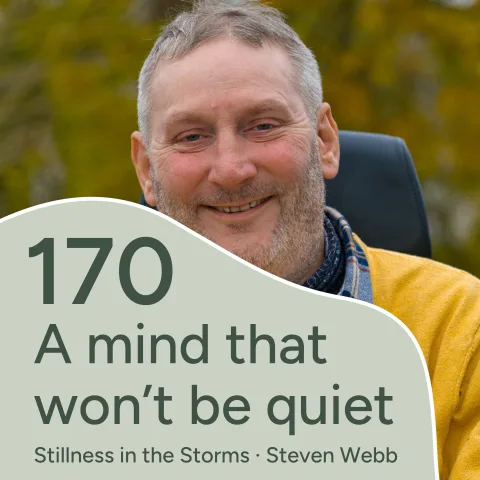
0:00 Foreign.
0:06 So welcome to stillness in the Storms.
0:09 I'm Stephen Webb, your host, and today's episode is really, really
0:13 simple.
0:14 Not easy, but simple.
0:17 You are not.
0:17 Your thoughts, you know, that voice in your head, that running
0:22 commentary, it's not you.
0:25 It never, never was.
0:26 And that's what we're going to talk about on today's podcast.
0:30 And also we're going to dig deeper into how do we stop that constant
0:34 overthinking, you know, when we get stuck on that same thought
0:38 or so we think it's the same thought as all coming up on today's
0:41 episode.
0:42 So just before we start, I just want to say a huge shout out
0:45 to Joan and Jenna.
0:47 Mia, you've supported the podcast Treating Me to a Coffee.
0:50 And Joan, you win the award this month, you treat me to 30 coffees.
0:55 Just thank you.
0:56 And it makes a big difference because that's what keeps this podcast
0:59 with no adverts.
1:01 And there's also the monthly subscribers like Audra and John and
1:05 many others.
1:06 Thank you so much.
1:08 And I'm going to list your names in future episodes because
1:12 without you, this podcast would have to have adverts or it
1:15 would not exist.
1:16 And I don't want to put adverts and I want to continue to
1:19 do it because it really does help so many people.
1:22 And you can treat me to a coffee.
1:24 Just go to stephenweb.uk and there'll be a link there where you
1:27 can just donate and treat me to a coffee.
1:31 Doesn't matter how many, you don't have to beat Joan.
1:34 30 coffees.
1:35 That was awesome.
1:36 Anyway, right, let's get on with today's show.
1:39 So have you ever wondered really about your thoughts?
1:42 Ever sat back and really thought about, well, where did they
1:45 come from?
1:46 Are they me?
1:47 Why are they just coming around again and again?
1:50 Well, if you do that, you'll notice how they just pop up.
1:55 They just seem to show up for no real reason.
1:58 You might get in the car and a thought will pop into your mind because
2:01 that's what it's used to doing.
2:03 So we've all know about the subconscious mind.
2:06 If you've been listening to my podcast more than, like, I don't
2:09 know, one or two episodes, you know, the subconscious mind.
2:12 You know how this works.
2:14 We have our thoughts popping into our head and we have our feelings
2:17 arise and we're triggered by things in the outside world constantly.
2:22 Like if you look around the room now and just look at items,
2:25 but don't pause on them for any longer than about half a second,
2:30 nothing happens.
2:32 But if you pause on them for more than a second or so, and then
2:36 a story starts to occur, whether it's looking at a window
2:40 or a photograph on the side.
2:42 You look at a photograph for 0.3 of a second, you go, oh, photo.
2:46 But you look at it for a minute and it says, ah, it's a photo
2:49 of my nan and I miss her, or something like that.
2:53 And this is what happens.
2:54 Life and things happening just triggers thoughts, it triggers feelings.
2:59 And that's what the subconscious mind is there to do.
3:02 That's what the mind is there to do.
3:04 Whether it's the subconscious or your conscious mind, it really
3:07 doesn't matter at this point.
3:09 It's just there, evolved to think, to protect you.
3:13 Just the same as animals, just the same as any other living species
3:17 with a mind.
3:19 It's thinking, it's sorting stuff out, is trying to navigate
3:22 the world, is trying to work out what's coming next.
3:25 How do I protect?
3:27 What do I have?
3:28 What tools I got, what food can I have?
3:31 How do I survive?
3:32 And that's the be all and end all of it.
3:35 It's nothing really, that magic.
3:38 And I think this is where the spiritual journey gets a little bit
3:41 confusing, because sometimes you may want the spiritual journey
3:45 that you want something amazing and bigger and beyond.
3:49 Like, there's something bigger than this.
3:52 Well, just think about it for a minute.
3:54 We talk about thoughts.
3:55 Just think about it for a minute.
3:57 You are a human.
3:59 You've evolved for millions of years, and you're sat here now listening
4:03 to a podcast, understanding my words.
4:06 And you have thoughts and you have feelings and you have autonomy
4:11 over your life to some degree.
4:13 You know, you chose what to put on your clothes today.
4:16 You're experiencing this life and you have this body that you can
4:20 experience joys, desires, you can experience real orgasms and everything
4:26 right through to really amazing stuff.
4:28 And you can experience real lows right down to, like, sorrow
4:33 and grief and pain.
4:37 And you experience love five minutes later.
4:40 Isn't that amazing?
4:41 Isn't that just the most incredible thing?
4:44 And then the spiritual journey comes in when we get to a certain
4:48 age where you go, maybe I want a little more than this.
4:50 Maybe I want more to my life.
4:52 There must be more to the daily routine.
4:55 And then you might start meditating or you might start reading
4:58 books.
4:58 And some people come at it from the Secret and things like that.
5:02 And I came to the spiritual journey really through suffering.
5:05 I was 40 years old.
5:07 I found myself single.
5:08 I had no money.
5:10 I had no money left on the credit cards whatsoever.
5:13 Nearly all my money that was coming in.
5:15 I was on benefits, and my chair had broke.
5:18 And I ended up crying my eyes out in a doorway of a really popular
5:22 shop.
5:22 And the security guy came over and just squeezed my shoulder.
5:26 Poor guy.
5:26 I bet he thought, what do I do with this one?
5:28 And he just squeezed the shoulder and said, it'll be all right.
5:31 I got my friend to come and get me.
5:33 And over the coming weeks, just.
5:35 Life was hell for me because my brain was relentless, because
5:40 I found myself just single.
5:42 Everything that I was thinking was all the worst things, you know,
5:46 what were they doing?
5:47 What were they up to?
5:48 Things like that.
5:49 I'm gonna go absolutely bankrupt.
5:51 I'm gonna lose everything.
5:52 My health is gonna go downhill.
5:54 And my brain would just constantly give me these thoughts.
5:58 But I thought, that was me.
6:00 This is me.
6:01 I'm gonna have all those things.
6:02 This is what's gonna happen to me.
6:04 Because I was thinking it.
6:06 And it wasn't until I started drinking most nights.
6:10 And when you have to ask a carer, bearing in mind I wasn't someone
6:14 that drunk at all.
6:15 And when you're asking the carer, can you pull me up a Southern
6:18 Comfort?
6:18 And then after a few days, can you pull me up 2?
6:23 Can you pull me up one more?
6:24 Just before I go to sleep, they do hold that mirror up to you,
6:27 which is a wonderful thing.
6:29 It's a nightmare of being paralyzed, having to have carers.
6:32 But at least I can't go to the fridge and fill myself with cheese
6:36 every day, because the fridge is a bit high for me.
6:38 And I wouldn't be able to open and close the door, let alone get
6:41 the cheese out.
6:42 So I couldn't get the alcohol out myself.
6:44 So at least I had that mirror to show me, hey, this is what you're
6:48 doing.
6:49 But of course, they would do it for me when I would ask and all
6:52 that.
6:52 And after a while, that wasn't working.
6:54 I'd go sleep for about an hour and a half, and I would wake up,
6:58 and it was just.
6:59 The thoughts just would not stop, no matter what.
7:03 Two or three weeks of that, that I ended up reading a book because
7:07 I really struggled to read with my dyslexia.
7:09 If I read a paragraph, I would not know what I just.
7:13 And I really need to read it about 10 times.
7:16 And that's why I do read books now.
7:18 I love books now.
7:19 But my.
7:20 It's really difficult.
7:22 Takes me sometimes two hours to read a single page.
7:26 And what I do now in my job, I get so many emails.
7:29 I literally have to read each email, like 10 times just to know
7:33 what it's actually saying.
7:35 I'm okay if someone reads it to me, which is great with a computer
7:38 now, but I'm going off topic now.
7:41 So my thoughts were relentless.
7:42 And I read a book as a man thinketh.
7:45 And I'm sure some of you have heard this story before, but in that
7:48 book, it said you are not your thoughts.
7:50 You have thoughts, but you're not your thoughts, or something like
7:53 that.
7:54 And I was like, really?
7:57 I'm not?
7:57 No, I am.
7:58 My thoughts, they're in my head.
7:59 They're me.
8:01 And I thought about it over the coming weeks.
8:04 And then I started to look into Zen and Buddhism and meditation.
8:09 Because the more books you read, if.
8:11 If one book says the answer to your anxiety and problems is meditation,
8:16 and you go, oh, yeah, maybe I've heard that one before.
8:19 And then the next book says the same thing, and next book says
8:22 the same thing.
8:22 At some point you gotta go, maybe there's something in this.
8:26 So I ended up trying to sit down, do meditation and things like
8:30 that.
8:30 I was.
8:30 I found that I was a terrible meditator and still am, but I still
8:35 sit and I do it.
8:37 My brain goes everywhere.
8:38 I sit down and I'm entertained by my thoughts.
8:41 But what I really did learn through meditation, and this is what
8:45 the main.
8:45 One of the main advantages and the great things about meditation
8:49 is that you discover you are not your thoughts.
8:52 You have thoughts, but you're not the thoughts.
8:55 So the first thing you may notice is if you are the thoughts,
8:59 how can you be aware of the thoughts?
9:03 Just the same as you're aware of the thoughts, you're aware of
9:06 your breathing.
9:08 Well, you're not your breathing.
9:10 Your body's doing the breathing and you're aware of the
9:12 breathing.
9:14 You're not your body.
9:15 You're aware that you're a body, and you cannot be something
9:19 and be aware of it.
9:22 So there's something deeper beyond the thoughts, and it's this
9:27 awareness.
9:28 Don't ask me what that is, because I don't know, but I know
9:33 I'm not my thoughts.
9:34 And the true answer to is, do you know what awareness is?
9:37 Do you know what it is at that level?
9:38 No.
9:39 That's the answer you will never know, because you can never
9:43 make that the subject an object, if that makes sense.
9:49 So your thoughts are the object.
9:52 The subject is seeing the thoughts.
9:54 You cannot be both.
9:56 So coming back to, are you your thoughts?
9:59 And how this will help with anxiety and overwhelm and overthinking
10:03 is when you truly grasp the fact that you can observe the thoughts
10:09 coming up, you can smile at them, you can be entertained by them.
10:13 And you don't have to take any notice of them.
10:15 You don't have to do anything with them.
10:18 Just the same as sitting in a train station and you're waiting
10:22 for your, I don't know, 9 o' clock train to London if you live
10:26 in the UK and the 8:50 to Bristol turns up.
10:31 So you decide, that's the Bristol train, I'm not going to get
10:34 on that.
10:35 And you don't spend all day thinking about the Bristol train,
10:38 do you?
10:39 You don't spend all day rethinking about it.
10:43 You wait till the train that you want to get on and you get on
10:46 it.
10:47 Well, that's the same as the thoughts.
10:49 Choose which ones you're going to get on.
10:50 Choose which ones you want.
10:52 So become the observer.
10:55 And the easiest way of doing this is as many times as possible
10:58 during the day.
11:00 Just sit and become aware of your breath and wait for the thoughts.
11:04 First thing that'll happen is you won't have any.
11:07 So we can do that now.
11:08 This is like magic.
11:10 This is like amazing.
11:11 If you've got relentless thoughts, you can do this.
11:14 So just make yourself comfortable, shake your arms out
11:16 now and just go, okay, I'm gonna, I'm gonna pay close attention
11:24 to all my thoughts.
11:25 And I am ready now go.
11:26 Give me all my thoughts.
11:33 And just like that, there was none.
11:35 Okay.
11:36 After about four seconds, they start creeping in, they start coming
11:40 up.
11:41 But what you can do is not necessarily do that, but if you become
11:45 aware of your breath, I'm breathing in, I'm breathing out.
11:50 And then you become aware of your thoughts and you see your thoughts,
11:55 you become aware of them.
11:57 And by doing that, the more, the more control it gives you over.
12:03 I don't have to do anything with it.
12:05 Just like someone giving you a to do list that's not yours, doesn't
12:08 bother you.
12:09 It's like, that's not my to do list.
12:10 Or someone writes out 10 things and you only have to choose
12:13 three.
12:14 You'll only think about the three you need to do.
12:16 You'll ignore the other seven unless they're ones you want to do.
12:20 My brain says, but this is the thing now, very much now, I'm entertained
12:27 by my mind.
12:27 I'm sat there just the same as you've sat in a cafe before and you've
12:32 people watched, I'm sure you have.
12:34 And you've just observed them, what they're doing.
12:37 You guess what job they're doing, you guess Whether they're
12:40 having a positive conversation or something and you make up a whole
12:43 story about them and then you leave it go.
12:45 Well, you can do that from the distance of your thoughts.
12:50 You don't have to go with them, you don't have to entertain
12:53 them and something magic happens.
12:56 And I heard this a lot.
12:58 Or just think positive, just be happy and think positive.
13:03 Well, that doesn't work.
13:05 And I used to preach that a long time.
13:09 I had a partner that I used to say constantly because I was a fairly
13:12 happy, go, lucky person until things started to go terribly wrong.
13:16 I was either one or the other.
13:17 I was like, nah, everything's fine, or no, everything's really
13:21 bad and it's the end of everything and I'm depressed, I'm
13:25 fed up.
13:26 And I've, you know, so I used to say to her when she was really
13:30 struggling, just think positive.
13:32 But I realize now that you cannot change your negative thoughts
13:36 into positive thoughts.
13:37 It's impossible.
13:38 A thought is a thought whether or not it's a positive thought, negative
13:42 thought, a desire, a problem solving thought, a judgment.
13:47 It doesn't matter what the thought is, you cannot change it
13:49 into another thought.
13:52 You know, I often say that it's like giving a kid an ice cream
13:56 and the kid's not happy with that flavor ice cream.
13:58 You cannot just change the ice cream.
14:01 You have to get another one by changing it.
14:06 But you cannot just magically go poof.
14:09 It's a different flavor.
14:10 Or the colored T shirt or whatever it is when they open it
14:13 up at 2 years old and go, that's not the one I wanted.
14:17 Well, you have to wait till the shops open or something.
14:20 So I'm going off track now.
14:23 But you cannot change the thought once it arises.
14:27 So the idea is what you do.
14:29 How do you change negative thoughts in the positive?
14:31 First of all, you cannot.
14:33 Secondly, you can change the trajectory of your thoughts by choosing
14:38 which ones to get on.
14:40 So your subconscious mind is your friend, it's not your enemy,
14:44 it's not your thing.
14:45 So it has a negative bias.
14:47 Because I use this example so many times.
14:50 I love it.
14:50 And the fact I can use AI now to create the image of two bears.
14:55 One running towards you with donuts and one running towards you.
14:59 A machete.
15:00 Which one should you focus on?
15:02 Well, you should focus on the one with the machete simply because
15:06 you're not going to get the donuts if you don't.
15:10 So you have a negative bias.
15:12 If we didn't have a negative bias, most of us wouldn't survive
15:16 childhood, let alone Survive millions of years of evolution.
15:20 Every living animal, every living thing has a negative bias
15:25 to look out for what is going to harm them.
15:27 It's why we judge.
15:29 If you're walking down the street, you'll judge people based
15:32 on, are they going to harm me, am I safe?
15:35 All of those things.
15:36 It's the same reason why if you fall over, when you walk into
15:39 a restaurant, the first thing is that, no, no, I'm okay.
15:42 Your leg's hanging off.
15:44 You know, you're bleeding to death.
15:46 You just smashed your head on the floor.
15:48 It's like, no, no, I'm fine.
15:50 Don't worry about me.
15:51 Everything's fine.
15:52 Nothing to see here.
15:53 But why do we do that?
15:54 Because we want everybody in the room to know that we're okay,
15:58 that we're not a threat to them.
16:01 And it's because people will see you in a negative light instantly
16:04 through something as innocent as falling over.
16:08 Then once you've convinced everybody you're okay, it's like,
16:10 wait a minute, I need an ambulance.
16:13 So a negative bias is normal.
16:15 It's right.
16:16 You should have one.
16:18 So going back to, how do we change the trajectory of our thoughts
16:23 then?
16:24 If you choose to get on the thoughts that you enjoy, the thoughts
16:28 that you want, the thoughts that help you to become more productive,
16:34 your subconscious mind will give you more of them.
16:36 And it's that simple.
16:38 Your subconscious mind wants to please you.
16:41 Remember when you fell in love with a certain dress or a color car
16:45 or a person?
16:47 You didn't have to convince your subconscious mind to literally
16:51 give you that thought constantly, every day.
16:55 Always remember falling in love as a teenager or maybe a bit
16:58 older or something like that.
17:00 You didn't have to go many seconds in the morning when you woke
17:03 up for that person to come into your mind.
17:04 So that's the point, because you got on that thought and you went
17:07 with it.
17:08 Your subconscious mind's like, right, that created an emotion.
17:12 I would go with that one.
17:14 And the more emotion it creates, the more the subconscious
17:17 mind will bring it up.
17:19 And this fits with the fits with the negative bias, simply because
17:26 if you have a negative bias like that fear of the bear with a
17:29 machete, it'll give you a real fear.
17:32 Well, along with that thought and the real fear, it's like, okay,
17:36 I've nailed it.
17:38 But if you see someone you find really attractive or something
17:41 that you really, really desire and want, that desire and want is
17:46 a real strong emotion.
17:47 And the subconscious mind will go, nailed it.
17:49 Put in more of these.
17:51 So that's what it'll do.
17:52 So the more you get on the thoughts that you want, the more
17:57 emotions those thoughts generate, the more you will have
18:02 of those thoughts.
18:04 So, and here's the main thing, this is if you take nothing away
18:08 from this podcast, apart from this one thing, is when you have
18:13 a thought, because you are aware of the thought, you don't have
18:18 to do anything with it.
18:21 There you go.
18:21 Just take that.
18:22 You don't have to do anything with the thought you have.
18:25 Plus, it's not your thought.
18:28 Most of your thoughts are from your parents or your grandparents
18:32 or aunties, uncles, teachers, the books that you've read, everything,
18:37 your influencers TikTok.
18:40 You notice that, that you end up.
18:42 Have you noticed when you've binge watched a TV program and then
18:47 you got that running commentary in your head that literally
18:50 sounds like one of the characters because you've watched
18:53 400 episodes in like three days?
18:55 Yeah, I had it with House.
18:57 When I watched House, I can't remember his name.
19:01 Character that played House.
19:03 Yeah, I can remember.
19:04 I was literally talking like him in my head.
19:08 I love that series.
19:09 It's so brilliant.
19:10 Miss it.
19:11 It was a good ending as well.
19:13 And talking about endings.
19:14 That's my podcast for this week and I have recorded a meditation
19:20 to go with this podcast about overthinking and just breaking that
19:25 cycle of overthought and just becoming aware of your thoughts to
19:30 help you out a little bit.
19:32 So I'm Stephen Webb.
19:34 Thank you so much to all the donators.
19:36 Thank you.
19:37 It really does make a difference.
19:38 It keeps the podcast free.
19:40 It means you don't have to listen to loads of adverts and a
19:44 review would be amazing.
19:45 If there's somewhere I can improve or somewhere I can make things
19:49 better or somewhere both.
19:51 If there's some way I can make this better, or if you've got a good
19:55 review from me, please do so.
19:56 But bookmark this podcast and.
19:59 Yeah, and where do you find the Inner Peace Meditations podcast?
20:03 Just look up Inner Peace Meditations podcast or go to StephenWeb
20:07 UK.
20:08 You're awesome.
20:09 Thank you.
20:10 And I love you.