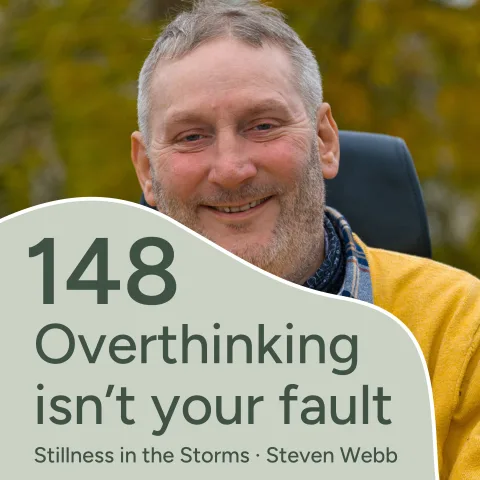
Episode 170 · 18 June 2026 · 14:46

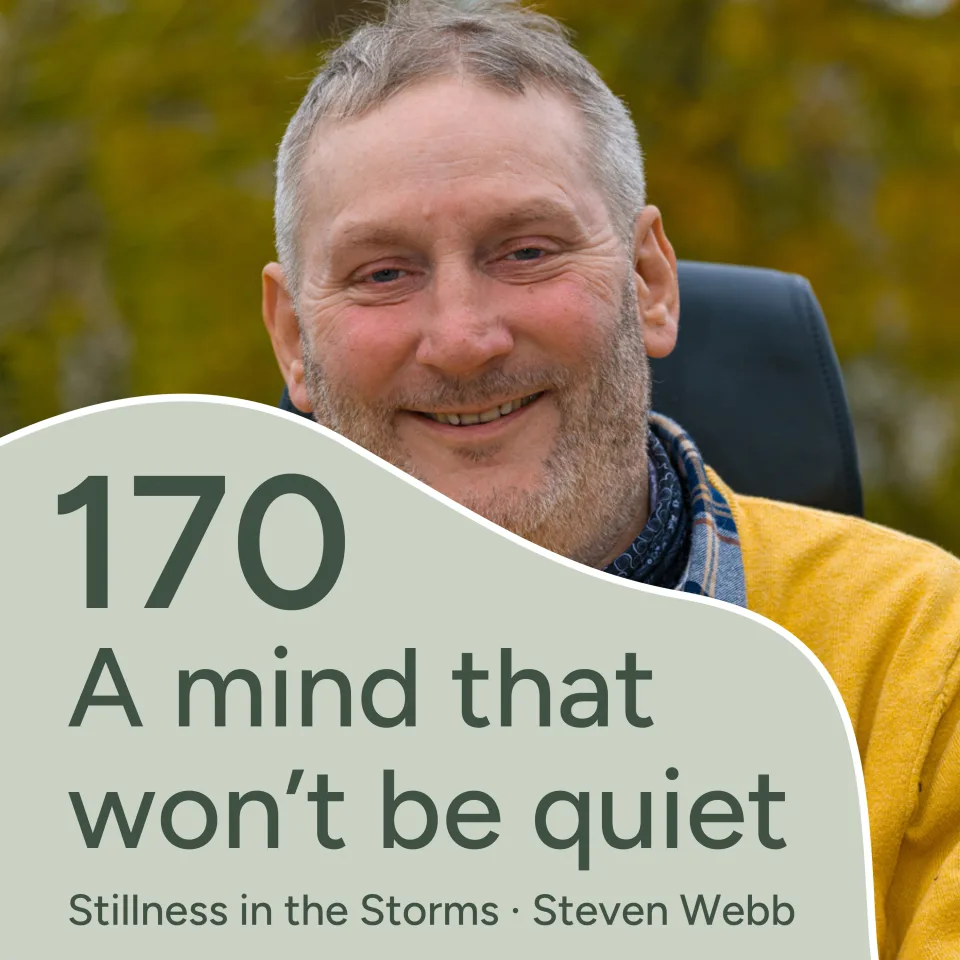
The Mind That Will Not Be Quiet

Why does your mind pick 3am? You have thirty to forty thoughts a minute and you asked for none of them. The mistake is deciding the goal is a blank, silent mind.

Subject: Anxiety, Overwhelm & Stress

Apple Podcasts Spotify

Stillness in the Storms · Episode 170

Why does your mind pick 3am? You have thirty to forty thoughts a minute and you asked for none of them. The mistake is deciding the goal is a blank, silent mind.

Set that as the target and the trains keep coming and you feel like you are failing at it. You are not. Here is the whole thing in one sentence. You are not the thought, you are the one listening to it. Because if you can hear it, you cannot only be it. There is a tiny space between the thought and the reaction, usually too small to notice, and that gap is the thing that changes everything.

One thing to try: Let one train in tonight and stay on the bench. You never had to empty the station.

In this episode

  • (0:00) Thirty to forty thoughts a minute, and 3am
  • (2:23) The mind does not care that you are tired. It has a list
  • (3:33) The whole episode in one sentence
  • (4:11) If you can hear the thought, you cannot only be the thought
  • (5:25) A thought pulls in, and you do not have to get on it
  • (7:17) At twenty he will still hand you the green sweet
  • (9:03) The tiny space, so small we do not know it is there
  • (13:09) You are the quiet one on the bench who watched every one

With gratitude to

Addie, Darren, Alice, Caroline and My Herb. And Sin, Annie, Laura, Adam, Dominique and Senga. A special thank you to Stuart, two years a monthly supporter.

The companion meditation: A Meditation to Quiet an Overthinking Mind

Support the podcast and join the Weekly Calm: stevenwebb.uk

Thank you for listening.

Steven

The question this answers

Why will my mind not shut up, and why is it always three in the morning?

You have between thirty and forty thoughts a minute and you asked for none of them. Your body is finished for the day, and your mind hears the silence and thinks, brilliant, she is finally listening. Then it hands you the thing you said in 2019, and the thing you have to say tomorrow, and a whole future built out of a worry that almost certainly never happens.

The heart of it

  • The goal was never a blank mind. The mind thinks the way the heart beats, and you would not lie there furious at your heart.
  • You do not have to board every train. Noticing one pull in is the whole skill.

Trying to stop thinking makes more thinking. It is like trying to calm water by slapping it. Set a silent mind as the target and you have signed up for a job that cannot be done, then called yourself a failure for not doing it.

You are not the thought. You are the one that hears it.

Sit with that a second, because it is easy to nod at and walk past. The thought says you always mess this up, and something in you hears it say that. Who is that? If you can hear the thought, you cannot only be the thought.

So, a quiet railway station. Not a busy one. There is a bench, and you are on it, and the trains come in one after another. Some are loud. Some you have ridden a hundred times and you know exactly where they go. You do not have to get on. You watch it pull in, and in its own time it pulls out again.

There is a way to get this wrong, and the spiritual crowd get it wrong constantly. Watching your thoughts is not going cold, arms folded, nothing touches me. That is not peace, that is hiding. The one who watches still feels it. You can notice the storm and still be stood out in it getting soaked. You are not aiming to feel less. You are aiming to be less owned by what you feel.

Then there is the gap, between the thought arriving and you reacting. Someone cuts you up in traffic and the heat and the thought arrive together, and in that gap you either lean on the horn and carry it for an hour, or you breathe and answer. Same event. Two entirely different days.

One small thing to try

Tonight, when the first train pulls in, do not fight it. Fighting makes it bigger. Say one thing instead. Ah, there is a thought.

That is it. The act of naming it means part of you stepped back and watched it arrive, and you are already back on the bench.

Some nights you will do that once and drift off. Other nights you will lie there for an hour and a half riding every train that comes. That is fine and that is normal. The forgetting is not the failure. Notice you are halfway down the line, get off, sit back down and laugh at yourself.

You did not have to empty the station. You just had to remember you are the one sitting down.

Questions people ask

Is this about getting to sleep?

Not really, though it helps. You can use it at your desk or in a queue. Three in the morning is just where most of us meet the problem.

What if the thoughts are about something real I need to sort out?

Then some of them deserve boarding. The trouble is we ride the ones that go nowhere. If a thought is taking you somewhere, go with it.

Is there a meditation to go with it?

Yes. Dealing With Overthinking, Watching the Trains, over on Inner Peace Meditations. No clever imagery, just you, a bench and the trains.

Listen together

The companion meditation

A guided meditation recorded to go with this episode, on Inner Peace Meditations.
Read along

The transcript

It follows the audio. Press any line to jump there.

overthinking · sleep · mindfulness

Read the transcript

So you have between 30 and 40 thoughts per minute.

You do not ask for these thoughts, they just appear.

And then usually around three in the morning, one of those thoughts

gets that hooks into you and you're gone.

Replaying that thing you said, rehearsing the thing you have to

say tomorrow.

Building a whole future of the worry that, let's be honest, probably

never happens.

We lie there and we think.

The problem is the thinking.

We try to stop.

We try to stop thinking, it just leads to more thinking.

It is like trying to calm water by slapping it down.

That is what today's podcast is about.

The mind that will not be quiet.

Hello, I'm Stephen Webbing.

Welcome to Stillness in the Storms, the podcast that helps you

find some firm ground, that inner peace when you don't have it.

No fluff, no quick fixes, just honest, down to earth wisdom from

someone who's lived it every single day.

So before we get into it, let me say a proper thank you to the

people who keep the podcast completely advert free this week.

It's Addie, Darren, Alice, Caroline and company called MyHerb.

I don't know their names, so thank you to them and a few of the

regulars that have come up this week and donated Sin, Annie,

Laura, Adam, Dominique and Senga.

You guys are awesome.

And a special one, Stuart, hits two years as a monthly supporter

this month.

Thank you, Stuart.

That is not a small thing.

Really appreciate you all.

You all keep this advert free and the inner peace meditations free

because we don't want to come here and listen to adverts.

So if you would like to join them or if you have got an idea for

meditation and you just want to reach out, just go to stephenweb.uk

it's in the show notes.

Let's talk about the noise in your head.

I want to talk to the over thing, the one who cannot find the

off switch.

Yeah, you lie down at the end of a long day and your body is done

and your mind goes, ah, brilliant.

She's finally listening.

Party time.

I know that one well.

And if I'm honest, that is me.

On the nights I have let things slide.

The mind does not care that you're tired.

It has got a list for you to go through.

So here's the thing, and it's the thing that most of us get backwards.

The mind is built to think the way the heart is built to beat blood

around your body.

You would not lie there at three in the morning furious at your

heart for beating, would you?

You would not call Yourself a failure because your lungs kept breathing,

especially without your permission.

No, but that is exactly what we do with the thinking.

We decide the goal is blank, silent mind.

And then the trains keep coming and we feel like we've.

We have failed at the one thing we're trying to do.

Just a bit peace of mind.

But you've not failed.

You've just signed up for the wrong job.

The mind thinks that is its job.

It is not going to stop.

And the good news, the actual good news is, is that it was never

supposed to.

So the goal is not to stop thinking what it is.

Here is the whole episode in one sentence.

You are not the thought, you are the one that hears it.

Sit with that for a second because it is easy to nod at and

miss.

There is the thought and there is the one who notices the thought.

And they are not the same thing.

So the thought says, you always mess up.

And something in you hears it.

Well, who is that?

Who is the one listening to the thought?

Because if you can hear the thought, you cannot only be the thought.

There is you underneath it, quietly listening to the whole thing.

This is the one who watches.

The moment you notice that even for a second, something loosens,

something just frees up.

You do not get rid of the thought.

You just stop being the thought.

You have thoughts, but are not those thoughts.

You took one small step back and now you are holding the thought

instead of the thought is holding you.

I hope you're keeping up with this.

Now, I use a wonderful metaphor for this.

So if you've heard me on the podcast before, you would have probably

heard me say this before.

So imagine a quiet railway station, not a busy one, a calm,

almost empty platform.

And there is a bench.

And you're sitting on that bench.

The trains come in, one after the other.

Some are loud, some are quiet, some you've ridden a hundred times

and you know exactly where they go.

So imagine a thought is a train pulling into the station.

And here is the bit we forget.

You do not have to get on the train.

A train comes in.

Ah, there is a train.

You can just look at it and its own time.

And in its own time, it pulls away again.

You do not climb aboard.

You stay on the bench and you just watch it go roll out.

So I think most of our suffering is not the trains.

It's not the thoughts itself.

It's how much we get on the train.

It's how much we go with the thoughts.

And normally we're going with the thoughts.

And we hate the thought.

We're going with this again.

I can't believe it.

Okay, I need to deal with it.

And it all goes around in our heads constantly.

And it really is.

You do not have to board every train.

You do not have to get on every thought that comes along.

Some you can just let pass.

And when you visualize sitting on the train station and just allowing

the thoughts to come and go like clouds coming and going, many

meditation teachers talk about, I like trains because I like

the train of thought.

I think it just.

It just works.

I just like it.

Maybe I just like trains.

I don't know.

When you get really good at this and it does take a while, you

can even drive the train and take it where you want to.

You can choose which thoughts to get on to.

You can choose the nicer the gratitude, the more positive thoughts.

And the more you choose to get on a train, the more your subconscious

mind will give you a certain type of train.

If you always get on the blue trains, your subconscious mind will

give you more blue trains.

Just like the child giving you sweets.

You know, if you tell a child once to give you a green sweet, when

you bump into that child when you're.

When the child's 20, he'll still give you that green sweet.

But there is, and I have to be honest with you, because there is

a way to get this wrong, and the spiritual crowd get it wrong

all the time.

Watching your thoughts is not going cold.

It's not standing back from your own life with your arms folded,

pretending nothing touches you.

It's not the illusion of being stoic like we think.

Oh, nothing ever, you know, touches me.

I have met people that.

I'm just observing it as a very calm way of never feeding anything

that is not peace, that is hiding.

That, I think is stepping into the spiritual bypassing, which I

spoke about before.

The one who watches still feels it.

You can notice the storm and still be standing out in the weather,

getting absolutely soaked.

Watching is not a wall you put up.

It is a room.

That is the difference.

The feeling is still there.

The grief, the fear, the anger, all of it is still allowed.

You are just no longer drowning in it because there is now

a little bit of you on the bank watching the river instead of

being swept in.

I'm mixing metaphors up completely today.

So you're not aiming to feel less.

We are aiming to be less owned.

What we feel by what we feel.

And I think that's really important.

And this brings me to the most important part, the gap.

I've often spoken about this between A thought arriving and you

reacting to it.

There is a tiny space.

Most of the time it is so small that we do not even know it's

there.

The thought comes, the reaction fires, and it all feels

like one thing, but it's not one thing.

There is a gap.

And the gap is where your whole life actually happens.

Genuinely so, for example, someone cuts you up in traffic, the

thought and the heat and maybe the anger, it all arise together.

And in that little gap, you either lean on the horn and carry

it for the next hour, or you take a breath and you just respond.

It's the same event, two completely different days.

And the only difference is whether you found the gap and you

chose to respond.

That is what meditation really is for.

Not bliss, not emptying your head.

It trains that gap.

It widens that little space between what happens and how you

answer it.

That is the whole game.

Everything else is just details.

Everything else is just nuances of it.

So let me give you something to actually do, because I am not

interested in the idea.

That stays as ideas.

There's no point in how many books have we read and we haven't

actually done anything with them.

That's me.

I should have just sat on the books originally and meditated rather

than reading them.

I've watched umpteen YouTube videos.

I've listened to so many teachers.

Very few teachers have actually made a difference in my

life because.

Not because the teacher, but because I didn't actually go and

do anything with it.

I thought, that's a brilliant idea, but I didn't do anything.

So tonight, when you're lying there and the train first pulls in,

do not fight it.

Fighting it just makes it bigger.

Instead, try one sentence, just ah, there is a thought and that's

it.

Name it as a thought and notice you're already back on the

bench.

That is it.

Name the thought and when you notice it, you're already back on

the bench.

The very act of going, that's a thought means a part of you stepped

back and watched it arrive.

You found the gap.

That gap will change your life.

It will give you two different outcomes.

You did not have to empty the station.

You just had to remember you're the one sitting down.

Some nights, you will do it once and drift off.

Although this podcast wasn't about falling asleep, you can use

this anytime.

But some nights, you'll sit on the bench and see your thoughts and

drift off to sleep.

Other nights, you'll lie there for an hour and a half, getting on

every single train.

It's just that's the reality and that is fine and that is normal.

That is what being human with a human mind is like.

Because here is the last thing and I want to leave you with.

And it is the thing that takes all the pressure off.

The forgetting is not the problem.

We all get swept off.

We all get on that train.

We all aboard the wrong trains.

You know, probably tonight I would do the same thing.

Forgetting is not a failure halfway down the line and go, oh,

I'm on the train again.

Just step off, get back on the bench and smile.

Laugh about it.

Laugh at your humanness.

Laugh at the mind that's evolved for millions of years because

you've got one of these intrinsically wise minds.

That is incredible.

That's evolved for millions of years.

Yep.

Every one of us.

It's not about staying on the bench forever.

It's about leaning and training your subconscious mind with

the thoughts that you want and times where you don't need thoughts.

And eventually there'll be more gaps between the trains.

You are not the thoughts that come and go all day and all night.

You are the quiet one on the bench who has watched every single

one of them arrive.

And normally you just get on them because that's what you've always

done.

You always were sat on the bench.

You just didn't know you didn't have to get on the train.

So, right, I've recorded a short meditation to go with this

one.

It is over on Inner Peace Meditations and it is called Dealing

With Overthinking.

Watching the Trains.

No clever visualizations, just you, a bench and the trains coming

and going.

Sit with it once or twice this week and it is only a few minutes

and it will do more than any amount of me talking about it, just

experiencing sat on that bench.

So that is the one who watches.

It goes much deeper than that.

And there's many more things we can talk about the Watcher.

But that's the brilliant start and it'll take you further than most

of the other things.

Anyway, I'm Stephen and thank you everybody who keeps this going.

If you can please leave a review, especially on Apple and Spotify,

makes a huge difference.

Follow the show.

Leave a review on one of those two because genuinely, it helps more

people find a bit of calm in their hard week.

Thank you very much and take care.

Be kind to yourself and I love you.

Weekly Calm

One calm email.
Every Sunday.

A little space to pause, a practical thought to take into the week, and a reminder that you’re not doing this alone.

Join and I will send you my book, 5 Simple Practices for Inner Peace. Free, and yours to keep.