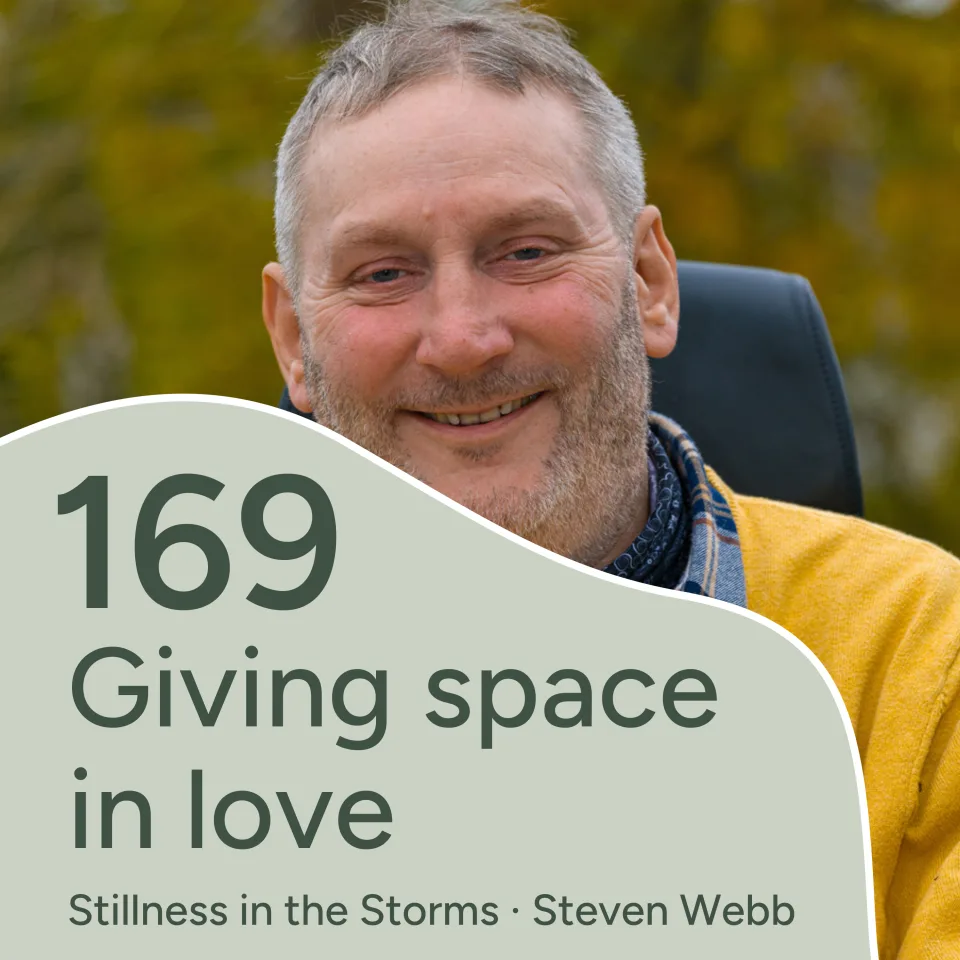
Episode 169 · 7 June 2026 · 16:42

Giving Space: Love Without Taking Over

What is the hardest kind of love? Giving somebody space. Not walking away, not going cold, not pretending you do not care. Space that still says I am here.

Subject: Love, Empathy & Other People

Apple Podcasts Spotify

Stillness in the Storms · Episode 169

What is the hardest kind of love? Giving somebody space. Not walking away, not going cold, not pretending you do not care. Space that still says I am here.

We argue with family most because we are trying to prove we have changed. See me, I am here. Real space is not silent punishment and it is not neglect. Before you step in, ask honestly whether you are helping them or reducing your own discomfort. Have you listened long enough, or are you just ready with the answer?

One thing to try: Before you speak, give it three seconds. Not toast on the floor. Three actual seconds.

In this episode

  • (0:03) One of the hardest forms of love, and what it is not
  • (3:16) Not going down the rabbit hole. That is evolution protecting you
  • (5:18) Become aware of the breath, or even just an itch
  • (7:48) Why we argue with family. Please see me
  • (10:24) Space is not coldness and it is not silent punishment
  • (12:39) Am I helping, or reducing my own discomfort?
  • (15:14) The three second rule, and it is not about toast

With gratitude to

Cheryl, Nitya, Yvonne, Eleanor, Ryan, Karen, Lana, Jess and Stuart.

The companion meditation: Create Space Around Your Thoughts

Support the podcast and join the Weekly Calm: stevenwebb.uk

Thank you for listening.

Steven

The question this answers

How do you help somebody without taking over?

I was on the phone to my daughter recently and I noticed that whatever she said, I wanted to jump straight in with my answer. I have been trying not to do that for four or five years and I am still not much good at it.

It is the hardest kind of love, this one. Not walking away, not going cold, not pretending you do not care. Staying close without taking the problem off them.

The heart of it

  • Space is not neglect and it is not silent punishment. It says I am here and I trust you.
  • Before you step in, ask honestly whether you are helping them or easing your own discomfort.
  • Three seconds is usually enough.

Most people already know the answer to their own problem. What they are short of is the room to reach it. We know what we should be doing. We just need somebody to stop talking long enough for us to work it out.

Real space says, I am here and I trust you.

The same is true inside your own head. Whatever arises, do nothing with it for a moment. Half the time the thought or the feeling goes on its way without leaving a story behind. The gaps between the notes matter as much as the notes.

Here is the uncomfortable part.

Very often when we are trying to fix something, it is our own discomfort we are trying to get rid of.

Somebody sits in front of you suffering and it spills over onto you, and fixing it makes you feel better. That one is well disguised. I do not spot it in myself half the time.

I have a bedroom torn up at the moment. A leak under the floor for months, the wood ruined, the skirting boards off. I have carers and a lot of people in my life, and every one of them has an expert opinion about it. Some days I just want to say, let me go.

It is why we argue with family more than anybody. We are trying to prove we grew up. See me, I am here, I know things now. It is decent evolutionary behaviour in a safe container. It just does not have to happen at every dinner.

Being mayor taught me the other way. You do not get a political opinion in the chair. Your job is to make sure everybody has their say and the thing gets debated properly. And when I shut up, the council usually arrives somewhere close to where I would have taken them, and now and again somebody says something that changes my mind.

Where this does not apply: if somebody is unsafe or vulnerable, step in. You know the difference.

One small thing to try

Three seconds. Not the toast on the floor rule. Three actual seconds after your friend stops talking, before you answer.

And three questions worth asking before you step in. Am I helping, or am I making myself more comfortable? Have I listened long enough for their own wisdom to turn up? What would this look like with more space in it?

Questions people ask

Is not saying anything the same as not caring?

No, and that is exactly the fear. Cold silence is a punishment and people can feel the difference straight away. Space with your attention still on them reads as trust.

What if they are about to make a real mistake?

Sometimes you can see more from outside. Sometimes they can see a great deal you cannot. Give it the three seconds first, then say your piece once, and let it be theirs.

Does this work on your own thoughts too?

That is where I use it most. Notice the itch before you scratch it. Notice the feeling before you decide what it means.

Listen together

The companion meditation

A guided meditation recorded to go with this episode, on Inner Peace Meditations.
Read along

The transcript

It follows the audio. Press any line to jump there.

love · boundaries · relationships · compassion

Read the transcript

This week, I want to talk about one of the hardest forms of love. And that's giving someone space.

Not walking away, not going cold, not pretending we don't care,

but staying close without taking over. And I mean this for ourselves as well. It's that urge to step

in and try to fix and help.

I'm Steven Webb, and welcome to Stillness in the Storms, the podcast that helps you have a little peace when

you need it most. How are you doing? And sorry I missed last week, but I have a lot going

on in my life at the moment. I have a bedroom that's totally tore up because we had a leak

under the floor for a long time, and we're trying to dry it out, so my wood floor has been

ruined and my skirting boards are now off, and yeah, I'm just a bit overwhelmed by it all. And I

have because I have carers and because I have lots of people in my life, everybody's telling me all their

expert views and sometimes I'm like, just let me go So space, that's what I want to talk about this

week. But just before we go on to that I want to thank awesome people that donate, because it's you

guys that keep the podcast free. It's you guys that make sure that you only hear my voice and

somebody isn't trying to sell you something. So thank you very much to Cheryl, Nitya, Yvonne Eleanor Ryan

Karen, Lana, Jess, and Stuart. You guys are awesome, and I always miss somebody, but I'll

catch up with you next week. Just a huge, warm thank you. Hand on my heart, really appreciate you I

know my listeners do as well. If you cannot donate, always leave a review, share the podcast. It all helps

somebody. Somebody out there needs to hear it, and you might be the only conduit to passing that on. So

I was talking to my daughter recently, and I realised that virtually everything she said,

whether it was on the phone or in person, I wanted to jump straight in and answer and give her

my thoughts. And I'm really trying not to do that. I've been trying not to do that for about four

or five years now, and I still find it very difficult, especially when we're so close to them because we

want to solve their problems. We don't like seeing them suffer. But what I've realised is if we just pause

and give space, that space is so much opportunity, not only for them to think through the solutions,

because very often we know the solutions. We know what we should be doing. We just need that someone to

give us space to be able to calculate and work it out. And I also think this is the same

for our own heads and our own feelings. And very often in meditation, I say, whatever arises, do nothing with

it And what I mean by that is just have that bit of space after it arises, and sometimes that

thought or that feeling and emotion, just disappears by itself without any lasting story.

We don't have to go down some kind of deep rabbit hole or deep story like we do think all

the time. That's just evolution trying to protect us in the future. If we can make sense of the thought,

make sense of the emotion, make sense of what our friend is going through, or that driver that chops us

up, or that person that shouts, or whatever is happening, that two-year-old crying.

If we can just give that a little bit of space, afterwards, we can look at it and go, ah,

that's what was happening But it is really difficult when we really care, and we want to fix it we

want to help It's really difficult when it's ourselves and our own thought because we want to step in.

We want to criticize the thought so like well, that's dumb. That's stupid. That's ridiculous Or we're like, yeah, that's

a good idea. I'll go with that one thinking, how is it going to work out? So just space, and

very often just enough pause for maybe two breaths or just one breath sometimes is enough

Sometimes the musician needs to go quiet because it's the, the gaps between the

notes and the gaps between the words are just as important as the words. With

no gaps and no space between thoughts and space between feelings, everything becomes so blurred.

And

with a bit of practice, we can all do this, and I think it's one of the most profound things

we can learn to do. Just give it three seconds after your friend finishes talking.

Just give it a couple of seconds after that emotion arises. When

you look at an item, don't jump to a story of, I want to buy that or, why is that

here Or, who put that there Just see the item

Just become aware of the thought. Just

become aware of the breath, the feeling. You

know, even if you just have an itch on your body, just, ah, there's an itch I'm not saying in

a couple of seconds time you don't have to itch it, but

it gives us that space to do it mindfully. And I genuinely believe, I believe this really in my

whole bottom of my heart, that if we have enough wisdom within ourselves, we've had million years

millions of years of evolution, we've got so much experience within every atom of our body, that when we do

give it space, things often solve themselves or didn't need solving

And it's even in council meetings, I sit there sometimes and emotions coming forward or something

and I'm like, I want to stick up my hand. I always go with the intention of not saying anything.

I'm going to be the wise one in the room that doesn't say anything. But I'm always there no I

want to prove to people that I'm intelligent, that I can see this, that I've got the answer to this.

That I can see something that perhaps none of you can But when I sit there and shut up, very

often the council come to their own conclusions very much in the same way as I might have wanted to

do anyway. Or I can change my mind because someone says something and I go, oh, that's, that's interesting. I

didn't see that And you also give the opportunity for others to shine. It's the one of the things that

I enjoyed about being mayor was You could not have a political opinion You had the final casting

vote if it was ever tied 50-50, and you had a vote anyway. You just hope it never went down

to the 50-50. But it's not your job as chair of the council to put your opinion. It's your job

to make sure everybody has a firm voice everybody said their bit, and it's debated to the length

that needs to be to come to an informed decision. If only we could do that in our everyday life

with our families. Just imagine sitting around that table with a barbecue or at the Christmas dinner and going, right,

we all just come to this informed, wise decision Not going to happen in my family. We're all two way

opinionated. We're all two way trying to prove to each other that we're the ones with the knowledge. Please see

me. See me. I'm here. I know this. That's why we argue with our family so much because we're trying

to prove to our family that, hey, look, I have grown up to this wise person. I do know this.

I do know more than you because we're trying to compete. It's a good evolutionary thing to do, to compete

for your family in a safe container. But do we always have to do it? Do we always have to

compete? No, we don't And the instinct to help is not wrong. It's, it's a nice

way of being, and sometimes we do need to step in and help. But nothing's harming and just giving that

bit of space, that little bit of pause. Says, says, can I step in at the right time when I

need to Because if we allow our minds or our feelings or someone else's minds or feelings or their

dilemma, if we allow them to solve it, if we allow them to come to the conclusion, very often it's

more powerful. It's like when someone decides to give up smoking or give up alcohol or a bad vice, it's

so much more powerful when they decide to do it rather than someone else trying to convince them to do

it

But fixing something very often, when we're trying to fix something, is our own discomfort that we're trying to get

rid of. If we're sitting with someone with problems, we're uncomfortable because the fact that they're suffering

spills over onto our discomfort. So if we fix it, we then don't feel so uncomfortable.

Then that's not such an obvious one to see

Very much sometimes that can be really disguised if we don't have that self-awareness. And I don't see it a

lot of time. I don't think, well, what someone else is going through is really, doesn't affect me, I'm just

trying to help them. But it does affect me in that moment, and it does affect me if I leave

there thinking I haven't done my best to try to help them And we don't want to feel powerless. We

don't want them to make a mistake. We don't want to sit back and see them go down in the

wrong direction because we think we've already seen that direction. And sometimes from the outside, yeah, we can see more,

but sometimes we definitely cannot see as much as what they can see, if only we give them a little

bit of space.

And you may feel sometimes that giving them space or staying quiet is like abandoning them is like as if

we're being cold. But it's not. Giving space is not walking away. It's not coldness. It's not neglect. You know,

it's not the silent punishment. Real space says, I am here and I trust you. I trust your wisdom.

I am listening to you. I recognise that whatever you're going through is not the same as what I'm going

through, although there may be similarities It's hearing them, which is very often important. How often

do we not feel heard? And

just by giving that few second space that really does help them to feel heard. And

why does this matter spiritually and really on the practical level? So meditation tells us to

sit with our own inner world, whatever's arising, and the same skill should apply to the outside world,

the current situation, the room full of people, the room with the animals. Even our animals need that bit of

space to Have you, if you've ever spent much time with a cat or a dog, you have to really

give them time. You say something, and you have to give them time to turn their head on the side

to really hear what you said, to give it real careful consideration, instead of just repeating it.

And then with this space, we can also choose whether or not help is actually needed or whether or not

that space is just the deeper help itself. We let whatever it is on our minds to breathe. We let

the body to feel. We allow it to happen. The body is way wiser than our minds are, and our

minds have access to way more wisdom than we think it does. Very often when we're moaning to somebody else,

we either just want to be heard or we want someone else to hear our

calculations, our thought patterns, and see whether or not we're justified So here are

three practical things, questions that you can ask yourself that if you ask it before you approach

a person or when things are happening is, am I helping or am I trying to reduce my own comfort?

Am I trying to prove to them that I know an answer? Have I listened long enough for their own

wisdom to appear?

And what would it look like if it had more space in it

What would love look like if it had more space in it, more acceptance? Space is a form of accepting

this moment, and

it's like saying, I am here. I trust you. Take your time. I am here. I trust you.

Take your time

So where does this not apply? Now, of course, we're no therapist. You know, if you are a

therapist and you are fully trained in this, please trust your training over mine every day of the week. I'm

not a therapist. I'm just someone that has suffered a lot and found ways to reduce my suffering and found

ways to accept and love the people around me a little more. But it doesn't apply if someone's unsafe, vulnerable,

or in situations where things are dangerous. You know that. You know there's a

big difference. You don't have to give space in those moments. But most of the time we're not in anything

like that. Most of the time we're just in a conversation that needs space. That conversation in our heads, that

conversation of what happens when a feeling arises. And

if we do give space, it stops us spiritually bypassing, and I've spoke about that in the past. We can

talk ourselves out or into how brilliant we are spiritually, how brilliant we're doing, how much work we've

done, and how wonderful we're doing. You know I've yet to find anybody that's done all the work. I've yet

to find anybody that's enlightened and doing brilliantly all day long and never makes mistakes. So yeah,

you're in good company if you're only enlightened about 30 seconds a day. You're doing well You're doing better than

me, I would say. So, okay, Slowly rewind it back. Isn't it important just

to give your feelings, your thoughts, the moment, your group, your friend, your relative,

your animal, whoever, just that little bit of space?

Even if it's only three seconds. Have a three-second rule. I'm not talking about toast falling on the floor. I'm

saying, have I given this three seconds because most of our problems, most of the things we think about, most

of the problems that our friends sometimes want to share with us, there's already solutions to

them or they don't need solving at all. We just need to give it space.

Just like the gap in the music, just like the space at the top and bottom of the breath.

Space, that's the word this week. So I don't know if you received my weekly Calm Newsletter. If you don't,

head over to StevenWebb.uk. And as with my Inner Peace Meditations, all these podcasts come free because of

very generous and lovely listeners that donate a coffee to me each week. As the listeners go up, the hosting

and all does come more expensive, and I really appreciate them being able to keep them completely free with no

adverts. That's my intention and I'm never going to change from that as far as I can at least cover

the cost So thank you so much to each and every one of you. Take care, guys, and have a

wonderful week, and I love you

Weekly Calm

One calm email.
Every Sunday.

A little space to pause, a practical thought to take into the week, and a reminder that you’re not doing this alone.

Join and I will send you my book, 5 Simple Practices for Inner Peace. Free, and yours to keep.