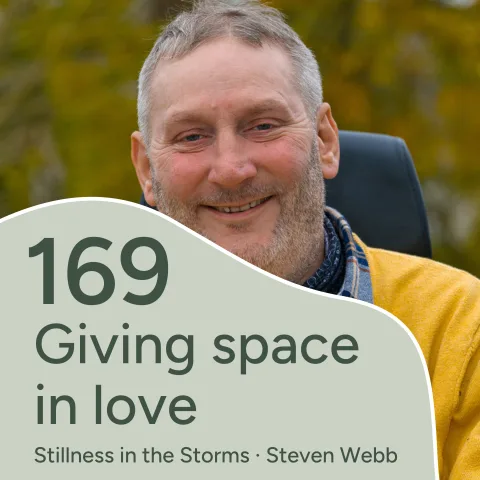
How can I say I love you to somebody I have never met? Because your suffering is the same as my suffering, and once you see that there is nothing else to say.
How can I say I love you to somebody I have never met? Because your suffering is the same as my suffering, and once you see that there is nothing else to say.
Your hopes and your dreams are mine with the details swapped. If you want to understand my suffering, look at your own. That is what loving yourself actually means, because once you accept that suffering is part of you, you stop needing other people to be different. Some have built walls out of fear, and it is harder to see in them. It is still there.
One thing to try: Look at one person who irritates you and find the bit of their suffering you recognise.
In this episode
(0:05) How can I look up and say I love you?
(2:37) Your suffering is the same as mine
(5:04) Want to understand my suffering? Look at your own
(8:02) This is what learning to love yourself means
(10:09) You have probably been where they are, differently
(12:09) The walls people build out of fear
Support the podcast and join the Weekly Calm: stevenwebb.uk
Thank you for listening.
Steven
The question this answers
How can I say I love you to somebody I have never met?
I end every episode that way and I sign emails to near strangers with much love. So the question is fair, and I want to answer it properly rather than let it sit there as a nice sign off.
The heart of it
Your suffering is the same as my suffering. The details differ. The thing underneath does not.
If you want to understand my pain, look at your own. That is the whole method.
Once you love the raw version of yourself, you start recognising it in everybody.
I did not come from a family that said it. We did not hug much. I am not sure I have ever told my mum I love her, even now, and I keep telling friends I am going to and then not doing it.
And yet I can say it to you.
Here is why. Let me guess a few things about you. You want to be happier. You want less suffering. You want more freedom to do what you want, when you want. You want to be healthier, and you want the people you love to hurt less.
That is not a trick. That is because you are me and I am you.
The details are all different. My idea of happiness is not a fortnight on a beach, it is walking along a river listening to birds. Fine. Different films, different books, different hobbies. But the wanting to suffer less is identical, and grief works the same in both of us.
So when I say I love you, what I mean is that I recognise myself in you. Not the roles and opinions and tribes, the person underneath all of that, who just wants to be content and to hurt less.
Even the rotten potato in the basement shoots towards the light.
Carl Jung
That covers everybody. Somebody avoiding their life with drink and somebody avoiding it with an evening of television are doing the same thing at different volumes. You can rank them if you want to. Underneath, both are trying to improve this moment.
And the people who make it hard to see? They have built walls out of fear. Show me anybody who fears nothing.
One small thing to try
Look at one person who irritates you and find the bit of their suffering you recognise.
Not their behaviour. What is underneath it. You will usually find something you have felt yourself, in another year, in another shape.
Do that for a week with whoever crosses your path. You end up with fewer enemies, which turns out to be a very large improvement to a life.
Questions people ask
Does this mean approving of what people do?
No, and I say so plainly. Even somebody doing something dreadful believes they are improving something. Understanding what drives an action is not the same as excusing it.
Is this just empathy?
It goes past empathy. Empathy is feeling what they feel. This is recognising that what they want is what you want, and it produces understanding rather than exhaustion.
Why is it easier to say to a stranger than to your own mother?
Because there is no history in the way. That is my problem rather than a principle, and I mention it in the episode because pretending otherwise would make the rest of it worthless.
Read along
The transcript
It follows the audio. Press any line to jump there.
love · compassion · empathy
Read the transcript
Foreign welcome to Stillness in the Storms.
I'm Stephen Webb, your host, and I want to talk about how I can
look up and say I love you.
How can I look up and say I love you to someone that is listening
to this podcast and I don't know you?
And that's what I'm going to talk about in today's podcast, because
I even answer on my emails with much love, and that's something
that has been alien to me all my life.
But I do it now.
Why do I do it?
And how can I say I love you to a complete stranger?
That's the topic of today's podcast.
So I come from a family that didn't really say I love you.
You know, we didn't hug much, and I don't think I've ever said
I love you to my mum, even to this day.
And I've been talking about this to some of my friends online
and some people that have been following me, and I follow them for
a long time and we've become good friends.
I've said to them many times that I'm going to go and tell my
mom I love her, and I. I haven't because there's some resistance
there yet.
On a podcast, I can say to you that I love you.
I can reply to an email to someone I barely know, much love,
and someone that comes on my life.
I can sign off my life saying, I love you.
Am I being genuine?
Am I.
Am I really loving that person?
Well, we'll all have our own shadows and projections about love
and what love is and things like that.
Let me explain one thing that I've learned, and it's something
that's given me a lot more freedom, and that is I do love you.
And we've got many things in common.
Let me guess.
You want to be happy.
You want to reduce your suffering.
You want to have more freedom in your life.
You want to be able to do more of what you want to do when you want
to do it.
You want to be healthier and you want the suffering of others
to reduce.
You want less enemies.
Have I done some kind of Jedi mind trick on you?
No, of course I haven't.
The reason why I know these things is because you're me and I'm
you.
Your suffering is the same as my suffering.
Your hopes and dreams are the same as mine.
Yes, through experiences, we've got a little differences on
what happiness means and what it means to reduce suffering and
the kind of things we want to do.
My happiness is not lying On a beach in another country for two
weeks on a holiday once a year, I like to just walk along a
river and just enjoy the birds and the singing.
That makes me happy.
So we have differences.
We have different films we watch, we have different preferences
on books and what we do for hobbies.
But the fact that we want to reduce our suffering, the fact that
we want to open our hearts and we want to feel this freedom, means
we're no different.
So when I say I love you, what I'm saying is I recognize myself
in you.
I recognize that your struggles, albeit they may come from
a different place, your desires may go towards a different
thing, but the suffering is the same.
If we both.
If you split up in a relationship or you lose someone,
you grieve and you suffer the same as I do.
We bleed in the same way.
It doesn't matter how old we are, it doesn't matter what.
The things that caused us to suffer, our aspirations and all are
pretty much the same.
So, yeah, I do love you.
So when I say that, I mean it, because I'm looking at the core of
the essence of the foundations of who we are.
That individual that hasn't got all the protections of all of
the thoughts and opinions and beliefs and the groups and the tribes
and the friends is that person that's alone, that just has the desire
to be content and happy and have less suffering.
That's who I love.
Because I'm learning to love that person in me, that raw person
underneath everything in me.
And what's that look like?
You know what that person looks like in me?
It looks exactly like you.
It really does.
So if you want to understand my suffering, have a look at your
own.
If you want to understand my desires and what it means to be happy
for me and how it feels.
How does it feel for you?
And that's when we start looking at each other and recognize
that we're all the same.
You know, whether you're fighting in a war for something that
you believe in, or whether or not you're fighting ecological war
to improve the earth, and whether you're trying to get rid
of plastic or whatever you're doing on a daily basis, you're still
fighting a very similar battle.
When you take away what the actual beliefs and the desires and
the outcomes, when you take away all those things, we're pretty
much fighting the same thing.
We want to achieve something.
We want to have hope.
We want to improve the world in some way.
And I say this in a warped way because it doesn't fit My thinking.
But even the person that does some of the most dreadful things
believes they're improving the world.
Think about that for a moment.
I'm not saying I agree with the actions, of course I don't.
But they are still believing they're trying to improve the world.
And that's what we're all doing.
So that's why I can look up and say, I love you.
Thank you.
Get to the core of who you are and learn to love the core of who
you are.
Because when you learn to love that, you'll be able to see that
in everybody else.
You meet everybody, even the people you don't ever meet, you will
recognize that same core value and belief.
Even on the opposite sides of the political spectrum, the opposite
sides of the religious spectrum.
You'll recognize that we aren't that much different after
all.
We all bleed.
We all have the same organs inside, things like that.
We all recognize that on a very physical sense.
But we actually have the same fundamental desires and.
And beliefs and griefs and pain and suffering.
I guess what I'm trying to say is, in my own.
In my own gibbering way, is that below all the opinions and beliefs,
below the desires for objects and successes and everything like
that, look at the fundamental core of what drives those things,
and you'll recognize everybody else on the planet is you, and you
are everybody else on the planet.
And this is what it means by learn to love yourself.
Because when you love yourself and you start to recognize that your
suffering is part of who you are, and the.
The desire to reduce that suffering is also part of who you
are and the desire to love and be loved.
When you recognize those things in everybody else, you see
everybody else as you.
Because everybody else is.
You know, we just may wear different clothes, we may have different
thoughts.
We may have got to different places in different ways through
different experiences in life of the things that hold us together.
The roots of trees are the same.
They do the same thing.
They may look different, they may have different structures to
them, but they're doing the same thing.
So what Your foundational core values of who you are.
The deeper you look, you'll realize that everybody has the same
ones, but we often forget about them.
We often judge people on their actions, we judge people on their
mistakes, and we judge people on what they want to do to be happy.
And just because it's not what you want to do to be happy, they
must be wrong or they must be different to you.
They're not different.
They're just learning to be they're learning to improve their
life in this moment.
And as Carl Jung says, even the rotten potato in the basement
shoots towards the light.
You know, someone that is trying to avoid life through substances,
alcohol or drugs or something like that, they're just trying to
improve their lives.
So no matter where we are, no matter what our starting point is,
if you take a snapshot of anybody's life right now, we all
just want to be a little happier, or we want to have a little
less suffering, or we want to have someone to understand us and
listen to us.
And even if you're not where that person is right now, you've
probably been there.
And it may be in different circumstances, but if you really
dig deep beyond the actual what is actually going on, like,
somebody may be using drugs to avoid life, you may use Netflix to
avoid life.
You know, on.
On a judgmental thing, you could say one's worse than the other,
but really they're the same thing.
You're just trying to improve your life in that moment.
What am I going to do right now?
Well, I'm going to have this drink, or I'm going to watch Netflix.
We're just trying to improve our lives right this moment.
So when I say I love you, I love you, because you're doing the
same as what I'm doing, I'm doing the same as what you're doing.
And we are all in this together.
And when we realize that, we all stop fighting, we'll stop making
enemies out of each other, we'll stop judging each other based
on the actions, and we'll open our hearts to each other based on
who we are behind the actions of who we are.
Fundamentally, at the core of who we are, if you sit in meditation
and you go deeper and deeper and you take away the opinions and
beliefs inside your mind and the thoughts and the emotions, all
that, you're left with a deep caring.
You know, the first thing that arises out of emptiness is a deep
caring and a desire, a desire to improve our lives, a desire to
be happier, to love more, to be loved more.
If that's a crime, to want to be loved more, love more, or open
our hearts, then everybody on earth is guilty.
I'm really sure of that, even if it's hard to recognize it in others.
Some people have built up so many walls and barriers, and they've
done that out of fear.
Well, show me a person that doesn't fear something.
Show me a person that doesn't fear being hurt or fear suffering
more or fear being ill or something.
Like that.
So we're all the same.
We're all the same fundamentally below our opinions
and beliefs and our stories and our egos.
So that's why when I say at the end of my life, or when I say
I love you, I can say that because I recognize myself in you.
We're not separate people.
We're just maybe slightly separate in where we are what we're
desiring and the stories that we're making up in our minds.
That's all.
So that's my podcast for this week and I hope you enjoyed it.
And I hope if it resonated with you in any way, let me know
in the review or the comments.
If it makes sense, if it makes you think that you can love a little
more, you can open up.
Do you recognize yourself in others?
Just spend the next week or so just whoever you come across, see
if you can recognize yourself in them.
Because when you truly do, it will change your life and you will
end up a lot happier because you'll end up with no enemies.
You'll end up with a lot more understanding, compassion.
It's not empathy.
It's beyond empathy.
It's deeper than empathy.
You'll end up with understanding and compassion.
And that's the way we improve the world.
That's the way we lift the world.
When we take away the stories and all the thoughts of desires and
aversions and all those things, life just gets a little better.
A lot better.
Amazingly better.
Take care guys.
Head over to my website and you can download the five Simple
Practices for Inner Peace.
It's a small little book I wrote, StephenWeb.com and if you
want to book in for a coffee with me, just a 15 minute coffee,
it's completely free, I don't charge or anything and I've got nothing
to sell.
You just head over to my website, click on the Book ofcoffee
and stephenweb.com also I have another podcast, Inner Peace Meditations
Podcast.
I will put a link in the show notes underneath this podcast which