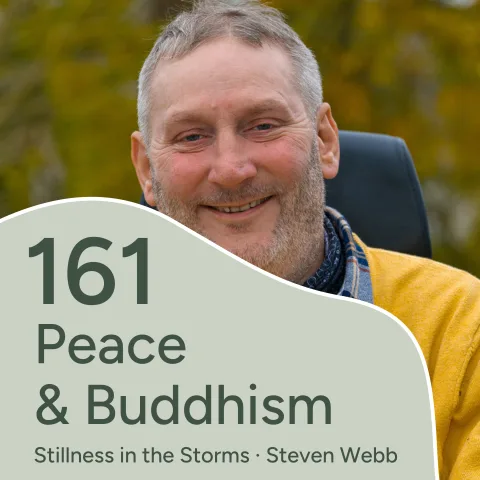
The Three Cultural Poisons and Coronavirus Covid-19
What can one person actually do when everything is falling apart? A lot more than you think, and it starts with picking up the phone and asking who needs something.
What can one person actually do when everything is falling apart? A lot more than you think, and it starts with picking up the phone and asking who needs something.
There are three cultural poisons and the first is denial. The environment is fine. Business is fine. It is not that people are ignorant in the insulting sense, it is that they do not know. I got my arms back after the swelling went down. Not my hands. Every single life is important, and I do not always feel governments weigh them the same.
One thing to try: Ring one person today and ask if they need anything. That is the whole thing.
In this episode
(0:01) No ordinary podcast, and what I cannot do one without
(2:30) Looking after each other, and keeping people afloat
(4:44) Opening it up, and you choose what you pay
(7:30) The swelling going down, and getting my arms back
(9:33) Hard bed, hours of silence, walking in silence
(11:45) The three cultural poisons, starting with denial
(14:32) What one person can do, which is an awful lot
(18:42) Every single life is important
Support the podcast and join the Weekly Calm: stevenwebb.uk
Thank you for listening.
Steven
The question this answers
What can one person actually do when everything is falling apart?
A great deal more than you think. Recorded on 20 March 2020, the week the UK shut down, so read it as a snapshot of that fortnight rather than a verdict on any of it.
The heart of it
Three cultural poisons make everything worse: denial, cynicism and hypocrisy.
You can always recover an economy. You cannot recover a person.
Every single life is worth the same, and I do not always feel that is how it is being weighed.
I am asthmatic, diabetic and paralysed, and I cannot use my chest muscles to breathe. I use my diaphragm only. So I am squarely in the path of this, and I am isolating, and I am not sleeping brilliantly.
The first poison is denial. It is just a flu, do not worry. World economies do not lose three trillion pounds over another flu. I do not mean ignorant as an insult. I mean people genuinely do not know, and the denial is what stops them finding out.
The second is cynicism, and this is the one I have the most sympathy with. What can I possibly do?
Wash your hands properly, and stop treating that as beneath you. You will never know which vulnerable person you did not pass it to.
Then pick up the phone. Who needs shopping left on a doorstep? In six weeks people will need lawns mowing. Somebody in Falmouth has made a card you can put through a neighbour's door with your number and what you can do. Send a thank you to a nurse or a delivery driver.
And isolating is itself doing something, which people forget.
The third is hypocrisy, and it is the one that gets me. My behaviour is exemplary, nothing to do with me, I only bought three packets of toilet roll.
One small thing to try
Use the time. That is not a slogan, it is the thing that saved me once.
After I broke my neck I spent about six months flat on my back with pins in my skull and a mirror above me, watching the ward through it. It was the most useful thing that ever happened to me. If they had patched me up and sent me home in a fortnight I would not have had the mind for any of what came after.
So treat this as your time in the monastery. Read a book a week, which is about an hour a day. Walk, at a distance. Sleep properly.
Questions people ask
Is it worth wrecking the economy over this?
I would rather we overreacted and were wrong. You can rebuild an economy. Nobody has ever brought back a person by admitting a mistake afterwards.
Why does the podcast keep going political?
Because the world does not stop at your front door and pretending otherwise is not peace. That said, this one is very much March 2020 and it should be read with that date attached.
What is the offer at the end?
A live guided meditation every weekday at two o'clock, twenty minutes, camera and microphone off if you prefer. Pay what you want or nothing at all. That series is what eventually became the Inner Peace Meditations feed.
Read along
The transcript
It follows the audio. Press any line to jump there.
buddhism · covid · suffering
Read the transcript
I'm Stephen Webb, your host of Living Deeper Lives.
And this is no ordinary podcast, apart from it's an awesome
podcast.
But I cannot do a podcast without talking about what's happening
in the world right now and with the experience of Facebook and
other people.
And I wanted to talk about the three cultural poisons and how it
fits in and how we can perhaps turn this around to some kind of
gift to ourselves.
But first, I just want to say, you know, hope you're staying safe,
hope you're doing what you can.
And what an absolute shitstorm this is.
You know, I'm.
I'm paralyzed with my chest muscles.
I cannot breathe through any of my chest muscles.
I breathe my diaphragm only.
I do have a problem with heart palpitations.
I took tablets for it.
I'm asthmatic and I'm diabetic.
That puts me in serious line of fire for this virus.
The virus is going to love me.
So I take a deep breath, and my carers are washing their hands,
they're doing everything they can, and I'm isolating myself.
I'm not panicking.
Well, a little bit panicking.
I'm feeling overwhelmed.
I'm feeling tired.
I cannot stop thinking about it.
You know, a few months ago, I was thinking, maybe I'll have a heart
attack.
Maybe I won't be healthy because I don't eat all that healthy.
Now all that's gone out the window, and I'm thinking, this might
get me.
And I'm a pretty positive thinker.
You know, all my life, I'm.
Everybody would.
I don't think anybody would say I was a negative thinker.
Anybody listens to my podcast, sees me do lives, my videos or my
blogs.
But this.
This is quite serious.
And I don't know quite how it's going to pan out.
I'm not an expert.
And what is refreshing is seeing so many countries come together,
so many leaders in companies that are changing the way they do
things.
And I think it's going to be over the next few months, some companies
are really going to win where they don't exploit the people, but
they change what they're doing in order to help people and real
leadership.
It's not going to be about making money.
It's going to be about looking after each other, seeing what you
can do to keep your workforce busy, seeing what you can do to stay
afloat, what you can help in your community.
It's not going to be about, oh, well, we're going to go under
and we're going to Suffer.
And we need a bailout from the government.
And the same with.
And exactly the same with governments, the governments that
really do put their people first and their economy second.
I know the economy is important, but because we're all
in this together, we're all dropping down the ladder of the economy.
It's not like one country's dropping down and the others are
all going up.
So it's quite.
It's one of those things.
It's a level playing field.
You know, let's all help each other out.
There's the government.
Let's try to help the people out as much as possible.
And then we've also got the situation of, you know, do we really
panic and close everything down and risk the economy and then
having it wrong and then it doesn't end up as bad as what they
say it might do.
Well, I would rather have that than I would have it the other way,
where we gamble.
Because the thing is, you can always recover an economy.
You cannot recover a loved one.
You cannot recover a loved one.
You know, once they're gone, they're gone.
It's no good saying, oops, we made a mistake.
And I think that's the case.
And I want to talk about the three cultural poisons.
And the three cultural poisons are denial, cynicism, and hypocrisy.
And I'm going to address each one in order.
But first I want to say that this could be a gift is here already.
You know, you're going to have this isolation for how long?
You might be one of the ones that have to go out to work.
And if you are, thank you.
My heart opens to you.
And if there's any way I can support you, please let me know.
And at the end of this podcast, I'm going to tell you what
I'm going to do to help people in isolation.
And you can all sign up and it will be free.
You can choose to pay for it or not.
But I'm opening up that you choose how much you want to pay for
it.
It's not going to be easy for people two or three weeks, let alone
eight, ten weeks in isolation not seeing each other.
We've never known anything like that.
And even with all the modern technology and Skype and Zoom and
all the other things, we've got an abundance of things.
We got more music we can ever listen to, more movies, more TV series.
We've got so much that we can do to entertain ourselves.
It doesn't matter, because it's relative.
If you gave somebody a Hundred years ago, all these things, they
would be fine.
But we've grown up with these things, so therefore they're nothing
special.
So isolation to us, even with all these things, is not going to
be easy.
It's going to be really hard.
We're used to freedom.
We're used to going where we want when we like.
We're not used to being isolated and such like.
So don't think it's going to be bliss just because we can talk
to our loved ones on Skype.
It really is not going to be bliss.
It's going to be bloody lonely.
It's going to be tough, and it's going to be a long, long time.
It's going to.
Each day is going to seem like a week.
But I want to talk about that.
You can really take advantage of this, you know, get some books,
use it as a personal growth.
And When I broke my neck when I was 18, initially, the first two
weeks intensive care, and then after that, I had about six months
in bed for that, on my back.
And I was about 20ft away from the nurses station.
So I would see the other patients coming and going.
They were just a few months ahead of me on their rehab.
And I was laying flat on my back.
And every 12 hours or eight hours or something, I'd be turned
one way and then turned the other way.
The only entertainment I had was the tv, little portable tv.
And I looked at it through a mirror above me because I could not
turn my head because my head was attached to four pins that went
in my skull on a rope that dangled off the top of the bed with
15 pounds of weight on top to keep my neck stretched out straight
and to stop me moving it.
And trust me, if I tried moving it, it really hurt.
So I didn't.
It was on the chance that if they stretch the neck out enough,
maybe the spinal cord might.
The swelling might go down, I might get some feeding and movement
back.
I did.
I got my arms back.
I can move my arms, but my hands are still paralyzed.
My wrists are very, very weak.
But I had this time in bed where they would come and wash me
every morning, about half a state, I think.
And then they would come and do me dinner.
And my family would come up and stay and friends would come up
and stay.
But I had a lot of time to think.
I had a lot of time out.
And I think really that was a gift.
If I'd broke my neck and immediately, a couple of weeks later,
let out loose in a wheelchair to come home, I would not have had
the mentality or the mindset to deal with it the way I do.
So taking time out, what can we do with this time out?
Well, read some books.
Choose a book a week, that's only an hour a day reading.
You could read a book a week.
Most books are about a five hour read.
And I'm, I'm dyslexic.
I really struggle to read and I can read now a book in most weeks.
I've just got to be disciplined enough to do it.
And there's normally way too much going on to not to do it or
to be distracted.
So we've got this perfect opportunity.
You can go for a walk, but isolate on your walks.
Don't have any contact with people any more than a high across
the road.
Of course, check with your authorities just in case you're not
allowed to do that.
But as far as I know, isolation does not mean actually
staying in your room unless you have the coronavirus.
That's a little bit different.
Check with your local health team to what you're allowed to do
but exercise, get fit.
You know, treat it as your, your time in the monastery.
You know, in a monastery they get out of bed at like 4 o' clock
in the morning.
Well, it's optional.
You can get out of bed earlier if you want.
You sleep on a hard bed.
You sit in meditation hours and hours a day in complete silence.
You just walk in complete silence.
You have to read, you have to do all these things.
And it helps us to grow, helps us to grow and open spiritually.
But I want to just end on what I've seen recently.
And I take a deep humble breath really in this part because
this will show human for what we are, our core values or not so
much our core values, but the level at which we are currently at.
And these levels go from, you know, me, my life slightly fantasy
thinking, which young child to absolutely me, me in control.
I want to control the world.
I have all the answers.
I am right.
Me, my country.
You know, you'll recognize that in a couple of leaders at the
moment.
You'll recognize that in some of your friends, especially some
narcissist.
And then you have the religion and things like that, what you believe
in and it's your group then me and my group, me and my, the Hell's
Angels, the religious groups and such like the mafia.
Can I put the mafia and a religious group in together?
I'm not saying they are the same, but it's the same thinking
in the way of me and my Group, gangs, My group have the answers.
My.
My group or my culture, it's where I fit in.
I lay down my life for my group.
Then you have more of a bigger picture where you love the world
and the world is your group and everybody's part of this.
And I think this coronavirus, this COVID 19 outbreak, will really
show us where we stand there as individuals and as groups and
as businesses.
So you'll have the three cultural poisons.
You've got denial, which is the first one.
The environment is fine.
While businesses in this denial, that will be all right, don't
have to worry about it.
We don't have to adapt well.
They won't be around in a few months time.
They're the ones that just won't survive.
But then there's an individual basis, you know, These are the people
that, oh, it's just a flu.
Don't worry about it.
It happens every year.
We don't have to do anything about it.
Well, I've got news for them.
The world's economies don't lose $3 trillion for just another
flu.
You know, it's way more than that.
You've just got it.
You don't have to be a mathematician.
You just have to look at the flu kills 0.1% in the Western world
because of hospital care and vaccinations.
It does kill a lot more in third world countries, granted.
And it kills thousands every year.
Yes, but we know about it.
It's something that I take a vaccination for every year.
It's something that I don't panic about every year because of
that.
It's something that my doctors and everybody knows kind of how to
treat.
This is different to that.
So it's not.
The environment is fine.
Get out of your denial.
You know, move out of that, because that won't do us any good.
In actual fact, it does it worse because you're probably making
the problem wor.
Oh, everything's fine.
I'm gonna go to the pub tonight.
I'm gonna go and mix with my friends.
I'm gonna go and have a party.
I'm gonna go and do all the other things, you know, get out of
that one.
And then cynicism.
What can I, one person, do?
Well, I recognize that.
I really do.
And I spoke about this on another podcast earlier on.
I came out of podcast three or four.
What can I do?
One person.
You can do a lot.
And yes, it does start at arm's length.
Wash your damn hands.
Don't be an ego chip about it.
Don't be, oh, well, I'm clean anyway.
I'll just do it for 10 seconds.
I can learn better.
Bollocks.
Wash your fucking hands, for Christ's sake.
You know, you don't know who quite you might pass that on to.
You don't know.
You don't know at what point you're stopping it.
And you could be the one that touches the one object that the one
vulnerable person may touch or the person that's going to the vulnerable
person next touches it.
And you may never know what cancer sufferer, what paralyzed,
what diabetic, what elderly grandma or grandpa that you've just
passed it on to because you were too damn stubborn to wash your
hands.
But what can you do as one person?
Well, you can do a lot.
You can do an awful lot.
You can phone friends, you know, and say, do you need anything?
Can I go and get shopping for you?
And leave on their doorstep, you know, at this time?
Give it another six weeks or so.
People are going to need their grass mode.
They're going to need shopping picked up.
They're going to need just maybe even, you know, the older generation
like to have their car started every couple of months.
Maybe you could offer one of them.
I don't know, that's probably a bad idea.
They'll probably think you're nicking it or something.
Note to Stevie Write out a plan before you start your podcast,
especially on big subjects.
But yeah, there's so many things you can do.
There's a girl called Emma in Falmouth that done a little card
that you can find online and it just says, hey, I'm so and so,
and my number is I can do this, this and this for you.
There's things you can do.
This is going to show us who we really are.
And there's plenty you can do as one person.
And even just isolating yourself and staying out of things
that's doing something.
It really is.
If you know a nurse or you know a doctor or you know somebody,
send them a thank you card.
If you know a nurse or a doctor or emergency services person
or someone, a delivery driver or something like that, send them
a thank you card.
Send them something that you appreciate them because they've got
to go on the front line and treat these people.
That could be you, that could be anybody else.
And I wouldn't like to be doing that right now.
So I'm glad they're doing it then.
The third of the three cultural poisons is hypocrisy.
My behavior is exemplary and this is probably the most annoying
one of all.
I can understand the denial.
That's ignorance.
That's not knowing.
I don't mean ignorance as in you're an ignorant person.
I mean ignorance as in not knowing.
You're just denying it.
Cynicism.
I can get that.
I really do get that.
It's difficult to know what one person can do but hypocrisy.
Wake the damn self up.
Wake yourself up.
My behavior is exemplary.
Nothing to do with me.
I'm all right.
I've only bought three packets of toilet rolls.
I don't care.
You know, I didn't start this.
It's nothing.
You, you know, I'm still going to go about my business.
Yes, it's the problem.
But I'm perfect.
You know, I don't think there's many of them around at the
moment, but there probably is a few.
I think we're.
Most of us have grown past that.
So look for the gift.
Look for the gift.
In this time of difficult circumstances.
I don't know what else to call them.
You know, it's not like a war, but it's a bigger effort and more
fearful than the war.
In a war effort, you have certain people that are going into
danger zones, which is horrible.
And I'm not taking anything away from that.
I feel blessed that I don't live in a time where I've ever had
to be asked to go for.
Go to war or ever been affected by someone directly in the
war.
But this affects all of us.
Everybody from the highest of president right down to, I'm going
to say the lowest.
But every, every human is important.
Every one life is important.
And I do hear governments not putting the same.
Well, I feel like they're not putting the same level to what's
going on to everybody.
It's almost like the elderly are not as important.
And that I just, it just annoys me.
If this was children dying, oh boy, you would see a different story.
And you see a different story of the whole of the people.
You really would.
You wouldn't have this complacency.
So just a quick recap.
Recognize the three cultural poisons.
That's what's going to damage us most of all at the moment.
Denial, cynicism and hypocrisy.
And recognize what you can do to grow yourself.
And I've got this offer for you.
And below this podcast and on my page, StephenWeb.com below this
podcast is a link.
And on my.
If you go to stillnessinthestorms.com the top
link will take you to a page where you let me know that you want
to be in every day.
Starting next week on Monday at 2pm, I'm going to do a live guided
meditation every weekday in Zoom.
You don't have to have your camera on, you don't have to have
your mic on.
Just turn up and we're just going to meditate every day for about
20 minutes and they're going to be guided.
You don't have to be a meditator.
It doesn't matter if you never meditated before.
But this is to ground ourselves and not to feel overwhelmed.
And the overthinking and the busy people just get a little inner
peace from this because unless we approach it from the ground up
and from our hearts, we're going to really struggle because
you cannot approach this from the mental thinking because it will
just exhaust you, it will overwhelm you and it will drown you.
So, reminder, go to stillnessinthestorms.com let me know
that you're in and I will email you the details.
And it's pay what you want, by the way.
And I'm going to use this money to hopefully raise enough money
for me to buy a new electric wheelchair, because mine is really
stuffed.
It's 15 years old now and it's falling apart.
So that's what you'll be funding if you can pay something
towards it.
But don't be put off if you can't, because I want to help as