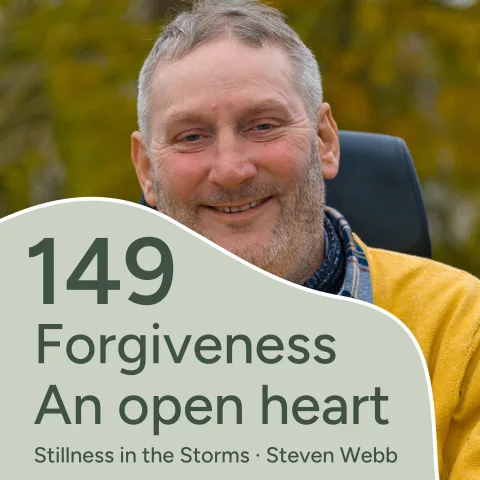
What if letting go is the wrong instruction? Every time somebody says it, your mind grips the thing tighter.
In 1992 I sat with a manual wheelchair I could barely move, triceps paralysed, hands paralysed, and I spent days trying to prove I was not disabled. The moment I accepted it, everything changed. Telling your body to forget something it built to protect you is a losing argument. It is quicksand. The more you struggle the deeper you go. So swap the word. Acceptance is not passive. It is the only thing that actually loosens the grip.
One thing to try: Find a quiet moment and say the true thing out loud. This is how it is. Then stop there.
In this episode
(1:40) 1992, and a chair I could not push
(3:57) How determined I was not to be disabled
(5:04) The version of me I was trying to live up to
(7:53) Say let go, and the mind grips harder
(9:05) You are telling the body to forget its own protection
(10:16) Quicksand. The more you struggle, the deeper
(12:41) The butterfly on an open hand
(15:27) We are all in a wheelchair of some kind
(19:08) Freedom is not letting go. Freedom is acceptance
With gratitude to
Ruth, Nina and Ray, Skila, Cheryl, Krysia, Penny, Jenna and Mia, Angie, Sean and Stefan
Support the podcast and join the Weekly Calm: stevenwebb.uk
Thank you for listening.
Steven
The question this answers
What if letting go is the wrong instruction?
Every time somebody tells you to let go of something, your mind has to fetch the thing first so it knows what to drop. Then it has to keep checking whether it has gone. Which means holding it. Which is not letting go of anything.
The heart of it
To let something go you must first bring it to mind, and the body then marks it as important. You have made it bigger.
Acceptance is not passive and it is not approval. It is the only thing that actually loosens the grip.
In 1992 I came out of hospital with a lightweight manual wheelchair. Custom paint job. My family and friends had fundraised for it and it cost a lot of money, and I have always liked having the best.
I could barely push it across my own carpet. My triceps are paralysed and so are my hands, so I was never getting it out of the gate, let alone up a slope. One day I spasmed out of it in the bedroom and ended up on the floor with my feet in the air and my lifeline round the back of my neck where I could not press it. I was there about two and a half hours.
And I still spent my days with my back to a wall so I would not fall out again, turning the television over, telling myself I was independent. Somebody suggested an electric chair and I said, not me, I am not disabled.
A side note. I had been in a wheelchair twenty years before I applied for my first blue badge. That is how much I was not going to be disabled.
I gave in to keep people quiet and bought the first one demoed to me. Awful seat, great big back wheels. And it gave me my life.
I was not letting go of anything. I could not suddenly be not disabled. What I let go of was the attachment to not being that disabled.
The quicksand is the right image. The more you struggle the deeper you go.
Letting go says, I need to push this away. Acceptance says, this is here, I see it, and I am going to open my hands.
You may be thinking you have no story like mine. We are all in a wheelchair of some kind. There is something you are bracing against, and the bracing is the tiring part, not the thing itself.
One small thing to try
Find a quiet few minutes. Think of the thing you keep telling yourself you should be over by now.
Then, in your mind or actually with your hands, open your palms upward and say it plainly. This is here. I am not going to fight it today.
You have not solved anything and you have not let go. You have put the rope down and stepped out of the tug of war. Notice how that feels, even if it only lasts a few seconds.
Questions people ask
Is accepting it the same as saying it is fine?
No. Not approval, not forgiveness, not agreeing it should have happened. Only that it did, and that arguing with that fact costs you more than the fact does.
If I accept it, will it go away?
Sometimes, eventually, and not because you pushed. It lets go of you rather than the other way round. Your subconscious stops flagging it once it knows you have heard.
Does this work on things that are still happening?
That is mostly what I use it for. My body is not going to improve. Accepting where it is now is what lets me do anything with the day.
Read along
The transcript
It follows the audio. Press any line to jump there.
letting-go · overthinking · acceptance
Read the transcript
Hello and welcome to Stillness in the Storms. I'm Steven Webb and this is the podcast for anyone who's going
through something hard. No quick fixes, no empty advice. Just an honest conversation from someone who's been
through a thing or two. I want to start today's episode with a personal story. And
this came to me about three o'clock in the morning when I was thinking about my next episode, what I
was going to talk about. And my mind just would not let go of a couple of things. I thought,
I'm gonna do a podcast about letting go. And in that moment, I lied down and I thought, right, well,
I'm just gonna accept the fact that my mind's gonna think all the rest of the night. And I just
lied there and went, go on then. And I think I was asleep in about 30 seconds. But the story
I want to tell you, when I left hospital after my spinal cord injury, when I broke my neck,
I was about 20 years old. I had a manual wheelchair. A lightweight one. My family and my friends had
fundraised for me. It was awesome. It had a custom paint job. I think it cost a lot of money
at the time.
And I've always been someone that likes to have the best. So... It kind of mattered to me.
So I here I was with this wonderful, amazing, lightweight wheelchair. But I could barely push the chair over
the carpet in my own home. I wouldn't be able to push it out the end of my road, let
alone out through my gate or my door. I couldn't, like, tilt it back. I couldn't go over a few
stones or anything like that. I certainly he couldn't push it up any gradient because my triceps were paralysed. My
hands are paralysed.
And there was one day when I was here, I managed to get myself into the bedroom and I was
playing a computer game and I
ended up spasming and coming out over the back and I ended up my feet in the air and lying
there and I couldn't get... The lifeline that was around my neck was just around the back of my neck
and I couldn't get it to press it. I think I was there for about two and a half hours
before someone came home and found me like it. But I was still stubborn, so I would spend my days
with my back to the wall so I didn't fall out again. And just watching Tv, you know, country music
channel and turning the Tv over from one channel to the other. I spent hours and days doing this. And
I thought, well, I'm still independent. You know, if the phone goes, I might just about get to it. Bear
in mind, this was like 1992. So we didn't have phones that you could sit on your lap or anything
like that, or not one that I could pick up in my hand anyway. So if the phone went I
it was like about a 20 chance I'd actually get there before it rang off.
But somehow I thought I was independent. My friends would come and take me out down to the nightclubs or
down to the pub. They'd push me all the way down the hill and all the way back and That
felt like independence to me. And then a social worker or someone or my dad or someone looked up and
said, well, why don't you get an electric wheelchair? It's like, no, not me. I'm not disabled. I'm not that
disabled. And anybody that's getting older and suddenly finally cannot walk that far. And I don't know what it's called
in the Us or over in Australia, but in the Uk we have blue badges for people that can park
closer to the stores. And I know loads of people that could do with a blue badge, but they won't
do it because, no, not me. I'm not disabled. A little side note here while I was editing. I noticed,
talking about the blue badge, I had been in a wheelchair 20 years before I applied for my very first
blue badge. That's how much I wasn't going to be disabled. Anyway,
back to the podcast. And I was very much like that then. I would see other people in wheelchairs I
go oh man, I feel for them. Couldn't imagine me in the wheelchair Totally forgetting that I was in a
wheelchair.
So I kind of gave in to give it a go just to keep people quiet. And I I ended
up buying the very first one that was demoed to me. It looked a bit different. Thinking back now, it
was awful. It's the most uncomfortable seat. It was... Great big back wheels and all that. But it suddenly
gave me independence. I could go out and about. And it made me realise that it was more about me
accepting I was disabled,
accepting my position, than it was me letting go.
I was trying to let go of that version of me.
Instead, I didn't know what version of me was me at that time. I don't know what it is now,
even, incidentally. But that version of me was not the one that I was trying to live up to. So
when I just accepted it, I went, okay, I'll give this a go. Everything changed. Now then, it's
something I work on constantly. But that's what I want to talk about in today's podcast is about the difference
between acceptance and letting go. So yeah, that's what I want to talk about in today's episode.
But just before we get there, I just want to say, before we go deeper, I want to take a
moment to say thank you. This podcast is completely free and there are no adverts, no sponsors, and no one
is paying me to sell you anything. The only reason I can do, keep doing this, and the reason this
podcast and all my other work continues is because of the kind people that treat me to a coffee. And
those small donations pay for everything. So a heartfelt thank you to this week's episode sponsors.
No supporters, no coffee buyers. You're just awesome guys ruf Nina and Ray.
Skillet, Cheryl chrissia Penny Jenna and Maya. Angie, Sean and Stefan. And
there was a couple of anonymous again this week. Thank you. And also, of course, there's the monthly donators that
I think next week I'll dedicate the show just to the monthly donators. So if you'd like to support the
podcast, you can buy me a coffee. The link is in the show notes and you can sign up for
my weekly calm newsletter. I'm actually starting to do a weekly now so But let's carry on. So,
letting go. Two little words that everyone loves to throw around. Let go of control. Let go of worry.
Let go of the past. Let go of that relationship. Let go of the outcome. Let go of expectations. And
it all sounds beautiful, doesn't Very wise. Very spiritual. Very new age. You can imagine it
written in a nice font on someone's Instagram. And I've probably liked them myself. When we learn to let go,
things become lighter. You know, you drop the bags and you're no longer held back. All the analogies. But here's
my question. How? How do you actually do that? How do you actually let go? And it sounds so
simple. I think there's a real problem with the phrase let go. And I want to be honest about it.
Because I think it's caused more stress than it's ever relieved in a lot of people. And people
are still asking me now how to let go. And how many times have you tried to let go or
something and it's still there months and years on? The problem is this. When someone tells you to let go,
your mind has to focused on what you're trying to let go. Whether it's a memory, whether it's a just
a thought, whether it's a past, whether it's a physical disability or anything you You have to bring
it to mind to let it go. So you have to be reminded of it. The minute you're reminded of
it, the body and the mind takes notice and puts an importance on it. And that analogy I I like
to use in a different contexts Try not to think of the bear running towards you with machete and donuts.
Just don't think about it. I want you to let that go. Get that image out of your head of
the bear. You can. It's really, really hard. Or they say the pink elephant in it. Imagine a flying pink
elephant. There you go I'll put some spots on it. Now we're thinking about it. But don't think about it.
It's impossible. But I think it goes deeper than that. I think it's harder than that. That's just a simple,
easy example. But when you when your body latches onto a thought, a feeling, an
experience, it uses it to protect you. And because that protection is
a tangible thing that helps you, it does protect you, it's evolved in
order to help us survive, you're actually telling the body to forget something that is incredibly important.
But if you accept that that danger is there and the body goes, okay, you've accepted now, I don't have
to keep reminding you of it. And I think that little shift makes all the difference. So you're lying in
bed and at three in the morning and worrying about something, and you tell yourself, I need to let this
go. And when you're worrying about that thing and you're also stressed because you can't let it go, you've added
a second layer. You've added an importance to it. And then you start turning over in the bed and you
bang your head on the pillow. It's just like, just stop thinking about it. But when you, just like I
said at the beginning of the podcast, this is where this episode come from When you just go, okay, think
about it.
I'm listening
okay And do nothing with it. It's like, ah. And
the mind will go on to something else. And the more you do that, the less that that thing that
you're trying to let go becomes important in your life. It's like quicksand. The more you struggle, the more you
fight, the more you try to force your way out, the deeper you sink in the The letting go becomes
another task on your task list to do.
If you've got to sit down to physically do a meditation oh let go. And I've done a meditation to
go with this podcast, but it's not about sitting down and letting go. It's about sitting down and accepting. If
you accept this moment, like I accepted my disability only in that moment, trust me. It's taken many more years
to accept many more layers of that, and I still haven't accepted it all because I don't know what is
going to trigger me next. The vulnerability and asking people for help, God, it's still there. But
the letting go, if you really truly want to let go of everything, it will be an endless and thankless
task for your body. Because your body will fight you all the way.
So, if letting go isn't quite the answer,
like I've talked about it, I've already mentioned it, just think of the word acceptance.
I know acceptance can sound really passive, like as if, what's the point? It's not really doing something. It's not
the hard labor It may sound like you're giving up, but it's not. It's actually one of the bravest and
most powerful things a human can do. There's real braveness and courage in
accepting what is. And
here's the difference as I see it. Letting go says, I need to push this away. I need to get
rid of this feeling, this situation, this part of my life. Acceptance says, this is here. I see it. I'm
not going to pretend it isn't there. And I'm going to open my hands and let it be what it
is.
Think of it like holding a butterfly. If you close your hand too tight, you can injure the butterfly but
If you hold your hand gently, keeping it closed enough to keep the butterfly in there, and you don't want
it to go. That takes a lot of work, a lot of nourishing, a lot of things to do with
it. But if you imagine just opening your hand and then trying to force the butterfly to go, but it
doesn't want to go.
It's just staying there on your hand. It's got nowhere to fly away to. And you're like, no far away
pushing your hand. Come on, go, go. That's frustrating, right? You want to blow on it. You want to encourage
it. But what happens if you just open your hand and accept that it's there? It's no longer going to
affect you. You're not going to get angry with it. You're just going to go, oh. And
then you're focused on other things. And
that's what happened with me in the wheelchair. I didn't force myself to let go of anything. I could I
couldn't suddenly be not disabled. So
I released that attachment to my manual chair of And the manual chair wasn't the attachment. It was the attachment
to I'm not that disabled. My attachment to my old life. And to who I thought I should have
been when not accepting who I am. It's like, I'm 53 years old now. Every morning I wake up, my
body reminds me I'm 53. But my brain thinks I'm anywhere between 15 and 40. Given
what I'm feeding like on that day or who I'm hanging around with. Or how stupid and childish or ignorant
or wise I might be feeding
But my body will remind me constantly. And no matter how much I try to fight it.
Just accepting the fact that my body is 53.
I'm then easier with it. I'm not fighting it. I'm not angry with it. I'm more accepting of it. And
then I can do something with it.
Because when I was refusing to be disabled, refusing to be disabled, that seems such a funny
sentence. But when I was refusing to accept the fact that my life had changed,
it was all hassle, trying to keep it up. And I just couldn't.
You know, I was suddenly free. I I was free. Not free from my disability. I'm still disabled. That
hasn't changed and it won't change. But free from the war I was waging against myself and reality. Free
from the exhausting daily fight with the way things were. And suddenly my life was open and free So
now you might be thinking, that's a lovely story and I get what you mean. I totally get it. Acceptance
is wonderful. Change the mean. And you may say, well, I haven't got that bigger story I'm not in a
wheelchair. How does it really apply to me?
Well, my answer is this. We all are in wheelchairs of some kind. There's something holding you back. There's something
that you're refusing to bring to the surface. There's something that maybe an maybe A
situation or something that you just, it isn't that you you want to forgive but you cannot let
go. And you almost want to forget it or different things. But you're like just tensed and you're trying to
force it to go.
And the acceptance is the twofold. Accepting it and then it will let go
by itself. It has to let go of you. I know that sounds really strange when it's a thought or
something but it letting go of you is the other way around. Suddenly a subconscious mind won't bring it to
mind. Suddenly when you see that person or when you see a situation, you won't be triggered by it.
Everybody's different. Maybe
your body, things are changing. These aches and pains. Maybe
it's a role you've lost, a job. We were talking about roles last week. A position, the identity have been
needed. Talking about that very much last week and the newsletter. But instead of sitting with this discomfort that
of that change, just you're scrambling to replace it. Fill the gap or prove you're still valuable. Just accept your
new life, your current situation. So I pretty much spoke for enough today, I think. And what I'm going
to suggest generally is that you consider just accepting whatever it is. Not approving of it. It's not
saying it's okay. If it's about forgiveness, it's not saying you forgive them or different things. That's a whole different
story. I'm just saying you're accepting this present moment. You're accepting the situation. Not pretending it doesn't
her Just acknowledging that it's there and loosening your grip on it a little.
Because here's what I've learned. When you accept, you create space. Space that was previously filled with fighting
and resisting and clenching. And into that space you can move. Opportunities can arrive. New parts of
yourself can emerge. A new life, a new part, a new a new direction So I want to leave you
with something small and practical. Something you can try today. So at some point, find the quiet moment. It doesn't
have to be long. Just a few minutes will do. And think about something in your life that you've been
trying to let go of.
Something you've been telling yourself and that over and over again that you shouldn't be bothered by it. And instead
of trying to push it away, I want you to try something different. In your mind or even physically, if
it helps, just open your hands, palms up, and say to yourself quietly, this is here.
I'm not going to fight it today. And
that's it.
You're not solving anything. You're not letting go. You're just putting down the rope for a moment.
You're stepping out with a tug of war.
So notice how it feels. And
if it just feels good for a few seconds, just allow it to be what it is.
It's not about letting go. It's just about accepting.
So here's the one takeaway from today.
Freedom is not about letting go. Freedom is about acceptance. And when you try to force something away, you keep
it alive. When you accept it truly and truly accept it, you take away its power from over you.
You open your hand and you can breathe.
And in that breath, you are free.
That's what happened to me when I went into a grey electric wheelchair all those years ago. My stubbornness got
out of the way. I accepted my small part of reality. And the whole world ended up being mine. I
could do things I many So many things you've seen in my life what I've done would not have happened
if I didn't accept things.
So thank you for listening. And God, it's been a long day. I'm so tired so But I wanted to
record this podcast before I went to bed because I've got a busy day tomorrow and I want to get