
My carers do not shower me the way I would shower me. I have got comfortable with that. Amae is the mutual trust in depending on somebody, which every baby does and most adults spend their lives resisting. Think of a bow and arrow. The moment your fingers let go it is at the mercy of the wind, and that is the only point at which it can reach anything at all.
Episode 123 · 8 June 2024 · 16 min
Amae: The Art of Surrendering and Finding True Strength
What if giving up some control is a strength rather than a loss? The Japanese have a word for it, amae, and I live it every single day.
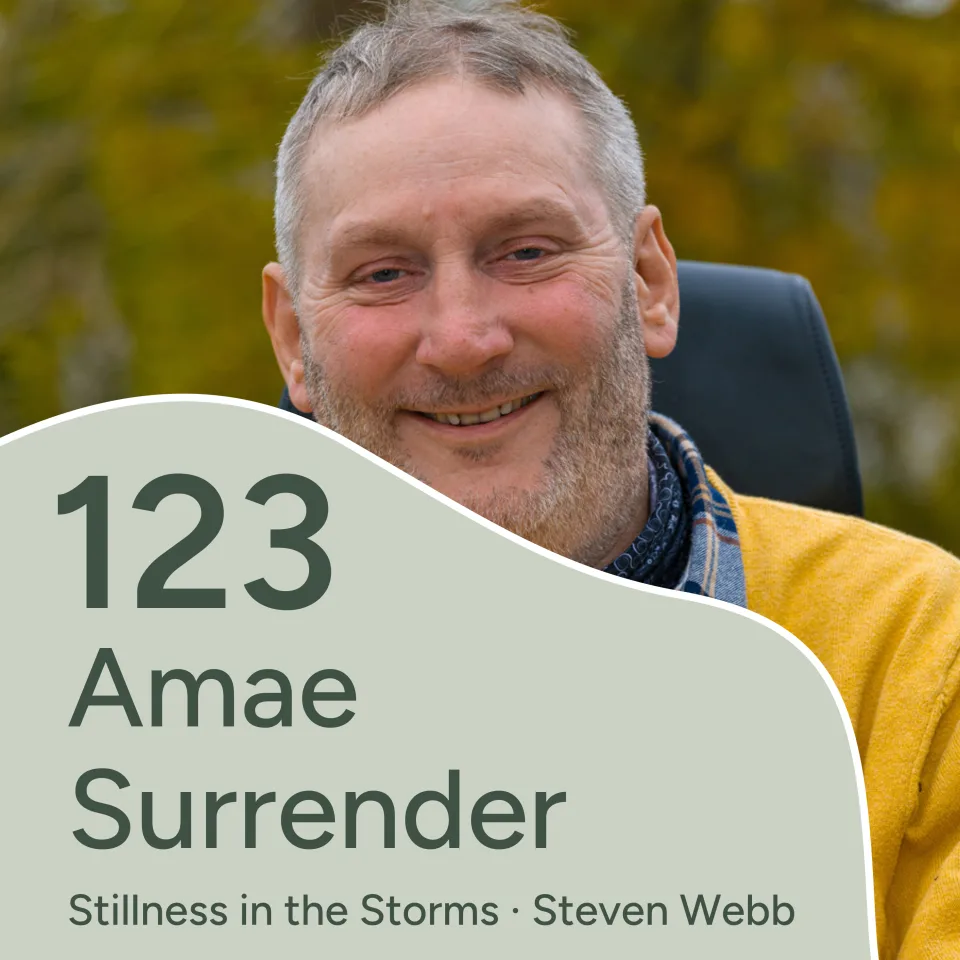
Episode 123 · 16 min
The question this answers
What if giving up some control is a strength rather than a loss?
The Japanese have a word for it, amae. There is no direct English translation. It is the comfort of being able to rely on somebody completely, in perfect safety, and I live it every day.
The heart of it
My carers do not shower me the way I would shower me. They do not clean the way I would clean. I have got comfortable with that, and it took a long time, because otherwise there is no comfort available at all. Nobody will ever do anything exactly your way.
Eckhart Tolle was on stage once and somebody in the audience said it was alright for him with the houses and the books and the money. He laughed and said that because he had once lost everything, he knew he could lose all of it again and be alright. That is the security. Not the houses.
Think of a bow and arrow. You pick a clear day with no wind, you set your aim carefully, you draw back and you wait for the right moment.
The moment your fingers let go it is at the mercy of the wind, and that is the only point at which it can reach anything at all.
You are not only letting go of the arrow. You are letting go of the expectation, and that is where the courage is.
I am hopeless at decisions anyway. More than one option and I am finished. My mum used to ask bangers and mash or fish fingers. Now people ask what I want for tea and I would rather they just told me. I cannot choose toothpaste in a supermarket.
And a careers teacher gave me about fifteen minutes at nine or ten years old to decide the rest of my life. Astronaut was not on the list. I still do not know what I want to do, and I do not think that hurts.
One small thing to try
Let somebody else make one decision today, and be genuinely alright with how they make it.
Not gritted teeth. Actually alright. Then notice whether the outcome was worse, or only different.
Questions people ask
Is this the same as giving up?
No. Giving up is walking away. This is choosing where your control genuinely reaches and stopping the fight everywhere else, which is closer to stoicism than to surrender.
Is it not risky to depend on people?
It is, and you already do. The pretence that you do not is what makes it feel risky when it becomes visible.
What if somebody does something badly?
Some things you nudge and some you let go. My carers all annoy each other and all annoy me, and every one of them is doing their best from where they stand.
The transcript
Read alongIt follows the audio. Press any line to jump there.
We all want that wonderful position of comfort and that security that a nice long-term
relationship or buying a house or building a career gives us. That little nest egg in the bank that
means that if things go wrong, I've got some money to fall back on.
And since breaking my neck, I realised that there isn't really that much security at all. And I came across
a Japanese word yesterday. Am I?
And just imagine being in a position where you are with somebody you can trust completely. You can
let go of all your defenses, knowing that you're in perfect safety. That wonderful support
surrounding you and that comforting embrace. In this space, you don't need to worry about any kind of judgement or
control. You are free just to be. Just to be exactly who you want to be.
To feel what you want to be. Say what you want to do. Do what you want to do. And
you feel completely safe. This is the essence of Amai. It's a beautiful concept from Japanese culture that
we're just going to explore today and I want to talk about it and I don't know if I got
the translation perfectly right but this is my take on it and... Yeah, being in my position it's a real...
I just love this concept. So, welcome to another episode of Stillness in the Storms podcast. I'm Steven Webb and
today we delve into Amai. The comforting feeling of being able to surrender completely and rely
on someone else in perfect safety.
So, Amai is a Japanese term that doesn't have a direct English translation. It refers to the
comfort and safety we feel when we can fully rely on somebody else. Surrendering our need for control
and trusting in their support. In Japanese culture, this concept is integral
to relationships. It's a deep sense of, you know, I'm with you now and I
do surrender some of my control to you. And as a baby, you have to do that anyway because you
can't do anything. A baby has no choice but to surrender. It cries if it feels ill, but it's got
to surrender the outcome to you.
And I just imagine what that must feel like for a baby in vulnerable moments. And I think if we
sit back and allow that to happen in our lives a little more without trying to control everything, I suppose
it's stoicism 101 really. Because stoicism very much looks at, well, it's a stiff upper lip. It's about not feeding
my emotions, not allowing my emotions to take over me. And that's not what stoicism is. Stoicism is about allowing
your feelings. And yes, not allow them to take over you unless you choose them to. But Stoicism really is
what is in your control and what is not in your control. And focus on what is in your control.
And just let go of what isn't in your control. And I'll come back to that a little bit later
with an example of the bow and arrow. But am I is it's not just a sign of dependence,
but a mutual understanding that
strengthens, you know, when we let go of that need for security. We feel vulnerable. But in that vulnerability, there's
courage and there's the ability to go, well, okay, I don't need all of that. I can lose everything.
And it was Eckhart Tolle that he was on stage one day and one of the audience member said no,
it's okay for you. You've got all this money. You've got like seven houses. You own half the world. You've
written like 40 books. You've got all the money in the bank, things like that. And he laughed in his
usual way. He'd done his giggle and he just said, yeah, but because I did not have anything at one
point, because I lost everything, I've got the security and knowing I can lose all my houses. I can lose
all my income and I know I'll be okay. And I think that's the opposite to Amai is we're trying
to be in control of everything, trying to control our bank balances, our income, our friends. What
happens in our lives, what happens around us. And I suppose myself as a paralysed person, I've got to rely
on people, you know, wiping my bum I got to rely on people showering me and doing everything I cannot
do. They've got to clean my house. They've got to tidy up and None of them do it the way
I would do it. Yeah, they don't even shower me the way I would shower. And I've kind of gotten
to a point where I'm comfortable with how they do things. But it's not exactly the way I would do
things. But you've got to find that balance in the middle. And unless you find that balance in the middle,
you
will end up with no security that You'll end up with no real comfort because no one will ever do
things the way you would do them. And I suppose am I is giving up the way things ought to
be. And when you give up the way things ought to be, you come to a place of, ah, things
are okay. Things are actually not that bad. And you give other people time. You have more space around you.
You have, the irony is you have more security that's the paradox of things, you know. The more
you don't hold on to things rigidly, the more control you have over them. There's a wonderful example
of the drumsticks. If you hold them too tightly, the music is rigid and not very nice. Hold them too
loosely, you drop the drumsticks. You have to hold them in a light way that the music can flow through
you. Life can flow through you. And that's what this is about is allowing life to be part of your
journey rather than you being controlled of everything.
Because life... Life's never going to turn out exactly the way you want it to. So
imagine setting up a bow and arrow. You can choose the perfect day, clear skies the little wind, and you
carefully set your aim to run back the bowstring, and you're ready to release and you take that perfect
moment. But the moment your fingers let go, the arrow is no longer under your control. There could be a
gust of wind. Anything can happen. You know, it is at the mercy of the weather, the wind and countless
other factors. You have to let go of more than just the outcome of where that bow and arrow ends
up. What it does. The moment you realise you're not just letting go of the physical bow and arrow, you're
letting go of the expectations. And then you have the security. You have the... In that vulnerability and the courage
to let go you have a lot more security because you're not going to be upset or pissed off about
how it ends up.
Because I did my best. I'm okay. At this point, I'm okay.
You know, the people around me, do they do everything I want to do? Hell no. Do they drive me
and saying yes but then my teachers. They all do things differently um Every single one of them. Every single
one of them annoy each other. Every single one of them equally annoy me. But in the face of it,
they do things the best they can, the best they know from their world um view And I think when
we allow that to happen and we sit back in our own vulnerability and go, do you know what? I'm
not in control of a lot of this.
We end up with that more control and more security because people then reach in and say, how do
you want things done how do you because If you're trying to control people too rigidly, they will become rigid.
You
know what I mean by that? You watch someone that's not enjoying their work. They're rigid. They're not enjoying it.
They're they're not doing the things they want to do. Nowhere near as well. I think, who was it
um Zig Ziglar or something like that always use the example of when they come around the corner there's three
people chopping stones. And he said to the first one, what are you doing? And he said, oh, I'm earning
a living. Said to the second one, what are you doing I'm chopping stones. And the third one, he said,
I'm building a cathedral.
Yeah, and you can imagine which one's happier. But where does this come into this podcast? I don't really know.
I just remembered that story. But if you allow people to be part of the bigger picture, be part of
your life, be part of the outcomes, you know, be vulnerable. Look up and say, well, where do you want
to go today? And just do that. You might end up in a place where you might enjoy even more
that you've never been to before. And
this vulnerability is really a source of strength. It's about recognising that you don't have to do
everything on your own as well. We are dependent on other people. We
think we've got autonomy over what we think and what we do, and we haven't. If you think that, you're
going to end up pretty pissed off most days because, trust me, the universe has way way different plans. You
know, you leave home, you get in a car and you drive somewhere, but the universe has different plans for
that journey. You put it in the sat nav and you have that perfect journey and it says, when does
it go like that? It just doesn't. But that's life. When
I was, I don't know, nine, ten years old and I did my careers. In 15 minutes I had to
decide what I was good at and what I was going to be for the rest of my life. And
apparently an astronaut wasn't an option then. It was like army or become, I don't know, a
doctor wasn't on the cards for me either. I think, I don't think my teachers or my careers people had
that high hopes for me. So about 15 minutes in the queue, I had to decide what exams I was
going to take for the rest of my life. I don't even know what I took. I can't remember now.
I still don't even know what I want to do now. But, you know, that doesn't hurt. And in the
words of that Buzz lohmans song um sunscreen
um don't worry if you don't know what you want to do at the age of 30. I know plenty
of people at 40 that don't know what they're doing. They're the most interesting people. So when we do let
go of the outcome, it opens us up to possibilities. It opens us up to other people's
ideas. It
opens us up to living a more broader life, a more fulfilled life. I'm not saying
everybody has to
encroach on your beliefs of what you should do and how you should do it. It's not about somebody else
telling you how you should live. It's about you just embracing the odd moment when you you
could just step back and allow someone else to make the decision and
be okay with that. I'm
okay with that because I can't make decisions. I'm terrible. If there's more than one thing to make a decision
on, that's it, I'm done. It's like, do you want this? Well, is that a yes or no? Oh, damn
it. Just tell me that's what you're having you know I still like it when I was a child because
my mom used to say, do you want bangers with a mash or fish fingers? Nowadays the carers would say,
what do you want for tea? Or my friends or anything like that say, what do you want? And I'm
like,
too much choice. I've
said this before. I can't even choose toothpaste in the
supermarket. That does my head in. It's like way too much choice. There's like, I think at the last count,
there was 3.2 million different types of toothpaste. Not
that many. I think I think it was only like 320 000 or something. But it's still crazy amount. There
may have been 40. I didn't stay there and count them, incidentally, as you can tell. But just
incorporating this in our lives gives us a sense of letting go. A joy that,
in that courage, because that's real courage. Just
allowing our dependence on somebody else. Because we are dependent on other people. Whether we like it or
not.
We give up so much of our time for other people around us. And
we don't even realise it we're trying We think we're in control, we're not.
So this concept's not just vital for like personal relationships, but also how we interact with the world. By
accepting help and showing our vulnerabilities. You know, we really foster that deeper, more meaningful connections.
With everybody around us, with family, with friends, in our relationships, with our partners, it is a
reminder that true strength lies in the ability to trust and surrender. That's worth remembering.
It's a reminder that true strength lies in our ability to trust and surrender. So that's my podcast.
Trying to let go a little bit more stopping Trying not to be in control. So thank you for joining
me on allowing me to talk about my new favourite word am I a m a e It's a
Japanese word. It has no translation to English really and just basically means imagine what it's like to completely let
go to somebody else and how much you can start embracing your life when you do start letting go of
what you're not in control of. I hope this helps in some way. And if you want to stay connected
and you want my weekly calm newsletter, head over to StevenWebb.uk. That's it. That's all my links. And a
real big thank you to you for leaving reviews, for donating to this podcast. You really make a huge difference.
You know, my heart really opens up to you and everybody that listens. And if you've got this far on
the podcast, things are allowing me to be in control of your thoughts just for a little bit.
Yeah, my heart really opens to you. And don't forget my other podcast, Inner Peace Meditations. There'll be a link
all on StevenWebb.uk. So till next time, thank you and I love you.
Found this helpful? Leave a review. Finding something hard that isn’t covered here? Tell me, and I may make an episode about it.
Listen next
More honest conversations
More on Love, Empathy & Other People Letting Go & Forgiveness
Weekly Calm
One calm email.
Every Sunday.
Put the kettle on. A short letter from me, one small practice and a question to carry into the week. A reminder that you’re not doing this alone.
Free. Sent to over 2,000 people each Sunday. Leave whenever you like. Read a recent letter